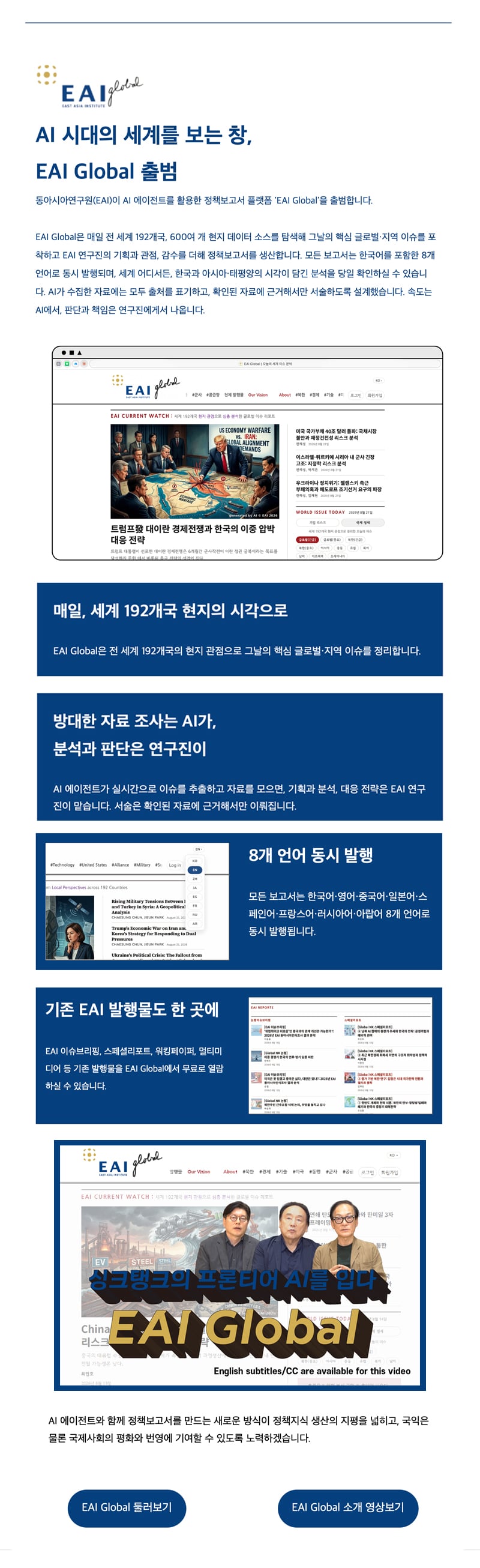
서구 지식계가 대북 전략 및 북한 연구를 주도하고 있는 현실을 극복하고 보다 균형 있는 북한과 한반도 문제 연구 및 통일전략과 동아시아전략을 복원하고자 EAI는 2018년 대북복합전략 영문 종합 웹사이트 구축을 기획하여 웹사이트를 지속적으로 관리 및 운영하고 있다. 대북복합전략 영문 종합 웹사이트 Global North Korea (Global NK)는 아카이브 성격의 웹사이트로써, 제재(Sanctions), 관여(Engagement), 자구(Internal Transformation), 억지(Deterrence)로 구성된 4대 대북복합 프레임워크를 기반으로 주요 4개국인 한국, 미국, 중국, 일본에서 발간한 자료들을 보다 체계적이고 종합적인 접근법을 통해 분류한다. 또한, Global NK에서 제공하는 통계치를 통해 웹사이트 이용자는 주요 4개국의 북한에 대한 인식 차이 및 변화를 확인할 수 있게 하였다. 본 웹사이트는 외부 기관의 북한 관련 발간 자료를 한 곳에 수집하는 역할 뿐만 아니라 자체적인 전문가 코멘타리(Commentary)를 발간함으로써 보다 분석적이며 전략적인 방식으로 북한 문제에 대한 방향을 제시하고자 한다.

웹사이트 바로가기: www.globalnk.org

워킹페이퍼
Understanding North Korea’s Strategic Assessments in 2009 and the Reference Point Gap on the Korean Peninsula

EAI Asia Security Initiative Working Paper No. 2   저자 Jihwan Hwang is an assistant professor of North Korean Studies at Myongji University, Seoul, Korea. Professor Hwang was a research fellow at the Institute for Unification Studies of Seoul National University.   His research interests include East Asian international relations and security studies, focusing on the North Korean nuclear crisis. His main concern is how to explain North Korea’s foreign policy in terms of international relations theories.   He published numerous articles, and his recent publications include “International Relations Theory and the North Korean Nuclear Crisis,” “Offensive Realism, Weaker States, and Windows of Opportunity: The Soviet Union and North Korea in Comparative Perspective,” “The Second Nuclear Crisis and U.S. Foreign Policy,” and “Rethinking the East Asian Balance of Power.” Professor Hwang received his Ph.D. in political science from the University of Colorado at Boulder.       Explaining the mindset of the North Korean regime has been a difficult, if not the most difficult, assignment for scholars and policy-makers who study North Korea. Without this understanding, negotiations often go nowhere and confrontations may escalate into a crisis because the situation is misread. Some have characterized North Korea as aggressive, reckless, and irrational (Downs 1999; Cha 2002; Bush 2002), while others have tried to pinpoint its unique internal logic and motives (Snyder 1999; Kang 2003). Although many have sought to explain Pyongyang’s perspectives and policy attitudes, they have still main-tained that North Korea is irrational by nature and have been unable to explain the North’s own version of consistency. Even though some try to explain North Korea’s behavior in a sys-tematic way, they assume that Pyongyang has adopted a single national strategy—of either confrontation or engagement (Sigal 1998; see also Cha and Kang 2003). Some argue that North Korea has never departed from its rogue nature, because the real nature of the regime has not changed at all but remains confrontational and irrational. On the other hand, those who argue that North Korea is ready to change its course of action if the United States and South Korea move first do not really explain North Korea’s eccentricities for Western society. Although proponents of both arguments are concerned with Pyongyang’s behavior and policies, they have failed to read the North Korean mind and explain how North Korean leaders think and why they behave in a certain way as they do. Aside from the question of whether the real nature of the North Korean regime has changed or not, it is important to understand the main factors that determine Pyongyang’s internal and external perceptions and behavior in terms of its own concept of rationality.   This paper emphasizes the importance of the concepts of “saving face” and “reference points” in assessing North Korea’s strategies. The concept of face-saving has often been discussed in explaining North Korea’s negotiating behavior (Snyder 1999; Sigal 2006; Zissis 2007). It is said that because the North Korean people have great self-respect, they cannot tolerate humiliation. The North Korean regime is understood to be willing to fight, even in an unfavorable situation, because it prefers saving face to being bullied. This attitude is thought to somewhat explain Pyongyang’s aggressiveness and brinkmanship.   However, it is unreasonable to say that North Korea tries to save face at all costs. Al-though the North always wants to save face, it is not likely to sacrifice strategic values or a specific objective in all circumstances. It is, rather, a very practical regime and makes every effort to maximize its own benefit. This does not mean that Pyongyang is always ready to accept the risk of being bullied and losing face in order to win some benefit. Both face-saving and gaining an objective are important to the North Korean regime. Ideally, it would like to save face and gain an objective simultaneously, but there must be many occasions where the leaders have to sacrifice one for the other. How and why does the North Korean regime make these choices? Regime choices may look irrational by Western standards, but may be rational in terms of the North’s way of thinking. Thus, it is necessary to understand the North Korean point of view regarding its strategic environment.   In order to explain the North Korean mindset, I hypothesize that North Korea’s face-saving is closely connected with gaining an objective or benefit. A corollary is that the North Korean regime is more likely to feel humiliated when it believes that it has failed to gain the benefit that it originally sought or expected. To explore this hypothesis, I turn to the concept of a “reference point.”   A reference point is a cost that people view as the limit of what they can concede—that is, they can concede no more than the cost involved. When people gain more than they expect, they are happy. When the outcome falls short of what they originally anticipated, however, they are disappointed. This reaction may be particularly true of North Korea. If the North Korean regime achieves its reference point, it will be satisfied. But if its reference point is threatened or appears impossible to attain, the North is likely to be seriously provoked and become aggressive, because it may feel that it has lost face. Thus the identification of the reference point is critical in understanding Pyongyang’s strategic mindset. Further, the reference point helps us understand the North Korean regime not by its emotional features but by its rational calculation of costs and benefits. The regime may often display unexpected behaviors to save face, but most of these actions can be explained in terms of the reference point, that is, the costs and benefits for North Korea from its perspective.   In short, I posit that recognizing Pyongyang’s reference points provides a more accu-rate picture of North Korea’s internal and external perceptions and behavior. We can iden-tify the reference points by examining not only the North Korean regime’s objective situa-tion on the Korean Peninsula but also its official perceptions and statements in the North Korean media such as the state-run newspaper Rodong Sinmum and the Korean Central News Agency. In the next sections, I will discuss the concepts of face-saving and the refer-ence point, and then explain North Korea’s strategic assessments in 2009. In the final section, I will survey the reference point gap on the Peninsula and provide policy recommendations to resolve the gap and move forward...(Continued)  

Jihwan Hwang 2009-11-12조회 : 19539
논평이슈브리핑
[여론브리핑 48-1호] 북핵실험 이후 국민안보의식 변화

[EAI·한국리서치] 6월 바로미터-안보인식/국정쇄신 방안 1. 북핵실험 이후 국민안보의식 변화, 2p 2. 이명박 정부/한나라당 국정쇄신 방향, 9p 3. 국정지지율/정당 지지율 변화, 12p         안보 불안감 증가 - 6월 20일 조사 : 안정적 12.3%, 그저 그렇다 27.8%, 불안 59.2%  - 안보 불안하다 : 29.5%(3/21)→32.8%(4/19, 북 로켓발사 후)→48.4%(6/5, 북 핵실험 후)→59.2%(6/20)   지난 5월 25일 2차 북핵실험 이후 한국인의 안보불안감이 급격하게 높아지고 있다.한국 정부의 PSI 가입 공표 및 5자회담 추진, 국제사회의 대북 제재 움직임이 가시화되면서 6월 초(6월 5일 조사) 시점보다도 국민들의 안보불안감은 계속 커지고 있다. 이번 조사에서 전반적인 안보상황이 ‘안정적’이라는 응답은 12.3%(매우 안정적 2.7%, 약간 안정적 9.6%), ‘그저 그렇다’라는 응답은 27.8%, ‘불안하다’는 응답은 59.2%(약간 불안 36.8%, 매우 불안 11.6%)로 가장 많았다.   [그림1] 현재 전반적인 안보상황   6/20 안보체감도      변화추이를 보면 핵실험 이후 국제사회의 제재 목소리가 커지고 이에 북한이 강경한 대응태도를 보이면서 국민들의 불안감은 더욱 커지고 있음을 알 수 있다. 북한의 대포동2호 발사가 예정되어 있던 3월 조사에서 전반적으로 안보상황이 불안하다는 응답이 29.5%에 불과했지만 4월 5일 로켓발사 후 조사결과에서는 32.8%로 약간 상승했다. 그러나 5월 25일 북한의 2차 핵실험이 진행된 이후 실시한 6월 초 사에서는 안보가 불안하다는 응답이 48.4%였고 이번 조사에서는 59.2%까지 상승하고 있다.   [그림2] 한국의 안보 불안감 변화(3월-6월) : “안보상황 불안” (%)   * 6월 5일 조사는 정기조사가 아닌 EAI ․ 매일경제 공동 긴급정치현안조사(600명) 결과임   [표1] 전반적인 안보상황 평가(%)     * 모름/무응답은 표기하지 않음   2월에 비해 북한에 대한 강경 목소리 높아져, 북한 배제나 남북관계 단절은 반대   - 북한 배제한 강경책 보다는 북한 포함한 대화 선호    바람직한 북핵해법“6자회담”77.2%,“북한 배제한 5자 회담”바람직 42.5%  - 2월에 비해 6자 회담 기대 줄고, 개성공단 중단 의견 높아져   안보불안감이 커지는 가운데 국민들이 생각하는 바람직한 북핵해법으로는 역시 북한과 한국, 미국, 중국, 일본, 러시아 등 주변 강대국이 참여하는 6자회담에 대한 기대가 가장 컸다. 무려 77.2%가 6자회담이 북한 핵문제를 푸는 해결방법으로 바람직하다고 답했다. 그러나 최근 이명박 대통령이 제기한 북한을 제외한 5자회담에 대해서는 우려의 목소리가 컸다. 5자회담이 바람직하다는 응답은 42.5%로 바람직하지 않다는 응답이 51.9%에 비해 적었다. 잘 모르겠다는 응답이 5.6%였다. 반면 개성공단이나 금강산 관광등 대북지원 및 교류 사업을 중단하는 방안에 대해서는 29.4%만 바람직하다고 답하고 65.2%는 부정적으로 답했다.   북한과의 대화와 교류를 유지하자는 의견이 높은 것은 사실이지만 제2차 북핵실험과 북한의 호전적인 발언이 이어지면서 강경한 대북정책에 대한 주문이 높아지고 있다. 우선, 지난 2월 조사에 비해 6자회담에 대한 기대가 약화되고 있다. 2월조사에서 바람직한 북한 핵문제 해결책으로 6자회담을 지지한 응답이 85.2%였지만 이번조사에서는 77.2%로 낮아졌다. 반면 대량살상무기 수선 의혹 선박에 대한 수색과 해상봉쇄를 의미하는 PSI 참여에 대한 지지는 49.2%에서 54.2%로 증가했다. 개성공단이나 금강산 관광 중단과 같이 대북교류와 지원을 중단하라는 주문 역시 21.1%에서 29.4%까지 높아졌다. 강경대응 비율이 증가한 셈이다.   [그림1] 바람직한 북핵문제 해결책(6/20) (%)   * PSI 참여에 대한 결과는 6월 24일 추가조사 결과임   [그림2] 주요 북핵 해결책에 대한 선호변화(2월-6월)     “한국도 핵 가져야”60.5%,“전시작전권 행사 예정대로”55.3%,“전쟁 발발 시 참전(지원) 하겠다”63.0%   핵보유 인식 5년 전에 비해 핵보유 주장 9.8%p 상승 고 연령층, 저 학력층, 자유선진당/한나라당 지지층에서 핵주권 여론 높아   북한의 핵보유가 가시화될수록 한국 국민들 사이에 한국도 핵을 가져야 한다는 여론을 강화시킨다. 한국도 핵을 가져야 한다는 주장에 대해 열 명 중 여섯 명은 ‘매우 동의(28.8%)’하거나‘대체로 동의한다(31.7%)’고 밝혔다.‘별로 동의하지 않는다’는 응답은 25.2%,‘전혀 동의하지 않는다’는 주장은 12.0%에 머물렀다. EAI와 중앙일보가 5년 전에 실시한 여론조사 결과와 비교해보면 10%p 남짓 핵 주권 여론이 높아졌음을 알 수 있다.   [그림1] “한국도 핵무기를 보유해야 한다”는 주장에 대한 평가(%)   젊은 세대, 고학력층, 진보성향의 정당 지지층에서는 한국도 핵을 가져야 한다는 핵주권에 대한 지지가 낮은 반면 고연령층, 저학력층, 보수성향의 정당 지지층에서 한국의 핵주권론에 대한 지지가 높은 것도 특징이다. 세대별보면 20대에서 47.5%, 30대에서는 48.0%가 핵주권에 부정적이었지만 40대에서는 69.2%, 50대 이상에서는 70.6%가 핵주권에 긍정적인 답변을 하여 크게 대비된다. 학력별로 봐도 중졸이하의 저학력층에서 76.7%가 한국의 핵보유 주장에 동의하는 비율이 높았다. 고졸층에서는 68.0%, 대재이상층에서 52.2%로 학력이 높을수록 핵주권에 대한 긍정적 응답은 낮아진다. 정당별로 보면 자유선진당과 한나라당 지지층에서 각각 70.7%, 68.1%가 한국도 핵무기를 가져야 한다는 입장인 반면 민주당 지지층의 경우 62.8%, 민주노동당 지지층 57.4%, 진보신당 지지층에서는 42.0%였다. 보수층이 힘의 균형을 중시하는 반면 진보성향일수록 남북 핵 경쟁에 비판적인 셈이다.   [그림2] 계층별 핵주권 여론 (%)   “2012년 전시작전권 환수” 55.3% 찬성, “시기 늦추거나 백지화” 37.5% “한반도 전쟁 발발 시 참전 하겠다” 63.0%, “참전하고 싶지 않다” 33.3%   북한 핵실험 등 남북관계가 고조됨에도 불구하고 한미간 합의사항인 2012년 전시작전권 환수에 대해서는 찬성 여론이 높았다. 55.3%가 ‘예정대로 환수’해야 한다는 입장이고 ‘시기를 늦추거나 백지화해야 한다’는 의견은 37.5%에 그쳤다. 한편 한반도에서 전쟁이 발발할 경우 참전하겠느냐(여성과 고연령층의 경우는 후방지원 등을 통한 참전)는 질문에 대해 응답자의 63.0%는 참전하겠다(반드시 참전 28.5%, 가급적 참전 34.5%)고 답했다. 33.3%는 참전에 부정적(가능하다면 참전하고 싶지 않다 24.6%, 절대 참전하지 않을 것 8.7%)이었다.   [그림3] 2012년 전시작전권 환수(%)   [그림4] 전쟁 발발시 참전 의향(%)   - 젊은 층, 고학력층일수록 전작권 환수 지지 높고, 참전의지 약해  - 고연령 층, 저학력층일수록 전작권 환수 부정적, 참전의지 강해   역시 사회계층 및 이념적 태도에 따라 전시작전권 환수 및 전쟁시 참전 책임감에 차이가 나타났다. 젊은 세대, 고학력층일수록 전시작전권 환수에 대한 지지가 상대적으로 높은 반면 전쟁발발시 참전하겠다는 의지는 약했다. 20대의 58.5%, 30대의 69.7%가 전시작전권 2012년 환수에 긍정적인 응답을 했고, 50대 이상에서는 40.2%에 불과했다. 학력별로 보면 대재이상의 59.3%가 전시작전권을 예정대로 환수하라는 입장이었고, 고졸층 54.4%, 중졸이하 층에서는 43.8% 수준에 머물렀다.   한편 한반도 전쟁 발발시 참전의사에 대해서는 20대에서는 절반인 51.5%만이 참전에 긍정적이었고, 30대에서도 54.8%에 그쳤다. 그러나 40대에서는 69.5%, 50대 이상에서는 70.9%가 후방지원 등을 통해 참전하겠다는 의사를 밝혔다. 학력별로도 대재이상의 고학력층에서 참전의사가 상대적으로 약했고(59.8%), 고졸(64.5%), 중졸이하(72.8%)에서 참전하겠다는 응답이 많았다. 한국 사회에서 젊은세대, 고학력층이 진보적 성향이 강하고, 고연령층, 저학력 층에서 보수적 성향이 많다는 점을 고려하면 결국 전시작전권 환수나 유사시 참전여부에 대한 태도가 결국 응답자들의 이념적 성향에 의해 좌우된다는 것을 의미한다. 실제로 한나라당이나 자유선진당과 같은 보수성향 지지자들이 미국으로부터 전시작전권을 환수하는 데 부정적이고, 한반도 유사시 참전하겠다는 강한 의지를 표명한다. 민주당, 민주노동당과 같은 상대적으로 진보적인 정당 지지자들이 전시작전권 환수에 적극적이고, 전쟁참전에는 부정적이었다.   [그림5] 계층별 2012년 전시작전권 환수 찬성(%)   [그림6] 계층별 참전의사 비율(%)    

정한울ㆍ정원칠 2009-06-28조회 : 13840
논평이슈브리핑
[여론브리핑 47-3호] 여론으로 본 북핵 실험 이후 안보위협과 대응 방향

[EAIㆍ매일경제] 여론브리핑 제47호 1. 불안한 정국, 국민 관심 “경제에서 국민통합”으로 이동  2. 노대통령 장례식 이후 요동치는 정국 3. 북핵 2차 실험과 한국인의 안보인식     1. 커지는 안보 불안감 - 6월 조사 : 안정적 16.9%, 보통 34.4%, 불안 48.4% - 안보 불안하다 : 3월 29.5% → 4월 32.8%(북 로켓발사 후) → 6월 48.4%(북 핵실험 후)   지난 2차 북핵실험 이후 한국 정부의 PSI 가입 공표, 국제사회의 대북 제재 움직임이 가시화되면서 한국인의 안보불안감이 급격하게 높아지고 있다. 이번 조사에서 전반적인 안보상황이 안정적이라는 응답은 16.9%(매우 안정적 1.2%, 대체로 안정적 15.7%), 보통이라는 응답은 34.4%, 불안하다는 응답은 48.4%(대체로 불안 36.8%, 매우 불안 11.6%)로 가장 많았다.   [그림1] 현재 전반적인 안보상황   [표1] 한반도 안보상황 평가(%)   변화추이를 보면 국민들의 안보불안이 점차 증가하고 있으며 이번 핵실험 이후 크게 증가하고 있는 것을 알 수 있다. 북한의 대포동2호 발사가 예정되어 있던 3월 조사에는 한국의 전반적인 안보상황이 불안하다는 응답이 29.5%에 불과했지만 북한의 로켓발사 후 조사결과에서는 32.8%로 약간 상승했다. 그러나 노무현 전대통령 추모기간에 북한의 2차 핵실험이 진행된 이후 실시한 이번 조사에서는 48.4%나 전반적인 안보 상황에 대한 불안감을 표시했다.   [그림2] 한국의 안보 불안감 변화(3월-6월) : “안보상황 불안” (%)   안보불안 고조, 바람직한 한미관계 방향은? - 중도(40.9%) 및 한미동맹 강화(39.7%) 우세 속 자주외교 노선(18.9%) 감소 - 자주외교노선 지지 2월 29.9% → 6월 18.9% 감소 (11.0%p▼) - 민주당 지지층에서도 한미동맹 강화여론이 자주외교노선 지지보다 많아   안보불안감이 가중되고 있는 가운데 한반도 안보의 지렛대로 이해되어온 한미동맹에 대한 국민들의 인식을 살펴보면 중도적 입장과 한미동맹을 강화해야 한다는 입장이 우세한 가운데 미국의 간섭으로부터 탈피하여 자주적 외교를 펼쳐야 한다는 자주외교노선 지지가 급감하고 있다.   지난 2월 조사와 비교해보면 한미동맹을 지지하는 여론과 자주외교노선에 대한 지지하는 여론의 격차가 더 벌어졌다. 장거리 로켓발사가 예정되어 있던 2월 조사에서 한미동맹을 강화해야 한다는 입장은 43.7%, 자주적 외교노선을 추진해야 한다는 입장은 29.9%였다. 이번 조사에서 바람직한 한미관계에 대해 물어본 결과 한미동맹을 강화해야 한다는 입장이 39.7%인 반면 미국으로부터 자주적 외교노선을 견지해야 한다는 입장은 18.9%에 그쳤다. 결과적으로 2월 조사에서 한미동맹을 강화해야 한다는 입장이 자주외교노선 지지에 비해 13.8%p 많았지만 이번조사에서는 동맹 강화 입장이 자주외교노선 입장에 비해 20.8%p 이상 많았다.   2월에 비해 격차가 더 벌어진 것은 주로 자주외교 노선 지지가 2월에 비해 11.0%p(29.9%→18.9%)나 줄어든 것이 주된 요인이 작용한 결과로 볼 수 있다. 이에비해 한미동맹을 강화해야 한다는 입장은 2월 조사에 비해는 43.7%에서 4%p 가량 줄어드는데 그쳤다. 대신 중도적 입장을 취해야 한다는 의견이 2월 조사에서는 25.9%에 불과했지만 이번 조사에서는 40.9%로 크게 늘어났다.   [그림3] 바람직한 한미관계 선호 변화(2월-6월) (%)     정당지지별로 보면 한나라당 지지층에서는 역시 한미동맹을 강화해야 하다는 입장이 58.2%로 높았고 자주외교를 지지하는 입장은 6.0%에 그쳤다. 반면 민주당 지지층에서는 한미동맹을 강화해야 한다는 입장이 33.8%에 그쳐 한나라당 지지층과는 인식의 차이를 보여준다. 그러나 민주당 지지층에서조차 자주외교노선(17.6%)을 선호하는 여론보다 한미동맹을 지지하는 여론이 근 2배에 달하고 있다는 점은 주목할 만하다. 강도의 차이는 있지만 한미동맹을 한국 안보 및 외교의 주요 지렛대라는 인식이 상당히 확산되었음을 확인할 수 있는 결과이다.   [그림4] 정당 지지별 한미관계 선호(%)   북한 핵실험 이후, 햇볕정책 평가 달라지나? - 햇별정책 유지/확대 73.1%, 축소 폐지 26.2% - MB 지지층에서도 유지/확대 여론 강해 64.7%   대북포용정책 소위 햇볕정책은 북한에 대한 압박보다 적극적인 지원과 협력을 통해 북한의 개방을 이끌어낸다는 긍정적인 취지에도 불구하고 ‘북한’에 의한 지속적인 핵/군사적 위협으로 인해 실효성 논란에 휩싸여 왔다. 북한의 태도변화 없이 진행되는 북한에 대한 포용정책은‘일방적인 퍼주기’로 끝나거나 심지어 북한의 핵개발이나 군 무장에 악용될 가능성도 지적되어 온 바 있다.   북한이 핵실험을 강행한 지금 국민들의 햇볕 정책에 대한 평가는 어떠한가? 조사결과 국민들은 대북포용정책이 현재와 같은 안보불안이 커진 상황에서 여전히 유효하거나 더 확대되어야 하는 정책으로 이해하고 있다. 북한의 2차 핵 실험과 그로 인한 안보불안감에도 불구하고 햇볕정책은 오히려 확대(34.6%)되거나 유지(38.5%)해야 할 정책으로 이해하고 있다. 이를 축소해야 한다는 입장은 20.7%, 중단해야 한다는 입장은 5.5%에 그쳤다.   특히 이명박 대통령 지지층에서도 햇볕정책의 기조가 확대되거나 유지되어야 한다는 입장이 압도적으로 많았다. 긍정지지층에서 64.7%가 대북포용정책이 확대되거나 유지되어야 한다고 답한 반면 축소폐지 해야 한다는 입장은 34.7%였다. 이명박 대통령 국정지지에 부정적인 응답층에서는 햇볕정책에 대한 지지가 더 높아 77.4%를 기록했다. 이들 중 축소/폐지해야 한다는 입장은 22.2%였다. 이러한 결과는 국민들은 현재 북한의 핵실험이나 군사적 위협을 햇볕정책의 실패로 보기보다는 오히려 위기 상황일수록 남북간 교류협력관계를 중시하는 것으로 볼 수 있다. 현재 개성공단을 비롯한 남북교류가 경색될 경우 정부의 정치적 부담이 심각해질 수 있음을 의미하는 결과다.   [그림5] 햇볕정책에 대한 선호(%)     [그림6] 이대통령 국정지지여부와 햇볕정책에 대한 선호(%)  

정한울ㆍ정원칠 2009-06-07조회 : 13219
워킹페이퍼
Moving From a North Korean Nuclear Problem to the Problem of North Korea

전재성 교수는 서울대학교 사회과학대학 외교학과 교수이자 재단법인 동아시아연구원 아시안안보센터 소장을 역임하고 있습니다.     The Current Situation   North Korea, in conducting its second nuclear test on May 25, 2009, is repeating its earlier pattern of nuclear diplomacy: raising the level of military tensions by launching a long-range rocket and performing a nuclear test, and then searching for the most favorable position once negotiations resume. This vicious circle, composed of North Korea's brinkmanship and other countries’ multilateral sanctions will continue without any prospect of solving the North Korean nuclear problem in the near future. The so-called action-to-action paradigm cannot succeed, because the most fundamental principles of North Korea and the countries conflict with each other. Japan, South Korea, and the United States hope that a "stick and carrot" approach will elicit concessions from North Korea during the process of negotiations, but North Korea will not take steps toward giving up its nuclear program, unless its leaders feel sure that they are being given reliable, material guarantees for the survival of their entire regime, sys-tem, and state. Because their nuclear program is their ultimate bargaining chip, “sticks and carrots” focusing only on specific issues of the negotiations will be fall far short of solving the problems of North Korea as a whole.   Sixteen years have passed since the outbreak of the first North Korean nuclear crisis in 1993. The Geneva Sys-tem, based on the Agreed Framework signed by the United States and North Korea in Geneva in 1994, lasted for eight years (from October 1994 to October 2002), but failed to manage the problems of nuclear proliferation and the normalization of relations. The success or failure of the new sys-tem of Six-Party Talks is yet to be seen, but as of now in 2009, negotiations based on the approach of the George W. Bush administration and, more specifically, the February 13 agreement of 2007 seem to be in a stalemate.   The North Korean problem is older than the North Korean nuclear problem. From the perspective of North Korea, the latter is its desired solution to the following questions: How will North Korea survive in the post-Cold War world, in which most socialist countries are no longer socialist? What kind of regime and sys-tem can North Korea sustain in this environment? How will North Korea compete with South Korea and resist absorption by the South? North Korea developed a nuclear program and pursued militaristic diplomacy as the most plausible shortcuts to solve the problems indicated by these questions.   For countries outside of North Korea, diplomacy has failed to solve either the North Korean nuclear problem or the more general North Korean problem. The Six-Party Talks that have been held by South Korea, the United States, Japan, China, and Russian Federation, and North Korea are stalled at the last phase of the second stage of what is termed “disablement,” and participants are now struggling to find a way to get into the third stage of the agreement of February 13. Reaching the issue of North Korea’s declaration and verification of its nuclear program is critical, because it will demonstrate a genuine intention to begin the process of giving up its program. Yet North Korea is desperately trying to strengthen its negotiating position vis-a-vis the Obama administration by first launching a long-range rocket and then by testing a nuclear weapon for the second time, reversing the achievements of the disablement stage and rejecting the Six-Party Talks altogether. North Korea desires to strike a comprehensive deal with the Obama administration through bilateral talks, and seeks a variety of political, economic, and diplomatic rewards such as a peace treaty, diplomatic normalization, economic assistance, the lifting of international economic sanctions, and possibly light-water reactors.   The five countries in the Six-Party Talks except North Korea have tried to evade facing up to the North Korean problem, because it is difficult to know how best to influence the future orientation of the North Korean regime, sys-tem, and diplomatic position. The structure of the Six-Party talks has also been narrowly focused on the problem of the nuclear program, leaving broader questions aside. The Northeast Asian international order, which is based on a strict and competitive balance of power, will be gravely influenced by the future orientation of North Korea, and therefore it is appropriate for the five countries most affected to deal with the North Korean problem directly. But by focusing so narrowly on the North Korean nuclear issues, these countries have maintained only minimal agreement on how to manage the nuclear problems that are involved, sometimes showing strategic and tactical differences on various specifics.   In spite of the five countries’ agreement on the Six-Party presidential statement criticizing North Korea's rocket launch on April 9, they have had a hard time finding common ground to deal with future North Korean problems. The United States has been determined to impose economic sanctions on North Korean firms by using a specifically targeted list, as well as to punish North Korea diplomatically by refusing to give serious and close attention to the North Korean nuclear problem. South Korea and Japan have maintained a policy of neglecting North Korea for different reasons. The two countries seem to continue minimal interactions with North Korea even if the North fails to meet the conditions suggested by these countries. China and Russia do not want to take the initiative either to punish or to side with North Korea, and only reluctantly facilitate cooperation among the other countries.   Existing Strategic Options   The North Korean problem is more than twenty years old. North Korea or, more specifically, Kim Jong-il will not give up nuclear weapons if he is not assured of the future preservation of his regime and sys-tem. A "holistic approach" to both the nuclear and the more general problems, is necessary. Such an approach is more feasible now, when the Obama administration has the advantage of a fresh start with most foreign policy issues.   However, strategic options under discussion in most of the countries that are involved are still narrowly focused on the North Korean nuclear problem, and they can be categorized as shown in Table 1.           We can also graph the approaches of the different administrations in South Korea and the United States (see Figure 1).   The North Korean nuclear problem is as much a political problem related to the ability of North Korea to survive as it is a problem of proliferation and military strategy. Against this backdrop, all the options outlined so far are not sufficient solutions. Even the four comprehensive negotiations in Table 1 are not comprehensive enough to deal with the "North Korean" problem and will face difficulties.   The Inherent Dilemmas for the North Korean Leadership   A proper strategic option should include a vision for the future of North Korea that is desirable not just for the populations of North Koreans, but also for most Northeast Asian countries and the United States. A long-term strategy aimed at the next decades should at least visualize a North Korea that is post-Kim Jong-il, with a new leadership, nuclear but economically poorer, or non-nuclear but with more international assistance. Looking ahead to a time when North Korea will coexist with other powers in an appropriate way, Northeast Asian countries will begin to coordinate their North Korean policy. To do so, neighbors will need to be clear about the nature of the North Korean regime and sys-tem.   North Korea is a divided country, which means that a strategic failure will increase the possibility of its being unified directly by South Korea in a fashion in which the latter absorbs the former. North Korea, unlike any other former socialist country, does not have room for strategic reorientation after failing a transitional phase.   North Korea is a totalitarian country, and needs extremely strong policy control and legitimacy. Separation of the North Korean people from the persistent tension and real or perceived threats from the outside world is indispensible to enable the country’s leaders to maintain totalitarianism in the twenty-first century.   North Korea is a relatively small, failing state, which cannot go through a long-term process of sys-temic reform without a heavy impact on every aspect of society. The wrong plan for sys-temic reform might bring about sweeping unanticipated consequences.   North Korea expects leadership change in the near future. The personality of the leader in this totalitarian state is crucial in determining the policy orientation of the country. The Third Leader in North Korea, whatever his strategic vision and policy environment turn out to be, will have far-reaching effects on all aspects of North Korean society.   From these observations about the essence of the North Korean political situation come the country’s dilemmas. North Korea faces three almost insoluble dilemmas as it plans its own future: (1) a dilemma between its nuclear program and its economic and political survival; (2) a dilemma between its need for economic reform and its need to maintain political totalitarianism; and (3) a dilemma between participating in the peace process on the Korean Peninsula and maintaining its political legitimacy.   Dilemma 1. The North Korean leadership may know that its economy cannot progress amid the current crisis over its nuclear program. At the same time, North Korea will also lose most of its political leverage, once it gives up its nuclear program, because only nuclear weapons have the power to narrow the tremendous gap between the two Koreas rather easily. Thus North Korea faces a dilemma between the option of maintaining its nuclear strategy and the one of giving it up.   Dilemma 2. North Korea, even in a very favorable postnuclear environment, cannot actively pursue economic reforms and opening, because its people will then gain information and material resources with which to question the legitimacy of the dictatorship. North Korean leaders are very cautious about the possibility of facing public opposition if the public is exposed to external influences.   Dilemma 3. North Korea has maintained a militaristic national strategy, culture, and social sys-tem by producing domestic tensions and antagonism based on its theory of war against capitalism and imperialism. The Cold War and the proclamation of imagined threats from the United States and South Korea have provided the North Korean leadership with its political legitimacy and powerful social control. If North Korea concludes a peace treaty with the United States and South Korea have provided the North Korean leadership with is political legitimacy and powerful social control. If North Korea concludes a peace treaty with the United States and South Korea, normalizing diplomatic relations, its strategy of selling the threat of the outside world to the North Korean pubic will no longer be effective.   Strategic Principles to Solve the North Korean Problem   1. Clearly state that North Korea will continue to exist in Northeast Asia, as long as it is able to maintain its sys-tem and state, while also conforming to international norms and standards. North Korea, in official and unofficial documents, has repeatedly argued that South Korea, Japan and the United States wish to "pose a threat to the North Korean sys-tem," "continue a hostile policy against North Korea," "invade North Korea," "start a nuclear war," and so on. These exaggerated expressions can be partially countered by clearly declaring that Japan, South Korea, and the United States do not have any hostile intention against North Korea in terms of its existence and survival. Vague or mixed expressions on the future of the North, however, will have a negative effect. For example, the former Bush administration stated that North Korea was a "sovereign" state, while it also named it as one of the "Axis of Evil." Moral judgment may deliver unintended messages even if it is accompanied by more benign political expressions.   2. Visualize the future of a Northeast Asian order in which a desirable North Korea coexists with neighboring countries. Verbal declarations that North Korea has a right to exist in a future Northeast Asia will not be persuasive enough, however: North Korea will need to be more convinced. For example, the way in which North Korea is represented strategic discourses about the future picture of Northeast Asia and strategic discourses of a future Northeast Asia will be a significant basis on which North Korea will situate itself in the future. Only a strategically drawn blueprint co-developed by all Northeast Asian countries will persuade the North that, if it gives up its nuclear program, will there be room for it to play a legitimate role.   3. Devise a new and future-oriented plan for the most desirable governance on the Korean Peninsula, and adjust the existing plan for reunification according to it. Reunification, for North Koreans, is a very threatening concept, especially when we consider the vast power gap between two Koreas in terms of international status, economy, and future development. Not only is the idea of unification by absorption beyond the pale, but unification by grand negotiation to pursue options such as making a confederation or federation based on political consent might also pose an unacceptable threat to North Korean leadership. Economically prosperous and politically democratic, South Korea would dominate a transitional Korean Peninsula in which the North Korea leadership would have a hard time surviving. In that sense, despite North Koreans' frequent reference to the ideal of reunification, they will not accept a policy of engagement by South Korea or the United States, if they think that the final destination is unification by the South.   South Koreans, for their part, will not give up the vision of reunification just to make North Korea more comfortable. However, when thinking about the rapidly changing political environment in South Korea and in the Northeast Asia region, the South should recognize that a long period of coexistence would be beneficial and necessary for the two Koreas to pave the way to some form of future peaceful and agreeable governance on the Peninsula. The new phenomena such as increasing integration at the regional level, deepening socio-economic interdependence among Northeast Asian countries, and the possibility of a democratic peace in the region might forecast what a new picture to the new relationship between the two Koreas could look like. If North Koreans understand that by transforming their own sys-tem, there will be numerous other, possibly "postmodern" ways of integrating the two Koreas peacefully, they may feel less threatened by an engagement policy on the part of the South or the United States.   4. Then, emphasize the universality of the norm of nonproliferation, and the inevitability of sanctions against any nonconforming acts of North Korea. The norm of non-proliferation is universal, in that it will prevent the proliferation of Weapons of Mass Destruction (WMD) in not only regional but global politics. Five countries except North Korea in the Six-Party Talks, agreed to the norm of nonproliferation, seeing it as a crucial step to prevent a further arms race and nuclearization in the region. North Korea has always argued that nuclear weapons are for deterrence against the United States’ hostile policy toward the North. North Korea will lose any logical need to develop its nuclear program if the United States and surrounding countries stick to the principle of "guaranteeing the future of North Korea."   5. Have a long-term plan for North Korea, especially for the Third Leader. It will take time and effort to convince the North other countries’ commitment to the above principles and ensuing policies based on them. It will also be hard for Kim Jong-il to radically change his "Military-First Politics." That sys-tem is the outcome of Kim Jong-il’s three years of painstaking efforts following the death of Kim Il-sung and the year 1997 when Kim Jong-il finally came to the forefront of North Korean politics. Kim Jong-il might have tried to find a new way to cope with the post-Cold War environment, but after a relatively long period of deliberation, he adopted a conservative and aggressive national strategy in the areas of politics, diplomacy, economy, and society under the name of "Military-First Politics."   The Third Leader(s) of North Korea who will inherit power from Kim Jong-il will face a similar situation under which he(they) should decide whether to follow Kim Jong-il's sys-tem or make a sharp break from the past and establish a wholly new national strategy, such as, one might hope a strategy of sys-temic opening and reform. It will take some time for the Third Leader to evaluate the environment and decide on his own strategy. What will be important for the region during that time will be clear strategic principles coordinated by surrounding countries. If the strategic principles discussed here are convincingly delivered to the North Korean leadership, the new leaders may give serious consideration adopting a new national strategy.   Pre-designed plans for the future of North Korea will help Kim Jong-il as well as the future Third Leader. Kim Jong-il himself will not try to transform "Military-First Politics" for various reasons, particularly domestic ones, may leave a message to his successor that the three North Korean dilemmas could be solved with the fresh start of a new Third Leader who does not have burdens from the past.   The five countries in dealing with North Korea should take a long-range perspective for the future and try to coordinate their visions. Only by devising a long-term North Korea plan, will they be able to encourage Kim Jong-il and the Third Leader to embark on a new strategy to revive the country without resorting to a nuclear program.   Policy Guidelines for South Korea and the United States   1. Devise a common strategy for "the future of North Korea" by engaging in strategic dialogue on that issue, not just on the issue of North Korea’s nuclear problem. It has been extremely hard to "study" North Korea due to the lack of data and information. Experience in dealing with North Korea for the last sixteen years, however, has allowed a learning process for both South Korea and the United States to find out what kind of state North Korea is, what purposes North Korea is really pursuing, and what coercions North Korea really fears. By sys-tematically processing these past experiences and reflecting upon the results of the two countries’ policy, a new policy knowledge network will be established.   2. South Korea should develop a new discourse for "future governance" on the Peninsula that goes beyond the idea of making one "modern" nation-state, a concept that lacks imagination. Instead, pay special attention to the functioning of various regional networks and the new "globalized" South Korea. New visions of how the two Koreas can coexist peacefully under changing environments are needed, and may be found outside Korean borders. The concept of "national sovereignty" is changing slowly: it will enlighten the future course of a new governance of the Peninsula, but not right away.   3. Consult with other countries in the region, especially China and Russia, about a desirable future for North Korea. Also make clear what future would be undesirable, and suggest restrictions that might need to be placed on North Korea's future actions. Draw upon the common understanding that a transformed North Korea and a new inter-Korean relationship that will not hurt Chinese or Russian national interests, and that North Korea's conformity to international norms will benefit them.   4. Design a new multilateral framework to deal with the North Korean nuclear problem and the problem of North Korea itself. The current Six-Party Talks are losing momentum not just because of North Korea's provocations, but also due to rising skepticism in other countries as well. To solve the North Korean problem, the Six-Party Talks need to be restructured into a complex network of multilateral, minilateral, and a set of bilateral talks to examine diverse issues ranging from nuclearization to normalizing the North.   5. Strengthen the realist notion of prudence by keeping away from any moral judgment of North Korea; focus on specific issues guided by strategic principles. New sys-tems of discourse and speech acts need to be developed to differently represent North Korea in public discourse. New concepts and new sets of hypotheses will convince not only the pubic in Northeast Asian countries, but also the North Korean leadership. "Smart" engagement should include both "hard" and "soft" means.   6. South Korea should devise a long-term engagement plan for North Korea, and establish when it will end its policy of "neglect" and begin to actively engage with the North. South Korea has been faced with North Korea's increasing hostile policy since the inauguration of President Lee Myung-bak. The lack of a reciprocal response from the North to the decade-long Sunshine Policy also makes the need to readjust the pace and the content of the engagement policy. Without a long-term strategy of engagement that goes beyond both the Sunshine version of engagement and the strategy of benign neglect, South Korea's policy cannot succeed. "A Third Approach," with a well-planned engagement on the one hand and a clear-cut scale of coercion to be applied against North Korea's wrongdoings, on the other hand, will be necessary.   7. The Obama administration needs to perform a bottom-up review not only of the North Korean nuclear problem, but also of the future status of North Korea in Northeast Asia. For this, preparation of an overall plan for the United States’ strategy toward Northeast Asia, will need to be done first. After North Korea's rocket launch and nuclear test, the United States administration will also initially focus on the policy means of economic sanctions and diplomatic punishment, while not pursuing any proactive dialogue, especially a bilateral one. But with a more long-term strategic plan in place, and a radically new way of thinking of the North Korean problem unlike that of the former the George W. Bush administration, negotiators will have a better chance to break through the current stalemate.   8. Search for new policy issues that will contribute to the project of "normalizing North Korea." This effort should be distinguished from simply rewarding the North for its behavior in the process of nuclear negotiations. The project of normalizing North Korea will include political, diplomatic, military, economic, and socio-cultural steps, which will be very much part of a state-building process. We need to convince the North that the common goal of South Korea and the United States is to further the successful long-term future of North Korea, so long as it functions within global norms. Projects might focus on long-term policy areas such as education, infrastructure, and state finance. South Korea and the United States, then, need to explore where their contributions will serve the most fundamental purposes.   

Chaesung Chun 2009-05-31조회 : 16992
논평이슈브리핑
[EAI 여론브리핑 44-4호] 한국도 핵무기 가져야 62.7%

북한 로켓발사 이후 안보인식과 핵무기 보유 여론 ㆍ북한 로켓 발사, 안보상황 인식에 미치는 영향 작아 ㆍ한반도 안보상황 불안하다 32.8%, 3월보다 3.4% 포인트만 높아져 ㆍ한국도 핵무기 가져야 62.7%, 2005년 보다 12%포인트 올라 지난 4월 5일 북한의 로켓 발사 이후 우리 정부는 대응책 마련에 골몰하고 있는 것으로 비춰지고 있다. 주된 내용은 '대량살상무기확산방지구상‘(PSI) 전면가입과 방어 개념의 미사일 전력 증강(MD)에 집중되고 있는 양상이다. 여기에 미사일 사정거리 연장 주장도 가세하고 있다. 정부나 언론의 분주한 대응과 달리 북한의 로켓 발사 이후에도 국민들의 안보상황 인식은 비교적 담담한 것으로 나타났다. 현재의 전반적인 안보상황에 대해 불안하다고 답한 비율이 32.8% (매우 불안하다 6.3%, 대체로 불안하다 26.5%)로 불안하지 않다고 답한 비율인 30.1%보다 2.7% 포인트(P) 높았을 뿐이다. 보통이라고 답한 비율은 36.4%였고 모름/무응답이 0.8%였다. 지난 3월에 실시한 여론바로미터 조사결과와 비교해보면 다소 불안하다는 응답이 늘어났지만 폭 폭의 변화라고 하기는 어렵다. 3월 조사에서는 ‘안보 상황이 불안하다’고 답한 비율이 29.4%였다. ‘불안하지 않다’고 답한 비율은 34.4%였다. ‘보통’이라고 중립적으로 답한 비율은 35.6%였고 ‘모름/무응답’이 0.6%였다. 4월 조사결과에서는 ‘불안하다’는 응답비율의 경우 3.4% 포인트 높아지는데 그쳤고 ‘불안하지 않다’는 응답비율의 경우 4,3% 포인트 낮아졌다. 결과적으로 북한 로켓 발사라는 대형 북한리스크에도 불구하고 국민들은 담담했다는 의미다. [그림 1] 전반적인 안보상황에 대한 우리 국민들의 인식을 보다 구체적으로 살펴보기 위해 성ㆍ연령ㆍ거주지역ㆍ이념성향에 따른 분석을 하였다. 우선, 성별로는 여성이 남성에 비해 높은 불안감을 나타냈다. 여성의 경우 불안하다고 답한 응답비율이 35.1%였다. 불안하지 않다고 답한 비율은 26.7%였다. 보통이다와 모름/무응답은 각각 37.3%와 0.9%로 나타났다. 반면 남성의 경우 불안하다는 경우가 30.4%였고 불안하지 않다는 경우가 33.5%였다. 보통이다와 모름/무응답은 각각 35.5%와 0.7%였다. [그림 2] 연령대별로는 19세에서 29세까지에서 불안하다는 응답비율이 가장 높았으며 50대 이상에서는 가장 낮은 것으로 조사되었다. 불안하다고 답한 비율만을 살펴보면, 19세에서 29세에서 38.9%였다. 30대에서는 32.9%, 40대에서는 34.2%였다. 그러나 50대 이상에서는 28.0%가 불안하다고 답한 것으로 나타났다. 불안하지 않다고 답한 비율은 불안하다고 답한 결과와 반비례하였다. 19세에서 29세에서는 불안하지 않다는 응답비율이 22.0%였다. 30대에서는 28.3% 그리고 40대에서는 31.2%였다. 그러나 50대 이상에서는 35.2%로 가장 높은 응답비율을 보였다. [그림 3] 거주 지역별로는 광주/전라 지역 응답자들의 안보 불안감이 가장 높은 것으로 나타났다. 반면 강원/제주와 대구/경북 지역 응답자들의 안보 불안감이 가장 낮게 조사되었다. 이를 보다 세분화하여 살펴보면 불안하다고 답한 응답비율에 있어 광주/전라 지역은 42.1%였다. 서울은 35.3%, 부산/울산/경남이 33.0%, 강원/제주와 대구/경북이 31.5%였다. 인천/경기는 29.6%였고 대천/충청 지역의 경우 27.7%에 가장 낮은 것으로 조사되었다. 불안하지 않다고 답한 경우에서는 강원/제주가 38.6%로 가장 높았다. 그 다음으로는 대구/경북으로 37.3%였으며 차례로 인천/경기(32.6%), 대전/충청(30.5%), 부산/울산/경남(29.6%) 그리고 서울(26.8%) 순이었다. 반면 광주/전라 지역의 경우 19.6%만이 불안하지 않다고 답했다. [그림 4] 이념성향에 따른 안보 불안감을 비교해보면 우선 진보라고 답한 응답자 중 불안하다고 답한 응답비율은 34.4%, 불안하지 않다는 응답은 27.6%였다. 나머지는 중립적이거나 모른다고 답했다. 중도라고 답한 응답자 중에서는 30.9%가 불안하다고 답했고 27.6%가 불안하지 않다고 답했다. 반면 보수라고 답한 경우에는 32.9%가 불안하도 답해 중도층과 진보층의 국민들과 큰 차이가 없었지만, 불안하지 않다는 응답은 36.6%로 다른 집단에 비해 상대적으로 높았다. 북한의 핵문제 및 로켓발사에 단호한 대응과 국제사회의 제재를 더 선호하는 보수층과 고연령층보다는 국제사회의 제재와 압력을 꺼려하는 진보층과 젊은세대의 우려가 상대적으로 더 큰 것으로 나타났다. [그림 5] [그림 1] 3월ㆍ4월 안보상황 인식 비교결과 (단위 : %, 보통이다와 모름/무응답 제외)   [그림 2] 성별 안보상황 인식 비교결과 (단위 : %) [그림 3] 연령대별 안보상황 “불안하다”인식 결과 (단위 : %) [그림 4] 지역별 안보상황 인식 결과비교 (단위 : %, 모름/무응답 제외) [그림 5] 이념성향별 안보상황 인식 결과비교 (단위 : %, 모름/무응답 제외) 북한 로켓발사, 핵 경쟁 여론 높여   ㆍ우리나라도 핵무기 보유해야 62.7%, 2005년보다 12.0% 포인트 증가 ㆍ안보상황 “불안하지 않다”에서 핵무기 보유 지지 오히려 높아 북한 로켓 발사 이후 정부의 대응책이 이렇다 할 가시적인 성과를 내놓고 있지 못한 상황에서 우리나라도 핵무기를 보유해야 한다는 주장이 인터넷 웹사이트를 중심으로 다시 고개를 내밀고 있다. 국민들 역시 긍정적인 시각을 보이는 것으로 나타났다. 우리나라의 핵무기 보유 주장에 대해 ‘동의한다’는 경우가 62.7%에 달했다. ‘동의하지 않는다’는 응답비율은 35.4%였다. ‘모름/무응답’은 1.8%였다. 이번 조사 결과는 북핵문제가 불거지기 시작한 지난 2004년 동아시아연구원이 중앙일보와 미국 시카고외교협회(CCFR)와 공동으로 실시한 여론조사 결과와는 차이를 나타낸다. 2004년 조사에서는 ‘우리나라도 핵무기를 보유해야 한다’는 응답비율이 50.7%였다. ‘보유해서는 안 된다’는 응답비율은 49.3%였다. 5년이 경과한 현재 우리나라도 핵무기를 보유해야 한다는 주장에 대한 동의비율이 12.0% 포인트 증가한 것이다. [그림 6] 주목할 점은 안보불안 요인 때문에 핵무기를 보유해야 한다는 주장이 나오는 것은 아니라는 점이다. 안보 상황에 대해 불안하다고 답한 경우 중 핵무기 보유에 대해 동의하는 응답비율은 62.6%였다. 반면 불안하지 않다고 답한 경우에서는 68.8%로 불안하다고 답한 경우에서보다 6.2% 포인트 오히려 더 높았다. 핵무기 보유에 동의하지 않는 비율을 보면 안보상황이 불안하다고 응답한 층에서 35.5%로 안보상황을 불안하게 여기는 사람들 중에서 29.6%보다 5.9% 포인트 높은 결과다. 결과적으로 현재의 안보 상황에 대한 평가와는 무관하게 우리나라도 핵무기를 가져야 한다는 주장이 나오고 있는 것이다. [그림 7] 우리나라도 핵무기를 보유해야 한다는 주장에 대해 동의한 응답자들의 특성을 분석하였다. 우선, 성별로는 남성의 경우에서 동의한다는 응답비율이 70.9%로 여성의 경우에서 동의한다는 응답비율 54.8%보다 16.1% 포인트 높게 나타났다. 연령대별로는 19세~29세의 경우에서는 45.8% 그리고 30대에서는 60.4% 동의한다고 답했다. 40대와 50대 이상에서는 동의비율이 더욱 높아져 각각 69.9%와 69.6%가 핵무기 보유 주장을 동의한다고 답한 것으로 조사되었다. 이념성향에 따라서는 자신의 이념성향을 보수라고 답한 경우에서 핵무기 보유 주장에 대해 동의한다는 응답비율이 66.5%로 나타났다. 중도에서는 62.5%였다. 이념적으로 진보라고 답한 응답자들에서조차 동의한다는 응답비율은 59.4%로 과반수를 차지하고 있었다. 상대적으로 젊은 여성층을 제외하고는 우리나라의 핵무기 보유에 대해 대체로 다수국민이 동의하고 있는 것이다. 현재 한국정부는 유엔 등 국제사회와의 공조를 통해 북한 핵문제 및 로켓발사 이후의 안보문제에 대응에 분주하다. 문제는 PSI 가입은 물론 MD체계 구축, 미국과의 협의에 의해 제한된 한국에 배치된 미사일 사거리 확대 문제 등 동아시아 지역 및 남북관계에서 긴장을 높이고 군비경쟁을 촉발시킬 사안들이 산재해 있다는 점이다. 결국 우려한 대로 북한 로켓 발사는 한국은 물론 주변국에서 군비확장과 핵 경쟁을 촉발시킬 계기로 작용하고 있는 것이다. 이번 여론조사 결과는 한국국민 여론 역시 이러한 우려를 뒷받침해준다. 물론 이러한 국민여론이 정부로 하여금 당장 핵무기개발이나 군비확장에 나서게 하는 현실적인 압박요인이 되기는 힘들겠지만, 경우에 따라서는 한국정부에게 적지 않은 부담으로 작용할 수 있는 사안임에는 틀림없어 보인다. [그림 6] 우리나라의 핵무기 보유 지지 인식 (단위 : %) * 2004년 자료 : EAIㆍ중앙일보ㆍCCFR ** 2004년 조사의 경우 보기 구성은 “예” “아니오”였음 *** 모름/무응답은 제외 [그림 7] 안보인식과 핵무기 보유 지지인식 비교 (단위 : %, 모름/무응답 제외)  

정원칠ㆍ정한울 2009-04-19조회 : 12409
워킹페이퍼
EAI Opinion REVIEW 1 : 여론조사를 통해 본 2009년 안보위기와 국민여론

요약문 리버럴 성향의 오바마 행정부와 보수성향의 이명박 정부가 어떠한 한미공조모델을 만들 것인지 귀추가 주목되는 가운데 북한의 강경정책은 아직 틀이 잡히지 않은 한미동맹을 시험대에 올려놓았다. 최근 북한의 대포동미사일2호 발사움직임이 포착되고 있고 연일 한국정부의 대북정책에 대한 강도 높은 비판과 발언의 강도를 높이고 있는 가운데 한반도에 긴장감이 고조되고 있다. 집권2년차를 맞이한 이명박 정부는 새로 등장한 오바마 정부와 한미동맹의 공조틀을 만들어가면서도 동시에 경색된 남북관계 및 북한 핵 위기국면을 타개해야 할 이중의 과제에 맞서게 된 것이다. 국민여론은 이명박 정부에게 직면한 이중의 안보과제를 해결해나가는 데 반드시 고려해야 할 변수다. 민주주의 사회에서 국민들의 동의와 지지 없는 정책은 성공하기 힘들다. 아무리 올바른 정치적 소신과 정치적 책임감에서 나온 정책이라도 다수 국민들이 반대하는 정책을 추진할 경우 정치적 역풍을 맞거나 소위 남남갈등의 정치 갈등으로 번지기 십상이다. 미국과 북한에 대한 정부 정책은 친미 대 반미나 친북 대 반북의 이념대결 양상으로까지 번질 가능성이 높은 사안이다. 집권 초기부터 광우병 파동에 이은 촛불시위로 곤경에 처했던 이명박 정부로서는 현재 직면한 안보도전을 슬기롭게 극복해나가는 과정에서 여론의 변화에 민감하게 반응하면서 정부정책에 반대하는 여론이 왜 생겨나는지, 반대하는 근거가 무엇인지에 대한 정확한 진단과 함께 반대여론을 설득하고 동의를 구하는 노력이 필수적이다. 이 글은 우선, 북한의 로켓발사 시험을 전후로 한반도 긴장이 급격히 고조되고 있는 상황에서 국민들의 안보위기감은 어떠한지, 국민들이 바라는 대북, 대미정책의 방향은 무엇인지 진단하고자 한다. 둘째, 이 과정에서 국민들의 안보의식이 어떻게 변화하고 있는지 살펴본다. 이 과정에서 국민들의 안보의식을 설명해온 논리와 틀의 한계를 지적하고자 한다. 마지막으로 국민여론에 대한 분석결과를 통해 정부가 참조해야 할 정치적 함의를 정리하고 있다.   <주요 목차> 2009년 안보위기와 국민여론 한국 국민의 대북-대미인식 변화 패턴 2009년 북한 미사일 위기와 국민안보의식의 변동 - 2009년 위기와 대북인식 악화 - 한미동맹 : 이익에 기초한 ‘조건부’ 동맹 지지에서 ‘신맹(信盟)’으로의 전환 여론을 통해 본 대북 해법 : 강온양면 절충정책 - 미사일 발사에는 강경대응 주문 - 북한문제 기본 해법은 대화 우선 - 관여(포용)정책과 견제심리의 확산 - 커지는 북핵 피로도, ”북핵인정론” -북핵 위기와 한미동맹 : 이명박 정부의 기회와 도전 참고자료 : 북한 미사일 관련 주요일지   <주요 조사결과> 북한이 미사일 발사를 강행할 경우 미국이나 일본이 이를 격추하는 것에 대해 '찬성한다' 51.1% '반대한다' 42.3% 최근 정부가 검토 중인 미국 주도의 PSI 참여 여부에 대해 '북한의 무기 수출을 감시하고, 이를 방지하기 위해 PSI에 참여하는 것이 바람직하다' 51.1% '북한과의 관계악화를 악화시키고 한반도의 긴장을 높일 수 있어 참여하지 않는 것이 바람직하다' 40.6%   바람직한 북핵 해결 방안에 대한 인식 '남북정상회담이나 특사파견' 85.7% 바람직하다 '6자회담'의 형식에 대해서도 85.2% 긍정적으로 평가 한국을 뺀 '북미간 직접협상' 방안도 55.6% 지지 북한을 자극할 수 있는 '국제사회 제제' 방안 49.4%, '해상봉쇄를 포함한 PSI'에 대해서 49.2% 지지 ' 미국의 군사조치'와 '개성공단/금강산 관광 중단'과 같은 강한 대북 압박책에 대해서는 바람직하다는 여론이 각각 31%, 21.1% 북핵 전만에 대해서는 '조만간 포기할 것'이라는 응답은 3% '장기적으로 포기할 것'이라는 응답은 45% '북한이 핵무기를 보유하는 선에서 타협될 것'이라는 전망이 36.6%

정한울?정원칠 2009-03-26조회 : 13354
논평이슈브리핑
[여론브리핑 42-1호] 북한 미사일 발사ㆍPSI참여ㆍ남북경협

[여론브리핑 42호] 목차 [현안1] 북한미사일 발사 대응ㆍ정부의 PSI 참여ㆍ남북경협 조사결과 [현안2] 4.29 재 보궐 선거 [추적] 국정지지도 정당지지도         현안1. 북한미사일 발사 대응ㆍ정부의 PSI 참여ㆍ남북경협 조사결과   □  미국과 일본의 북한미사일 요격 찬성한다 51.1%, 반대한다 42.3% □  한국 정부의 PSI 참여 바람직하다 51.1%, 바람직하지 않다 40.6% □  개성공단 등 남북경협 유지/확대해야 한다 70.7%, 축소/중단해야 한다 24.8% 북한은 내달 4일에서 8일 사이에 사실상 미사일로 추정되는 로켓의 발사실험을 강행하겠다는 입장을 고수하고 있다. 로켓 발사를 위해 2개 항공로를 폐쇄하겠다고 국제민간항공기구(ICAO)에 통보까지 한 상태다. 남북관계가 경색되고 있는 가운데 불거진 북한의 로켓 발사에 대해 국민들의 입장은 비교적 강경한 것으로 나타났다.   우선, 북한이 미사일을 발사할 경우 미국이나 일본이 이를 격추하는 것에 대해 ‘찬성한다’는 응답비율이 51.1%로 과반수에 달했다. ‘반대한다’는 응답비율은 42.3%였으며 무름/무응답이 6.6%였다.   정부와 여당 지지층에서 찬성여론이 높았고, 야당 지지층과 진보성향 국민들 사이에서 반대여론이 높았다. 세대별로는 50대 이상에서 62.9%가 찬성한다는 여론이 많았고 다른 세대에서는 찬성여론과 반대여론이 팽팽하게 맞섰다. 이념적으로는 역시 보수성향의 응답층에서 56.1%가 북한 미사일에 대한 미국 혹은 일본의 요격에 찬성했고, 진보층에서는 42.2%가 찬성했다. 중도층에서도 52.1%가 북한이 미사일 실험을 강행할 경우 이를 격추해야 한다는 데 동의했다.   진보층이나 야당인 민주당 지지층에서도 10명 중 4명 꼴로 미국 혹은 일본이 북한 미사일을 격추하는 것에 찬성한 것은 특징적이다. 북한에 대한 강경정책보다는 유화적 정책을 주문해왔다는 점을 고려할 필요가 있다. 북한 미사일 발사강행과 개성공단의 남한 인력 억류 등으로 사회 전체적으로 북한에 대한 강경한 입장이 확산된 결과로 보인다.     [그림 1] 북한 미사일에 대한 미-일 격추 찬반의견   [그림2 ] 이념 성향별 미-일 격추 찬반의견   한편 최근 정부가 검토 중인 북한을 타겟으로 한 PSI 참여여부에 대해서도 긍정적인 여론이 부정적인 여론을 앞서고 있다. 한국정부가 북한의 무기 수출을 감시하고, 이를 방지하기 위해 PSI에 참여해야 하는 것이 바람직하다는 의견은 51.1%였다. PSI 참여가 북한과의 관계악화를 악화시키고 한반도의 긴장을 높일 수 있어 참여하지 않는 것이 바람직하다는 의견은 40.6%였다. 모름/무응답 비율은 8.3%였다. 진보층의 40.3%가 바람하다고 답했고, 바람직하지 않다는 의견은 50.8%였다. 보수층에서는 59.9%가 바람직하다고 답한 반면 바람직하지 않다는 의견은 34.9%에 그쳤다. 여론의 풍향을 좌우하는 중도층에서도 과반수 이상인 51.9%가 정부의 PSI 참여를 긍정적으로 평가했다.     PSI란? (Proliferation Security Initiative) 최근 정부는 대량살상무기의 확산을 막기 위해 의심국가의 선박을 공해상에서 봉쇄하고 감시하는 PSI에 참여할 것을 검토하겠다고 발표한바 있다. 미국이 주도해온 PSI 구상은 대량살상무기를 실은 선박을 해상에서 봉쇄하고 감시하는 제도로서 미국을 비롯하여 세계 15개 핵심국가들이 참여하고 있으며 60여개국이 협력의사를 밝히고 있다. 한국은 그 동안 북한을 자극하지 않기 위해서 훈련기간 중 참관만 했을 뿐 참여하지는 않아왔다.   [그림 3] 한국 정부의 PSI참여여부 인식   [그림4] 이념 성향별 한국 정부의 PSI참여 여부 인식     그러나 개성공단 사업을 비롯한 남북경제협력 사업의 경우 정부가 대폭 혹은 소폭이라도 확대하는 방향으로 추진해야 한다는 여론이 29.2%, 현재수준을 유지하는 방향으로 추진해야 한다는 여론이 41.5%였다. 축소 또는 중단 방향으로 나가야 한다는 24.8%였다. 북한의 미사일 발사나 대량살상무기 수출에 대해서는 강경대응을 주문하면서도 경제협력은 최소한 지금보다 악화되어서는 안된다는 입장이다.     개성공단을 비롯한 남북경협의 방향에 대해서도 보수라고 답한 국민들 중 24.5%가 확대를 현상유지 입장은 그리고 35.6%가 축소 또는 중단을 꼽았다. 진보층에서는 42.9%가 확대를 14.6%는 축소 또는 중단을 개성공단을 비롯한 남북경협에 대해 우리 정부가 취해야 할 정책 방향이라고 답했다 ▧   [그림 5] 개성공단을 포함한 남북경협 방향성 인식   [그림 6] 이념 성향별 개성공단을 포함한 남북경협 방향성 인식  

정원칠ㆍ정한울 2009-03-21조회 : 25640
워킹페이퍼
Estimating the DPRK’s Nuclear Intentions and Capacities: A Comparative Foreign Policy Approach

EAI Fellows Program Working Paper Series No.8 요약문 This paper develops a novel assessment of the nuclear program of the Democratic People’s Republic of Korea (DPRK), commonly known as North Korea. Using a theory-driven, comparative foreign policy approach, the paper undermines two common assumptions about the DPRK nuclear threat: first, that its nuclear intentions are a rational response to the external environment; and second, that this heavily industrialized state with long nuclear experience must have developed enough technical capacity by now to go nuclear whenever it pleases. In their place, the paper puts forth the general theoretical hypotheses that (a) the decision to go nuclear can rarely if ever be based on rational cost-benefit analysis, but instead typically reflects deep-seated national identity conceptions, and (b) the capacity to go nuclear depends not only on raw levels of industrialization and nuclear technology, but also on the organizational acumen of the political regime. In the case of the DPRK, these hypotheses suggest that while it is deeply committed to the goal of acquiring an operational nuclear deterrent, it may find it very difficult to successfully implement that wish. Finally, the paper provides preliminary evidence—not much more is possible in this case—to suggest that these hypotheses may well be correct in the case of the DPRK. 저자 Jacques E. C. Hymans is Assistant Professor of Government at Smith College in Massachusetts, USA. He is the author of The Psychology of Nuclear Proliferation: Identity, Emotions, and Foreign Policy (Cambridge University Press, 2006) and articles in the European Journal of International Relations, the Journal of East Asian Studies, Security Studies, and other publications. Hymans received his Ph.D. from the Harvard University Department of Government in 2001. 본 working paper는 미국 헨리루스재단의 지원을 받은 "EAI Fellows Program on Peace, Governance, and Development in East Asia"에 제출된 논문이며, 온라인 버전으로만 배포됩니다.       This paper develops a novel assessment of the nuclear program of the Democratic People’s Republic of Korea (DPRK), commonly known as North Korea. Using a theory-driven, comparative foreign policy approach, the paper undermines two common assumptions about the DPRK nuclear threat: first, that its nuclear intentions are a rational response to the external environment; and second, that this heavily industrialized state with long nuclear experience must have developed enough technical capacity by now to go nuclear whenever it pleases. In their place, the paper puts forth the general theoretical hypotheses that (a) the decision to go nuclear can rarely if ever be based on rational cost-benefit analysis, but instead typically reflects deep-seated national identity conceptions, and (b) the capacity to go nuclear depends not only on raw levels of industrialization and nuclear technology, but also on the organizational acumen of the political regime. In the case of the DPRK, these hypotheses suggest that while it is deeply committed to the goal of acquiring an operational nuclear deterrent, it may find it very difficult to successfully implement that wish. Finally, the paper provides preliminary evidence—not much more is possible in this case—to suggest that these hypotheses may well be correct in the case of the DPRK. What are the strategic intentions and technical capacities of the nuclear program of the Democratic People’s Republic of Korea (DPRK), also known as North Korea? Notwithstanding the strident debates over how to deal with the DPRK nuclear issue, in fact no one can claim to know the answers to these basic questions. Indeed, even to the extent rough mainstream consensus answers have emerged, the evidence supporting them is very thin. But the cloud of ignorance that hangs over the DPRK nuclear debate contains a silver lining. The absence of solid information about the case actually can free us to focus on the theoretical assumptions that usually remain implicit in proliferation threat assessments. The result of this exercise is an alternative assessment of the DPRK case that defies the standard formulae. Moreover, the return to theoretical basics promises to improve our understanding not only of this case, but of other current cases of proliferation concern as well. For the sad truth is that even for countries on which plentiful information has been available, the record of strategic threat assessment is abysmal.2 The paper is organized as follows. The next section briefly reviews the literature on DPRK strategic intentions and capacities. It finds that even the best, most theoretically self-conscious work on the case suffers from questionable assumptions about the general dynamics of nuclear proliferation. In particular, first, the typical assumption that the DPRK’s nuclear intentions can be viewed as a rational response to the unfriendly post-Cold War external environment can be called into question—not on the grounds that the DPRK is uniquely irrational, but instead because the basic choice to go or not to go nuclear is a revolutionary one that rarely if ever lends itself to rational, cost-benefit analysis. Bomb desires are better understood as the product of non-rational emotions, and in particular, of the fear and pride that grips “oppositional nationalists.” The paper provides evidence that the DPRK leadership is and has always been oppositional nationalist, and preliminary evidence that its desire for the bomb dates back many decades. Second, the typical assumption that the technical challenges of building the bomb are mere nuisances for heavily (albeit inefficiently) industrialized states like the DPRK can also be called into question—not on the grounds that it may not yet have acquired certain key pieces of technology, but instead because its regime type is prone to extreme organizational and managerial ineptitude. The DPRK fits snugly into a class of regimes that from a neo-Weberian perspective can be labeled “neo-patrimonial” or “sultanistic.” The comparative politics literature indicates that even when such regimes gain access to the latest technology, their management pathologies are so pronounced that their “big science” projects routinely run aground. The paper provides preliminary evidence that the DPRK may indeed not be up to the nuclear research and development challenge. Finally, the conclusion of the paper briefly tackles the question of how the United States should handle this very different DPRK than the one usually portrayed...(Continued)

Jacques Hymans 2007-04-12조회 : 12976