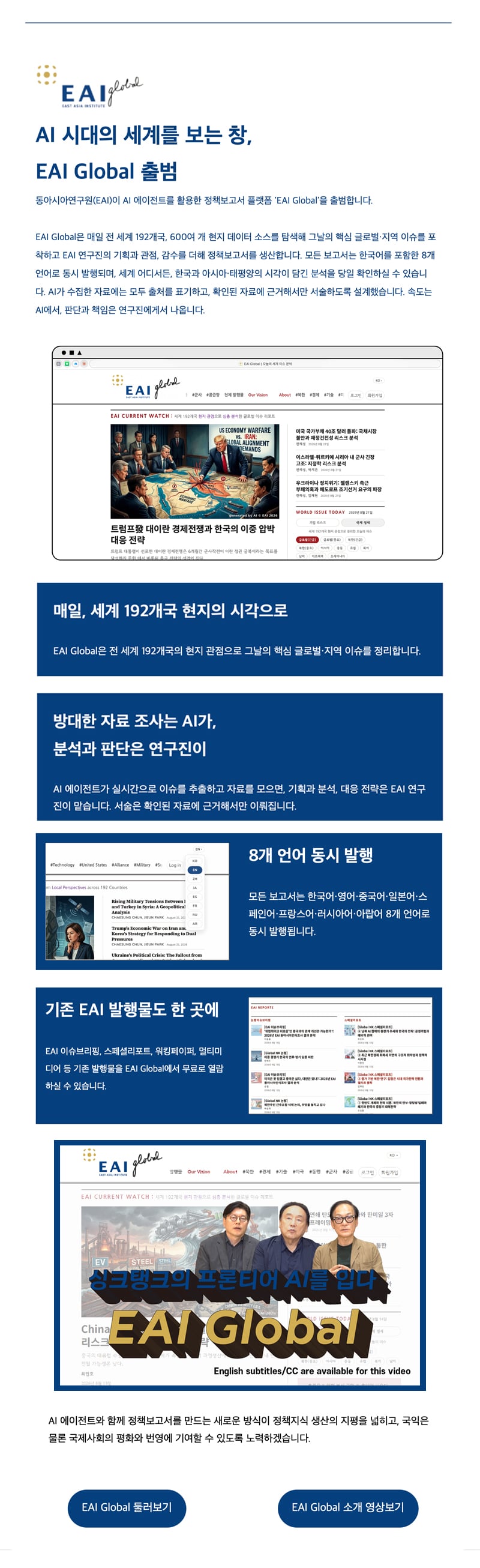
서구 지식계가 대북 전략 및 북한 연구를 주도하고 있는 현실을 극복하고 보다 균형 있는 북한과 한반도 문제 연구 및 통일전략과 동아시아전략을 복원하고자 EAI는 2018년 대북복합전략 영문 종합 웹사이트 구축을 기획하여 웹사이트를 지속적으로 관리 및 운영하고 있다. 대북복합전략 영문 종합 웹사이트 Global North Korea (Global NK)는 아카이브 성격의 웹사이트로써, 제재(Sanctions), 관여(Engagement), 자구(Internal Transformation), 억지(Deterrence)로 구성된 4대 대북복합 프레임워크를 기반으로 주요 4개국인 한국, 미국, 중국, 일본에서 발간한 자료들을 보다 체계적이고 종합적인 접근법을 통해 분류한다. 또한, Global NK에서 제공하는 통계치를 통해 웹사이트 이용자는 주요 4개국의 북한에 대한 인식 차이 및 변화를 확인할 수 있게 하였다. 본 웹사이트는 외부 기관의 북한 관련 발간 자료를 한 곳에 수집하는 역할 뿐만 아니라 자체적인 전문가 코멘타리(Commentary)를 발간함으로써 보다 분석적이며 전략적인 방식으로 북한 문제에 대한 방향을 제시하고자 한다.

웹사이트 바로가기: www.globalnk.org

논평이슈브리핑
[Global NK 논평]Towards a Successful Third US-North Korea Summit: Finding Convergence between Two Denuclearization Calculations

.a_wrap {font-size:14px; font-family:Nanum Gothic, Sans-serif, Arial; line-height:20px;} ■ 본 Global NK 논평의 원문 보기 및 PDF 다운로드는 Global North Korea 웹사이트를 통해 이용 가능합니다.  [바로가기]      After the second US-North Korea summit, which failed to result in a final agreement, North Korea clarified its denuclearization calculation during a late-night news conference. First, when the US lifts some of the UN sanctions which impede the civilian economy, especially the people’s livelihood, North Korea will completely and permanently dismantle the production facilities of all nuclear materials, including plutonium and uranium, in the Yongbyon complex, through a joint project involving technicians from both North Korea and the US in the presence of US inspectors. Second, North Korea will make a written pledge to permanently halt nuclear weapon tests and long-range missiles test launches. Third, the most important issue is security guarantees in the process of denuclearization. However, as it would be more burdensome for the United States to take military-related measures towards such guarantees, North Korea suggests a partial lifting of sanctions as a corresponding measure. Fourth, for complete denuclearization, this early stage process is unavoidable and North Korea must implement this process at the current stage. Fifth, as the United States continued to insist at the talks that North Korea must take one more measure beyond the dismantlement of the Yongbyon nuclear facilities, it seems clear that the United States is not prepared to accept North Korea’s proposal. Meanwhile, the United States explained its own calculations with relation to North Korea’s denuclearization at a press conference right after the summit. First, for North Korea to fully denuclearize, it is not sufficient to permanently dismantle its nuclear facilities in Yongbyon- it must include additional nuclear facilities which are designated by the United States. Second, the core sanctions that North Korea wants lifted cannot be removed in exchange for the dismantlement of the Yongbyon nuclear facility alone. Third, North Korea currently has a different vision of denuclearization than the United States. But over the past year, the gap between the two visions has been reduced to some extent, and the US expects to ultimately share the same vision with North Korea. Fourth, if North Korea chooses to denuclearize, it will seek international support to become an economic power. The greatest achievement of the second North Korea-US summit was to clearly prove that there is no potential for convergence between the current North Korean and American trajectories towards North Korea’s denuclearization. Since the Singapore Summit, there has been a deep divide among domestic and foreign policymakers and experts between the optimistic and pessimistic views on the possibility of convergence between the two different calculations. EAI has voiced ongoing criticism of the dichotomy between these two views and pointed out that North Korea has been seeking to implement a three-step negotiation strategy for the North Korean vision of complete denuclearization, which differs from the vision shared and pursued by the US and South Korea. In the first phase, North Korea proposed the voluntary destruction of the Punggye-ri nuclear test site as well as the Tongchang-ri missile facility and missile engine test site in exchange for a suspension of the joint ROK-US military exercises as a confidence building measure. In the second phase, North Korea will demand, based on the principle of “action for action,” an end to the US hostile policy against North Korea; a security guarantee for the regime; and an easing of economic sanctions in exchange for the permanent disposal of the Yongbyon nuclear facility. In the third phase, North Korea will propose nuclear disarmament talks which will include the disarmament of the Korean Peninsula as well as the surrounding regions (EAI Issue Briefing (2018.6.21)/Global NK Commentary (2019.1.4)). The second summit clearly showed that neither the optimists who believe that North Korea will accept complete denuclearization nor the pessimists who argue the opposite have the solution to this problem. Rather, it demonstrated the accuracy of prudent analysis which asserts that North Korea will negotiate present and future denuclearization through confidence building and corresponding measures, but that North Korea will not give up the nuclear weapons which are necessary as a minimum deterrence for its survival. Therefore, the nuclear facilities of Yongbyon can be dismantled if the United States offers an appropriate corresponding measure, but North Korea is not willing to report its complete nuclear facilities as the US demanded. North Korea currently faces a difficult challenge. The North’s Foreign Minister Ri Yong-ho said at the press conference “our principled position won’t change in the slightest degree, even if the United States proposes negotiations again in the future. Our measures will not change. ” However, as long as North Korea continues along its current trajectory, it is hard to expect that the other side will be willing to provide the corresponding measures of an easing of sanctions and a security guarantee that the North wants. Moreover, as Kim Jong Un said during his 2019 New Year’s Address, if the North seeks “a new way for defending the sovereignty of the country and the supreme interest of the state and for achieving peace and stability on the Korean Peninsula”, the regime will still not have a guarantee and sanctions will be strengthened. As a consequence, North Korea will face a second “Arduous March.” Thus, North Korea must recalculate its current trajectory and seek “a new way for guaranteeing the regime and achieving prosperity without nuclear weapons.” In order to see tangible results towards achieving the North’s complete denuclearization at the third summit, the United States must seek to complement the calculations which have played into its own trajectory in these negotiations. First, the United States should push forward a discussion through close cooperation with South Korea and China on a security guarantee for the regime which encompasses both diplomatic and military aspects. The guarantee must be so powerful that North Korea becomes willing to place its trust in such a guarantee rather than in its nuclear weapons. Only then will North Korea be able to recalculate its trajectory to aim for complete denuclearization. There is an urgent need to hold immediate discussions on how to build multiple-layered regime guarantees on a bilateral level, such as between North Korea and the US, North Korea and China, and South Korea and North Korea; on a multilateral level such as through the Six-Party Talks; and on an international level including the UN. Second, there must be international discussions regarding how to provide sanctions relief and support for the economy in steps which correspond to the reporting, inspection and destruction of all of North Korea’s nuclear facilities, nuclear materials and nuclear weapons, including those at Yongbyon. North Korea can demonstrate its sincere willingness to engage in the process of complete denuclearization by taking these steps. South Korea, from a perspective of prudence beyond both optimism and pessimism, must also recalculate its own trajectory so that it may converge with those of North Korea and the US to achieve a successful third North Korea-US Summit. More importantly, there must be recognition that the third summit will be totally different from the first summit. The first summit was held at the level of confidence building based on North Korea’s three phases of negotiation. The second summit proved that the existing North Korean and American denuclearization trajectories will never converge. Through the third summit, both North Korea and the US should reach an agreement by establishing new trajectories that can encompass the needs of both parties. Therefore, unlike the past two summits, the role of South Korea in the third summit matters. South Korea must induce North Korea to recalculate its trajectory to aim for the complete denuclearization of North Korea and, at the same time, create a new path towards denuclearization which includes a more attractive security guarantee and economic prosperity together with the United States. In this way, the trajectories of the three countries may hope to converge at the third meeting. North Korea’s complete denuclearization is moving rapidly towards the moment of truth. While the last two summits were exploratory forays, the third summit should be a historic meeting between all of the winners in the ring.     ■ Young-Sun Ha is the Chairman of the Board of Trustees of the East Asia Institute, and also a Professor Emeritus at Seoul National University. Dr. Ha received his Ph.D. in political science from the University of Washington   ■ 담당 및 편집: 백진경 EAI 연구원             문의: 02 2277 1683 (ext. 209) I [email protected]

하영선 2020-06-05조회 : 8418
논평이슈브리핑
[하영선 칼럼] 성공적인 3차 북미정상회담이 되려면: 북한식 계산법과 미국식 계산법의 수렴

.a_wrap {font-size:14px; font-family:Nanum Gothic, Sans-serif, Arial; line-height:20px;} [편집자주] 전 세계의 이목이 집중된 가운데 제2차 북미정상회담이 베트남 하노이에서 개최되었으나, 양측이 최종 합의를 도출하지 못한 채 마무리되었습니다. 북한 비핵화에 대한 북미 간 입장 차이가 여전히 존재하고 있기 때문입니다. 북한이 핵무기를 완전히 포기하지 않고, 미국 또한 북한이 핵무기보다 신뢰할 수 있는 외교·군사 체제보장안을 북한 측에 제시하지 못할 경우, 북한 비핵화를 위한 진전은 기대하기 힘들 것이라고 하영선 EAI 이사장은 분석합니다. 특히, 1, 2차 북미정상회담은 결과적으로 ‘탐색전’의 성격이 강했던 바, 3차 북미정상회담에서 실질적인 성과를 거두기 위해서는 중재자로서의 한국의 적극적인 역할이 요구된다고 저자는 강조합니다. 즉, 한국은 북한이 완전한 비핵화의 길로 가도록 설득하는 한편, 미국과 함께 북한의 체제보장과 번영을 위한 구체적이고 매력적인 방안을 마련해야 합니다.       최종 합의문을 마련하지 못한 2차 북미정상회담이 끝난 후, 북한은 심야 기자회견에서 비핵화를 위한 북한식 계산법을 분명하게 밝혔다. 첫째, 미국이 유엔제재 일부, 즉 민수 경제와 특히 인민생활에 지장을 주는 제재를 해제하면 북한은 영변의 플루토늄과 우라늄을 포함한 모든 핵물질 생산시설들을 미국 전문가들의 입회 하에 양국 기술자들의 공동 작업으로 영구적으로 완전 폐기한다. 둘째, 핵실험과 장거리 로켓 실험 발사를 영구적으로 중지한다는 확약을 문서형태로 표명한다. 셋째, 비핵화에서 보다 중요한 문제는 안전 담보 문제이나 미국이 아직 더 부담스러워 하므로 부분적 제재해제를 상응 조치로 제기한다. 넷째, 완전한 비핵화를 위해서는 이러한 첫 단계 공정이 불가피하며 우리가 제시한 최선의 방안이 실현되는 과정을 반드시 거쳐야 한다. 다섯째, 그러나 미국은 영변 핵시설 폐기 조치 외에 한 가지를 더 해야 한다고 끝까지 주장했으며 따라서 미국이 우리의 제안을 수용할 준비가 돼 있지 않다. 한편, 미국은 정상회담 직후 기자회견에서 북한 비핵화의 미국식 계산법을 설명했다. 첫째, 북한의 완전 비핵화를 위해서는 북한이 제시하고 있는 영변 핵시설의 영구 폐기만으로 불충분하고 미국이 요구하는 핵시설을 추가로 포함시켜야 한다. 둘째, 영변 핵시설의 폐기만으로는 북한이 원하는 핵심 제재의 해제를 받아들일 수 없다. 셋째, 북한은 현재 미국과 다른 비핵화 비전을 가지고 있다. 다만 지난 한 해 동안 비전의 차이는 상대적으로 줄어 들었으며, 궁극적으로는 같은 비전을 공유할 수 있으리라 기대한다. 넷째, 북한이 비핵화를 선택하면 경제 강국이 되도록 국제지원을 도모한다. 2차 북미정상회담의 최대 성과는 북한 비핵화를 위한 현재의 북한식 계산법과 미국식 계산법이 수렴 불가능하다는 것을 분명하게 보여 준 것이다. 싱가폴 정상회담 이후 국내외 정책당국자와 전문가들 사이에는  두 계산법의 차이가 충분히 조정 가능하다는 낙관론과 전혀 불가능하다는 비관론이 첨예하게 맞서 왔다. 동아시아연구원은 이 문제에 대한 소박한 낙관론과 비관론의 이분법을 비판하고, 북한은 한미형 완전 비핵화와 다른 북한형 완전 비핵화를 위해서 3단계의 협상 방안을 추진하고 있다고 지적해 왔다. 첫 단계에서는 풍계리 핵 실험장과 동창리 엔진 실험실과 미사일 발사대의 자진 폐기를 통한 신뢰구축 조치로 한미연합훈련의 중단을 유도하고, 두 번째 단계에서는 영변 핵시설을 영구 폐기하는 대신, ‘행동 대 행동’의 원칙에 따라 체제보장을 위한 대북 적대시 정책의 종식과 경제제재 완화를 요구하며, 세 번째 단계에서는 완전한 비핵화를 위해 ‘조선반도 비핵화’라는 시각에서 한반도와 주변 지역을 포함한 핵군축 회담을 제안하는 것이다(EAI 논평(2018.6.21)/하영선 칼럼(2019.1.3)). 2차 북미정상회담은 북한이 완전 비핵화에 합의했다는 낙관론이나 전혀 합의하지 않았다는 비관론 대신에, 현재와 미래의 비핵화는 신뢰 조성과 상응 조치에 따라서 합의할 수 있으나 북한의 안전을 확실하게 담보하는 최소 억지체제를 유지하는 과거의 핵무기를 포기할 수는 없다는 신중론이 결과적으로 올바른 분석이었음을 증명해 줬다. 따라서 영변 핵시설은 상응 조치에 따라 폐기할 수 있으나 미국이 요구하는 추가 핵시설의 신고를 할 수 없었던 것이다. 북한은 현재 어려운 난관에 직면해 있다. 북한의 리룡호 외무상은 기자회견에서 “우리의 이러한 입장에는 추호도 변함이 없을 것이고 앞으로 미국측이 협상을 다시 제기하는 경우에도 우리의 방안에는 변함이 없을 것입니다.” 라고 마무리했다. 그러나 북한이 현재의 북한식 계산법을 계속 추진하는 한 북한이 원하는 제재 해제와 안전 담보라는 상응 조치를 기대하기는 어렵다. 더구나 김정은 위원장이 신년사에서 말한 것처럼 “자주권과 국가의 최고 이익을 수호하고 조선반도의 평화와 안정을 이룩하기 위한 새로운 길”을 모색한다면 체제는 여전히 보장되지 않으면서 제재는 심화되어 북한은 제2의 고난의 행군을 겪어야 할 위험에 직면하게 될 것이다. 따라서 북한은 “핵무기 없이 체제 보장과 번영을 이룩하기 위한 새로운 길”을 찾는 북한식 계산법을 하루 빨리 새롭게 마련해야 할 국면을 맞이했다. 미국 역시 3차 북미정상회담에서 북한의 완전 비핵화를 위해 실질적인 성과를 거두기 위해서는 현재의 미국식 계산법을 보완할 필요가 있다. 첫째, 북한이 명실상부한 완전 비핵화를 위한 새로운 계산법을 신속하게 마련하도록 돕기 위해서는 북한이 핵무기보다 신뢰할 수 있는 외교와 군사의 체제보장 논의를 미국이 한국과 중국의 긴밀한 협력을 받아 본격적으로 추진해야 한다. 북미, 북중, 남북한 같은 양자, 6자회담과 같은 다자, 유엔 같은 국제 차원의 다중 체제보장 구축 논의가 시급하다. 둘째, 북한이 완전 비핵화의 진정성을 구체적으로 보여 주는 영변을 포함한 전체 핵시설, 핵물질, 핵무기의 신고·사찰·폐기와 상응한 제제 해제와 경제 지원을 진행하는 방안을 국제적으로 논의해야 한다. 한국도 낙관론과 비관론을 넘어선 신중론의 시각에서 3차 북미정상회담의 성공을 위해 북한식 계산법과 미국식 계산법을 수렴할 수 있는 한국식 계산법을 새롭게 마련해야 한다. 무엇보다 중요한 것은 1차와 3차의 북미정상회담의 성격이 전혀 다르다는 것을 제대로 인식해야 한다. 1차회담은 북한의 3단계 협상 방안에 따라 신뢰구축 수준에서 진행된 것이다. 2차회담은 기존의 북한식 계산법과 미국식 계산법의 수렴이 불가능하다는 것을 잘 보여 주었다. 3차회담은 북한과 미국이 새롭게 계산법들을 마련하여 합의에 이르러야 한다. 따라서 1차나 2차 회담과는 전혀 다른 한국의 역할이 중요하다. 북한이 새롭게 완전 비핵화 계산법을 만들도록 최대한 유도해야 하며, 동시에 미국과 함께 북한의 체제보장과 번영을 보다 적극적으로 포함하는 북한 비핵화 방안을 보완하여 3차 회담에서 두 계산법이 수렴되도록 해야 한다. 북한의 완전 비핵화는 빠르게 진실의 순간에 접어 들고 있다. 그 동안의 1차와 2차 회담이 탐색전이었다면 3차회담은 링 위의 모든 주인공들이 승리하는 역사적 만남이 되어야 한다. ■     ■ 집필: 하영선_ EAI 이사장, 서울대학교 명예교수. 미국 워싱턴대학교(University of Washington)에서 국제정치학 박사학위를 받았으며, 서울대학교 정치외교학부 교수, 서울대학교 국제문제연구소장, 미국학연구소장, 한국평화 학회 회장을 역임했다. 주요 저서 및 편저로는 《복합세계정치론: 전략과 원리 그리고 새로운 질서》, 《한일 신시대와 공생복합 네트워크》, 《변환의 세계정치》, 《미중의 아태질서 건축경쟁》 등이 있다. ■ 담당 및 편집: 최수이 EAI 선임연구원            문의: 02 2277 1683 (ext. 105) I [email protected]     [EAI논평]은 국내외 주요 사안에 대해 다양한 분야의 전문가들이 심층적인 분석을 통해 의견을 개진하고 정책적 제언을 발표할 수 있는 담론의 장을 마련하고자 기획된 논평 시리즈입니다. 인용할 때에는 반드시 출처를 밝혀주시기 바랍니다. EAI는 어떠한 정파적 이해와도 무관한 독립 연구기관입니다. EAI가 발행하는 보고서와 저널 및 단행본에 실린 주장과 의견은 EAI와는 무관하며 오로지 저자 개인의 견해임을 밝힙니다.    

하영선 2020-06-05조회 : 8402
논평이슈브리핑
[Global NK 논평] For Kim Jong Un, Trump is the Best, and the Last, Opportunity

.a_wrap {font-size:14px; font-family:Nanum Gothic, Sans-serif, Arial; line-height:20px;} ■ 본 Global NK 논평의 원문 보기 및 PDF 다운로드는 Global North Korea 웹사이트를 통해 이용 가능합니다.  [바로가기]      The second summit between President Trump and Chairman Kim Jong-un has been set for February 27 and 28 in Vietnam. The question is what kind of progress the two leaders will make after their highly symbolic but unsubstantial meeting in Singapore in June of last year. How much and what kind of concessions will Kim make in his declared efforts of denuclearization? How much will Trump reward Kim with normalizing relations between Washington and Pyongyang as was promised in the last meeting? As many experts speculate over the prospects of the upcoming summit between the two unpredictable leaders, one thing seems to be clear. Mr. Trump represents a unique opportunity for Kim.  Trump is unique because he is the first American president, and possibly the only one, who is willing to meet with Kim without many preconditions. This is exactly what happened in the last meeting, after which many Americans criticized Trump for giving Kim the prestige of sharing a world stage with the American president in exchange for nothing. The second meeting has been set in a similar manner, with Mr. Trump announcing the meeting even as his negotiator is still finalizing the terms and conditions in Pyongyang. Trump is unique because he is not beholden to the traditional American values of human rights and promoting democracy. In his commentary to the Chair of CSIS Korea, Robert King, a former special envoy for North Korea human rights issues, noted the total absence of the subject in Trump’s 2019 State of the Union Speech. It was a sharp contrast to 2018, when the President strongly condemned Kim’s human rights abuses, saying “no regime has oppressed its own citizens more totally or brutally than the cruel dictatorship in North Korea.” Everyone knows North Korea has serious human rights issues. Yet, past US insistence that human rights be addressed was one of the main stumbling blocks preventing a nuclear deal with Pyongyang, which suspected the Americans of seeking regime change. In his analysis of the US nuclear negotiation with Libya, Bruce Jentleson of Duke University argued that the Bush administration’s focus on achieving policy change of denuclearization instead of regime change was the key to the successful deal with Kaddafi. Trump is unique also in what King calls his “transactional approach to foreign policy.” He is willing to make deals based on raw national interests as well as personal motives. Trump wants a legacy that he can claim nobody has done before. In his speech last week, Trump boasted that he was the one who prevented a major war with North Korea. Stating that there has not been a missile launch in 15 months, he said “as part of a bold new diplomacy,” he and Kim “continue our historic push for peace on the Korean Peninsula.” In his New Year Address, Chairman Kim put strong emphasis on North Korea’s economic development. If Kim really wants economic reform, he has all the support he needs. As Kim paid his fourth visit to Xi Jinping after his speech in January, it is no secret that China wants to see Kim pursue Chinese-style economic reform and willingness to provide the necessary support. Perhaps more importantly, South Korean President Moon Jae-in wants to see the North Koreans prosper instead of regime collapse. In his New Year’s news conference, Moon mentioned the possibility of reopening Kaesong Industrial Complex and Mt. Geumgang Tours as part of broadening inter-Korean economic cooperation. In his National Security Strategy paper published December last year, Moon made it clear that his government wants to build a permanent peace regime on the Peninsula which will lead to sustainable development in inter-Korean relations and common prosperity. Moon’s peace drive reflects the sentiment of the South Korean public. In the latest Korea Gallup poll, 65 percent of South Koreans indicated that they preferred a gradual unification to a rapid absorption of the North, which had only 19 percent support. And 12 percent stated that they did not want any unification at all. Yet, with US sanctions, neither Beijing nor Seoul can help Kim with his ambitious economic initiative. The good news is that now Kim has another big supporter for his economic agenda: Mr. Trump. Trump tweeted that he “looks forward to meeting Chairman Kim who realizes so well that North Korea possesses great economic potential.” In his latest tweet, Trump again emphasized that “North Korea, under the leadership of Kim Jong Un, will become a great Economic Powerhouse. He may surprise some but he won’t surprise me, because I have gotten to know him & fully understand how capable he is. North Korea will become a different kind of Rocket - an Economic one!” The real challenge is what concessions Kim is willing to make. Kim has to make a strategic decision to show the skeptics and the world a convincing case for North Korea’s denuclearization efforts. That will require a delicate balancing act between his impulse to hedge by maintaining a certain level of nuclear capability and meaningful denuclearization of North Korea’s nuclear material stockpile and production capability, as well as ICBMs and related technologies. The second summit will not solve all the denuclearization issues. But it ought to result in concrete enough measures as a starting point for a real peace process on the Korean Peninsula. Trump is the best, and maybe the last, opportunity Kim has now. But time is running out fast as the Trump presidency is increasingly consumed by mushrooming political scandals, special counsel Mueller’s investigation, opposition from House Democrats, and the possibility of impeachment. Let Mr. Trump declare a real deal of the century before it is too late. But ultimately, it is all up to Kim.     ■ Seong-Ho Sheen is a professor at Graduate School of International Studies at Seoul National University. He is also a member of Policy Advisory Board of Ministry of Defense, Republic of Korea.   ■ 담당 및 편집: 백진경 EAI 연구원             문의: 02 2277 1683 (ext. 209) I [email protected]

신성호 2020-06-05조회 : 8382
논평이슈브리핑
[Global NK 논평] The Denuclearization of North Korea and the US-China rivalry

.a_wrap {font-size:14px; font-family:Nanum Gothic, Sans-serif, Arial; line-height:20px;} ■ 본 Global NK 논평의 원문 보기 및 PDF 다운로드는 Global North Korea 웹사이트를 통해 이용 가능합니다.  [바로가기]      Following a year of breathless expectations, negotiations between North Korea and the United States have stagnated due to many reasons. Pundits skeptical of North Korea’s genuine intentions to denuclearize believe that Kim Jong Un is still developing technologies for nuclear warheads and long-range missiles despite the moratorium on nuclear and missile tests. North Korea, as shown in the recent announcements made by several officials, has criticized the United States for failing to implement corresponding measures such as a partial lift of sanctions from the American side. There is a growing expectation that early next year, there will be a second breakthrough summit between North Korea and the United States, but the nature of the North Korean nuclear problem is changing against the background of the Northeast Asian international situation, especially the extensive clash between Washington and Beijing. American unipolarity, which lasted for about two decades after the end of the Cold War, seriously threatened the prospects of survival of so-called “rogue states.” As one of these rogue states, North Korea sought the ultimate weapon to gain recognition as a political entity worth surviving after its socialist comrades had all fallen. To prove itself powerful enough to pose a threat to the American unipole was somehow effective to draw attention and concessions from Washington, and the state thereby found leverage to fight for diplomatic normalization with the United States and for economic development. However, the lack of trust between North Korea and the United States, and North Korea’s fear of being structurally absorbed by South Korea after reform and opening made Kim Jong Il hesitate over the strategic decision to denuclearize. Under the new US-China rivalry, North Korea has suddenly found itself in a far more difficult position. Amidst growing geopolitical and geoeconomic competition, the two giants are eager to avoid the relative losses that promise to follow after the resolution of the North Korean nuclear problem. The complete denuclearization of North Korea will bring about not only a denuclearized North Korea, but also a Korean Peninsula under a peace treaty. What becomes of North Korea after a peace treaty is signed will be the focus of attention as it has the potential to change the geostrategic balance of power in Northeast Asia between the United States and China. Will North Korea transform itself into a pro-American country after diplomatic normalization? Will North Korea remain a staunch ally of China and fight against the US policy of counterbalancing China? Will North Korea try to maintain a policy of equidistance between the United States and China to maximize its own strategic and economic interests? It is completely uncertain what kind of diplomatic strategy North Korea will follow after it denuclearizes, and this is what lies behind the strategic hesitation of both Washington and Beijing to jump into the phase of peace treaty. It seems likely that Kim Jong Un will strive to pursue a self-reliant diplomatic strategy to maximize the interests of the North Korean regime in a practical way. However, North Korea’s nuclear weapons are not so powerful as to make it possible for the country to evade falling victim to the diplomatic dilemma that the rivalry between the United States and China is inflicting on every other East Asian country. Without a well-devised diplomatic strategy, North Korea will face the same strategic dilemma as everyone else, and its nuclear weapons will not save Kim Jong Un. Even with a nuclear arsenal, Kim lacks products to sell that might prove North Korea’s value as a regional player. It follows that President Trump and President Xi Jinping will not be willing to take the geostrategic risk necessary to conclude a peace treaty that may harm their future geopolitical interests, and thus we may deduce that both are hoping to maintain the status quo on the Korean Peninsula while eliminating the immediate security threat posed by North Korea’s development of nuclear weapons. As President Trump concentrates on dealing with the rising tensions between America and China, he may be satisfied with the absence of direct nuclear threat from North Korea. At the same time, China prefers for its neighbors to be stuck in the midst of stalled negotiations rather than having to address a denuclearized North Korea with close economic and strategic relations with South Korea and the United States. In 2019, negotiations to denuclearize North Korea will face recurring difficulties unless the United States is able to identify more positive interests that may result from the negotiations, and China becomes confident that it can depend on North Korea to take its side in the competition with the United States and that it will have a better chance to pursue its own strategic interests after a peace treaty is concluded. The combination of a denuclearized North Korea and a post-peace treaty Korean Peninsula will change the status quo in Northeast Asia. Meanwhile, the South Korean government, which continues to pin its hopes on achieving denuclearization and a peace treaty, needs to ponder the strategic interests of the two giants. South Korea’s roadmap for the future should depict a peaceful Peninsula that plays a beneficial role in its relations with both the United States and China, and a more positive role for South Korea overall to achieve a better harmonization of interests between the two.     ■ Chaesung Chun is the Chair of the International Relations Studies Center at the East Asia Institute. He also serves as a professor of the department of political science and international relations at Seoul National University. Dr. Chun received his Ph.D. in international relations from Northwestern University.   ■ 담당 및 편집: 백진경 EAI 연구원             문의: 02 2277 1683 (ext. 209) I [email protected]

전재성 2020-06-05조회 : 8410
논평이슈브리핑
[Global NK 논평] Tasks Ahead beyond the Stalemate

.a_wrap {font-size:14px; font-family:Nanum Gothic, Sans-serif, Arial; line-height:20px;} ■ 본 Global NK 논평의 원문 보기 및 PDF 다운로드는 Global North Korea 웹사이트를 통해 이용 가능합니다.  [바로가기]      The Stalemate following the June 12th North Korea-US Singapore Summit Following the June 12th North Korea-US Summit in Singapore, expectations that the process of denuclearization of North Korea would be accomplished in a short period were high. However, the negotiations between the two parties has since stagnated. As discussions progress over the detailed steps that must be taken to achieve denuclearization and establish a peace sys-tem, underlying mistrust and conflicts of interest have also grown. North Korea has argued that a renewed relationship with the United States is a prerequisite for denuclearization, while the United States has stood firm that irreversible steps towards denuclearization must be made before an end-of-war declaration or partial sanctions relief can be entertained. The fundamental cause for this stalemate stems from the differences in understanding and intentions regarding the summit between North Korea and the United States. The main takeaways from the June 12th North Korea-US Summit in Singapore are that both parties need to work to build a new permanent and stable peace regime on the Korean Peninsula, and that North Korea must work to completely denuclearize the Korean Peninsula by reconfirming the Panmunjom Declaration. Following the summit, optimists argued that the North Korean nuclear issue would be fully resolved and a peace regime established on the Peninsula in due time. Pessimists, however, felt that the agreement lacked specific roadmaps and a timeline for denuclearization. In other words, the agreement reached remains at the basic step of merely emphasizing the importance of the principle of establishing a peace regime. This discord between the two views has produced conflicting interpretations of the meaning of the summit as well as the future prospects for North Korea’s complete denuclearization. What is absolutely necessary at this point is to move beyond the simple dichotomy of optimistic or pessimistic views and to critically analyze and explore the chances of actually solving the problem, beginning with a review of the North Korea-US summit. The key point of the summit was whether or not North Korea would agree to the U.S. demand for the complete, verifiable, and irreversible dismantlement (CVID) of North Korea’s nuclear weapons and related capabilities. Prior to the summit, serious negotiations augmented the prospect of resolution. Basically, the two leaders reaffirmed the April 27th Panmunjom Declaration to denuclearize the Peninsula using the expression “the denuclearization of the Korean Peninsula.” The US was not able to reach a consensus with North Korea to use the term CVID in the agreement, nor were they able to establish a specific roadmap for completing North Korea’s denuclearization. The US did not have a chance to declare the termination of the Korean War and offer concrete measures to guarantee the security of North Korea’s regime. The summit did not result in any tangible progress on denuclearization, as the joint statement used the same language as the Panmunjom Declaration rather than offering a new agreement on denuclearization. North Korea’s genuine strategic intentions and its approach to the negotiation with the U.S. are critical at this point. On April 20th, during the Plenary Meeting of the Seventh Central Committee of the Workers' Party of Korea, North Korea declared that “the historic tasks under the strategic line of simultaneously developing the two fronts set forth at the March 2013 Plenary Meeting of the Central Committee of the Party have been successfully carried out.” North Korea also announced a “new strategic line on channeling all efforts into the economy.” It is critical to note that the new strategic line is neither the past Byungjin strategy of pursuing economic development with nuclear development, nor the most desirable strategy that puts the economy first and includes the total dismantlement of nuclear weapons. Rather, North Korea will reduce its nuclear arsenal to a minimum level of deterrence and, at the same time, devote major resources to the pursuit of economic development. It is also important to note that North Korea is not ready to accept the verification process that the US is pushing for. If North Korea accepts CVID or FFVD (Final, Fully Verified Denuclearization) as proposed by the US, then it must give up all of the nuclear weapons that it has produced thus far to guarantee a minimum level of nuclear deterrence. North Korea will adopt a nuclear-free, economically focused strategy when it is confident that the so-called U.S. hostile policy toward North Korea has completely disappeared. This means that North Korea must be convinced that US-North Korea relations are as strong as US-South Korea relations. Despite the initial agreement between the U.S. and North Korea, North Korea will stick to its own version of denuclearization that is both reciprocal and staged, responding to the US to establish a peace regime, normalize relations and lift economic sanctions. North Korea confirmed the aforementioned recognition through its official comment on the summit, which stated, “We had a mutual understanding that it is important for both parties to simultaneously follow the principle of concerted action in the process of achieving the peace and stability of the Korean Peninsula and the denuclearization of the Peninsula.” Since the summit, it has been demonstrated that even if North Korea itself understands the inevitability of inspections and verification measures, the regime wants to maintain extreme caution in accepting the outside inspections and verification desired by the US. North Korea is currently pushing for a certain form of self-verification as the first step towards denuclearization. Self-verification is a bid to evade the US demand of having outside inspectors and permitting intrusive inspection measures. Rather than accepting an international inspection team composed of American or third country-led specialists, North Korea prefers to advance denuclearization after completing their own voluntary reporting and inspections. No matter how much the US pressures North Korea with economic sanctions and diplomatic isolation, North Korea will want to keep the military option of using its nuclear weapons. This is because giving up the last resort of minimum nuclear deterrence and agreeing to complete denuclearization is a life or death decision for the regime. While it is likely that North Korea will unilaterally rapidly implement the first step of confidence-building measures towards arms reduction, as was done in Punggye-ri and Dongchang-ri, the second step of the denuclearization process, which touches on minimum nuclear deterrence capability, will proceed very slowly and cautiously. Moreover, if North Korea is going to complete the final third step of complete, irreversible, and verifiable denuclearization confirmed by outside inspectors to the satisfaction of the international community, Kim Jong Un will require a new strategic determination by North Korea in addition to the one made on April 20th. As the new strategic line adopted by North Korea on April 20th was a conditional decision to pursue step-by-step, mutual nuclear arms reduction in response to the wishes of the international community, particularly the US, North Korea will have to confront once again the choice to pursue a new version of the Byungjin line of economic development based on reform and opening, with genuine, complete denuclearization. It still remains questionable as to whether the US will be able to offer concrete measures that conform to North Korea’s demand for a complete guarantee for its regime. According to the Rodong Sinmun, Chairman Kim Jong Un stated that the deep-seated mistrust and animosity between the two sides has resulted in numerous issues over the years, and put forth that in order to achieve real peace and denuclearization on the Korean Peninsula, the two sides must promise mutual understanding and not regard one another as the enemy. He also called for the implementation of legal and institutional measures in order to ensure security. Furthermore, he said that establishing a permanent peace regime on the Peninsula would be a very meaningful security guarantee, and that the two sides must cease taking hostile and provocative military actions towards one another.   The Tasks Ahead The DPRK took the first step of confidence building by declaring a moratorium on the future development of nuclear weapons and ICBM-related capacity as well as dismantling parts of nuclear and missile engine sites. It is the second step where the problems arise. The second step requires complete denuclearization, including the dismantlement of existing nuclear weapons for minimum deterrence, but North Korea will be extremely cautious and move slowly. The last step should be to make a strategic decision to embrace complete denuclearization and economic opening to satisfy all members of the international community. South Korea and other countries in the region must push for a co-evolutionary policy towards North Korea at each stage of the process to accompany North Korea’s efforts towards internal transformation. In the first step, there must be concrete and sys-tematic support for North Korea’s security and prosperity and a blueprint for North Korea to stand on its own two feet. There must also be continued pressure so that if trust-building measures prove insufficient and the situation begins to look dim, North Korea does not backslide as it has in the past. South Korea and the US, as well as other neighboring countries such as China and Japan must participate to the fullest extent possible until denuclearization is achieved, forming a strong cooperative partnership to apply pressure until this occurs. Second, if North Korea’s demand for a complete regime security guarantee is to be satisfied, it is imperative that a long period of confidence building between the US and DPRK come first. A peace regime requires a complex of political, legal, institutional, and military confidence-building measures. The US-DPRK summit was the first step towards political confidence building using dialogue and cooperation instead of military measures to resolve issues. Ultimately, this type of effort can lead to the creation of US-DPRK diplomatic ties. The focus of institutional and legal confidence building is the declaration of the end of the Korean War and the conclusion of a peace treaty. As there exists a historical precedent of North Korea pushing these measures as a unification strategy to realize the withdrawal of US troops from the Korean Peninsula, mutual efforts to reduce mistrust are critical. North Korea also needs various types of support to secure its international position. However, as military strength continues to be an important policy tool, it is always possible that such promises may turn out to be no more than “a pile of paper” in the realm of international politics. Thus, military confidence building is also an extremely critical part of this process. As North Korea denuclearizes, the US needs to fulfill its pledge to eliminate its nuclear threat. Meanwhile, North and South Korea have been successful during the subsequent inter-Korean summit meetings in engaging in simultaneous arms reduction and other military confidence-building measures in order to drive the process forward. As the USFK copes not just with North Korea’s nuclear weapons but also with conventional threats, the US and the ROK should cooperate closely to discuss the future role and scale of USFK through multiple levels of military talks with North Korea. In order to offer a comprehensive security guarantee, there should be a global cooperation plan to offer economic support and support North Korea’s internal transformation. Third, in order for North Korea to completely denuclearize, there must be a new push for a North Korean-style opening and reform policy to overcome the limitations of the new strategy line declared on April 20th. In order to further develop North Korea’s reform and opening measures, which are more desirable and realistic than the present strategic line, the surrounding countries must also cooperate to create a co-evolutionary North Korea policy that goes hand in hand with North Korea’s efforts to affect changes from within. Fourth, the issue of North Korea’s denuclearization and security guarantee is not limited to creating a peace regime on the Korean Peninsula; it involves creating a peace regime throughout the whole Asia-Pacific region. North Korea’s nuclearization poses an insurmountable threat to the Asia-Pacific region as it has the potential to escalate an arms race. The instability of the North Korean regime has a significant influence on both the US and China, whose aim is to form an Asia-Pacific architecture favorable to their own interests. Thus, if we are to successfully achieve the total denuclearization of North Korea, we must work together to build not only a peace regime on the Korean Peninsula, but also a peace regime in the Asia-Pacific. North Korea’s complete denuclearization will require both international sanctions and international economic support. Furthermore, a complete security guarantee for North Korea should be done at combined levels including the bilateral level with the US, China, and South Korea; the multilateral level with the members of the Six-Party Talks; and the global level with the United Nations.     ■ Young-Sun Ha is the Chairman of the Board of Trustees of the East Asia Institute, and also a professor emeritus at Seoul National University. Dr. Ha received his Ph.D. in political science from the University of Washington. ■ Chaesung Chun is the Chair of the International Relations Studies Center at the East Asia Institute. He also serves as a professor of the department of political science and international relations at Seoul National University. Dr. Chun received his Ph.D. in international relations from Northwestern University.   ■ 담당 및 편집: 백진경 EAI 연구원             문의: 02 2277 1683 (ext. 209) I [email protected]

하영선, 전재성 2020-06-05조회 : 8424
논평이슈브리핑
[Global NK 논평] Moon Faces Two Americas in Trying to Make Peace with North Korea

.a_wrap {font-size:14px; font-family:Nanum Gothic, Sans-serif, Arial; line-height:20px;} ■ 본 Global NK 논평의 원문 보기 및 PDF 다운로드는 Global North Korea 웹사이트를 통해 이용 가능합니다.  [바로가기]     It is no secret that America today is deeply divided between red America and blue America under President Trump. When it comes to foreign policy, American allies and friends often find themselves in difficult positions between these two Americas. But the true division that they face is not between red and blue, but between the President and the rest of his team. Mr. Trump is impulsive, transactional, and seems to have no concern for traditional American values. Others in his policy circle represent the more familiar, principled American approach: deliberate, rational, calculating, and driven by an underlying respect and desire to maintain America’s global leadership. This division often creates interesting dynamics in America’s dealings with major foreign policy issues like trade, alliance relations, and nuclear proliferation in Iran and North Korea. Trump’s ego and pride in being the “king of the deal” often clash with conventional wisdom in diplomacy leaving everyone, including his own staff, guessing as to his real intention. Trump, like a master gambler, enjoys being unpredictable and keeping his counterparts off balance with reckless bluffing and surprising offers. North Korea is one of the prime examples of Trump’s high rolling diplomacy. Trump’s first year in office was largely spent making war-like threats against the North Korean regime, defined by anger and hostility against Pyongyang’s ongoing missile and nuclear tests in 2017. However, the combative rhetoric promising “fire and fury,” warning that the US was “locked and loaded,” and ready to deliver “total destruction” to North Korea suddenly transformed as Trump proclaimed his “great respect,” and “honor” for the North Korean leader when Kim Jong-un, through South Korean interlocutors, proposed a summit early this year. To everyone’s surprise, Trump accepted Kim’s offer and proceeded without much deliberation or a denuclearization action plan. American hawks, led by NSC advisor John Bolton, maintain a deep mistrust towards North Korea’s commitment to denuclearization. They were deeply concerned when Trump emerged from the June Singapore summit without any tangible measures to take on Kim’s nuclear program. They view the first Trump-Kim summit as a substantial US concession which rewarded Kim for doing essentially nothing. This sentiment is widely shared throughout both liberal and conservative policy and intelligence circles in Washington. They advocate pushing for “complete, verifiable, irreversible, denuclearization” (CVID) or, as Secretary Pompeo has dubbed it, “final, fully verified denuclearization” (FFVD). American hawks also view Trump’s maximum pressure approach to Pyongyang as the best opportunity to force the defiant Pyongyang regime to come clean regarding the true extent of its decade-old nuclear program once and for all. Trump’s aids are determined to prevent their boss from being tricked by the North Korean charm offensive a second time. They want hard evidence of Pyongyang’s denuclearization commitment accompanied by concrete measures before Trump heads for a second summit. Meanwhile, South Korea’s administration has pushed for more peaceful and stable engagement with North Korea. Moon Jae-in made it clear that his first priority is peace on the Korean Peninsula. While echoing the goal of CVID, Moon tried his best to connect Kim and Trump so that they might engage in dialogue, not war. Moon met with Kim three times over the past six months, each time emphasizing the importance of denuclearization in order to further the peace process between Washington and Pyongyang. The problem is that CVID is not easy. Dr. Sig Hecker, a nuclear expert at Stanford University, says it will take up to ten years to achieve under the best circumstances with North Korea’s full cooperation. Many experts suspect it will be difficult for Kim to give up the regime’s “treasure sword,” which offers a powerful deterrence against the mighty US-ROK alliance. As Moon pushes for the second Trump-Kim summit as the next step for replacing the Korean War armistice with a peace treaty, which would mark a tectonic shift in inter-Korean relations, the key issue to be addressed is to what extent a deal on the nuclear front must be finalized for Trump to meet Kim again. At the moment, prospects do not appear bright as Washington and Pyongyang seem engaged in a serious tug of war over the denuclearization issue. Bolton and Pompeo are reportedly pushing for more concrete measures including a nuclear list, inspections, and a time line as prerequisites to a summit, while the North Koreans are threatening to resume their halted nuclear program. As before, Moon finds himself boxed in between American demands for more pressure on North Korea and Pyongyang’s call for more help from Seoul to ease the pain of economic sanctions. And once again, there is only one person who can help him- Trump. For all the controversy and recklessness that have characterized Trump’s foreign policy management, it was indeed Trump’s unorthodox approach that opened the door for the Moon’s engagement efforts with North Korea. The good news is, with the US midterm elections over, Trump can now direct his appetite for another glamorous foreign policy moment towards North Korea. The bad news is that, having been stung by the Democrats in the House elections, Trump may lash out with new anger towards Kim for his nuclear defiance. Which Trump will show up remains to be seen.       ■ Seong-Ho Sheen is a professor at Graduate School of International Studies at Seoul National University. He is also a member of Policy Advisory Board of Ministry of Defense, Republic of Korea.   ■ 담당 및 편집: 백진경 EAI 연구원             문의: 02 2277 1683 (ext. 209) I [email protected]

신성호 2020-06-05조회 : 8367
논평이슈브리핑
[하영선 칼럼] 김정은 2019년 신년사와 완전 비핵화의 과제

[편집자주] 올해도 어김없이 새해 첫 날 북한의 신년사가 발표되었습니다. 그러나 형식은 예년과 크게 달랐습니다. 인민복이 아닌 양복차림으로 등장한 김정은 국무위원장은 연단이 아닌 집무실 소파에서 신년사를 전했습니다. 이러한 파격적인 행보와는 달리, 내용적인 측면에서는 여전히 기존의 병진노선의 승리를 바탕으로 사회주의 혁명을 추구하고 있는 것으로 보입니다. 특히, 이번 신년사에서는 북미관계를 그 어느 때보다 강조하고 있는데, 이는 북미관계 개선이 국내역량 및 남북역량 강화를 위한 핵심 전제이기 때문이라고 하영선 동아시아연구원 이사장은 분석합니다. 다만, 북미관계 개선을 위해서는 ‘비핵화’라는 과제를 풀어야 하는데, 완전한 비핵화를 둘러싼 양측 간 인식의 차이가 존재하는 한 그 과정이 쉽지만은 않을 것이라고 덧붙입니다.       김정은 북한 국무위원장은 과거와는 달리 조선 노동당 청사 접견실에서 할아버지 김일성 주석과 아버지 김정일 위원장의 커다란 초상화가 내려다 보는 소파에 편안하게 앉아 2019년 신년사를 발표했다. 신년사는 2018년을 “우리 당의 자주 노선과 전략적 결단에 의하여 대내외 종사에서 커다란 변화가 일어나고 사회주의 건설이 새로운 단계에 들어선 역사적 해”로서 규정하고 있다. 북한은 2018년 4월 20일에 그 동안 추진한 경제건설과 핵무력 건설의 병진노선의 승리를 선언하고, 사회주의 경제건설에 총력을 집중하는 새로운 전략노선을 제시했다. 그러나 신년사는 새로운 전략노선이 비핵화와 경제건설을 추진하는 것이 아니라 병진노선의 승리를 토대로 하여 사회주의 혁명을 계속 상승시키고 사회주의 전진 속도를 높여 가는 중요한 계기가 되고 있다고 분명히 밝히고 있다. 북한은 2019년 국내역량 강화를 위해서는 “나라의 자립적 발전을 확대 강화하여 사회주의 건설의 진일보를 위한 확고한 전망을 열어 놓아야 할 투쟁 과업”을 달성해야 하므로, “자력갱생의 사회주의 건설의 새로운 진격로를 열어 나가자”를 새로운 구호로 내걸고 있다. 이에 따라 사회주의 자립경제를 최우선적으로 강화하고, 사회주의 정치 역량을 백방으로 다지며, 사회주의 문명 건설을 다그치고, 국방력을 튼튼히 다져야 하며, 마지막으로 혁명의 일꾼들이 분발하여 투쟁할 것을 강조하고 있다. 그러나 이러한 역량 강화를 위해서는 북미관계의 개선이라는 국제역량과 남북관계의 개선이라는 남북역량의 강화가 필수적이다. 남북역량의 강화에 대해서 북한은 “지난 해는 70여 년의 민족분열 사상 일찍이 있어 본 적 없는 극적인 변화가 일어난 격동적인 해”였다고 대단히 긍정적으로 평가하고 있다. 세 차례 남북 정상회담은 남북관계가 새로운 단계에 들어섰다는 것을 뚜렷이 보여 주는 것이며, 판문점 선언, 9월 평양 공동선언, 남북 군사분야 합의서를 사실상의 불가침 선언으로 중대한 의의를 가진다고 말하고 있다. 그리고 남북 체육인과 예술인들의 활발한 인적 교류와 철도, 도로를 비롯한 다양한 분야의 협력사업 등의 첫 걸음에 만족을 표시하고 있다. 그러나 주목해야 할 것은 북한은 체제보장과 제재완화와 연관하여 두 가지 중요한 요구를 하고 있다. 우선 “북과 남이 평화 번영의 길로 나가기로 확약한 이상 조선반도 정세 긴장의 근원이 되고 있는 외세와의 합동 군사 연습을 더 이상 허용하지 말아야 하며 외부로부터의 전략 자산을 비롯한 전쟁 장비도 완전히 중지되어야 한다.”고 밝히고 있다. 그리고 “정전협정 당사자들과의 긴밀한 연계 밑에 조선 반도의 현 정전체제를 평화체제로 전환하기 위한 다자 협상도 적극 추진하여 항구적인 평화 보장 토대를 실질적으로 마련해야”한다고 말하고 있다. 다음으로 개성공업지구와 금강산 관광을 재개할 용의가 있다고 말하면서 겨레의 단합된 힘만 보여 줄 수 있다면 외부의 온갖 제재와 압박도 민족 번영의 활로를 열어 나가려는 우리의 앞 길을 가로 막을 수 없다고 주장하고 있다. 그러나 북한의 이러한 주장들이 현실적으로 본격적인 협상의 의제가 되려면 우선 북한이 국제 사회가 요구하는 완전한 비핵화를 받아들여 실천에 옮기려는 진정성을 보여야 하고, 다음으로 남북관계의 군사적 긴장 완화가 현재의 신뢰구축을 위한 초기 단계를 넘어서서 보다 본격적인 운용과 구조적 군비 통제 단계를 거쳐야 하고, 동시에 동북아 체제가 공동 진화해야만 가능하다. 금년 신년사는 국제역량 강화를 위한 북미관계를 과거 어느 때보다도 비중 있게 다루고 있다. 북미관계 개선은 국내역량과 남북역량 강화의 핵심 전제이기 때문이다. 우선 북미회담을 “가장 적대적이던 조미관계를 극적으로 전환시키고 조선반도의 지역의 평화와 안전을 보장하는데 크게 기여”했다고 평가하고, “6.12 조미 공동 선언에서 천명한 대로 새 세기 요구에 맞는 두 나라의 요구를 수립하고 조선반도의 항구적이고 공고한 평화체제를 구축하고 완전한 비핵화로 나가려는 것은 우리 당과 공화국 정부의 불변한 입장이며 나의 확고한 의지입니다.”라고 밝히고 있다. 그러나 북한의 완전한 비핵화를 위한 노력을 설명하면서 “우리는 더 이상 핵무기를 만들지도 시험 하지도 않으며 사용하지도 전파하지도 않을 것이라는 데 대하여 내외에 선포하고 여러 가지 실천적 조치를 취해 왔습니다.”라고 설명하고 있다. 이 설명은 미래의 비핵화만 언급하고 과거의 비핵화를 포함하고 있지 않다. 북한의 완전한 비핵화를 잘 설명해 주고 있는 것은 작년 12월 20일 조선 중앙통신에 발표된 “낡은 길에서 장벽에 부딪치기 보다 새 길을 찾을 것이 나을 것이다.”라는 논평이다. 이 글은 ‘조선반도 비핵화’와 ‘북비핵화’에 대한 미국의 ‘그릇된 인식’을 고쳐 주기 위하여 대단히 친절하고 자세하게 개념의 차이를 설명하고 있다. “조선반도 비핵화는 북과 남의 영역 안에서뿐만 아니라 조선반도를 겨냥하고 있는 주변으로부터의 모든 핵 위협 요인을 제거한다는 것을 의미한다는 것을 똑바로 알아야 한다.”고 강조하고 있다. 그리고 조선반도 비핵화를 위해서는 북한의 핵 억제력을 없애기 전에 ‘조선에 대한 핵 위협을 완전히 제거하는 것’이라고 주장하고 있다. 동시에 북한은 싱가폴 정상회담에서 ‘북비핵화’가 아니라 ‘조선반도 비핵화’에 합의했다는 것이다. 지난 열흘 사이에 새로운 전략노선이 채택되지 않은 한, 이 평론의 내용은 신년사에서 말하는 북한 형 완전 비핵화를 자세하게 해설하고 있다. 북한 형 완전 비핵화를 위해서 북한은 미국과의 정상회담에서 현재 3단계의 협상 방안을 추진하고 있다. 첫 단계에서는 풍계리 핵 실험장과 미사일 엔진 실험장의 자진 폐기를 통한 신뢰구축 조치로 한미연합훈련의 중단을 유도하고, 두 번째 단계에서는 과거 핵의 일부인 영변 핵시설의 신고와 사찰을 받아들이는 대신, ‘행동 대 행동’의 원칙에 따라 체제보장을 위한 대북 적대시 정책의 종식과 경제제재 완화를 요구하며, 세 번째 단계에서는 완전한 비핵화를 위해 ‘조선반도 비핵화’라는 시각에서 한반도와 주변 지역을 포함한 핵군축 회담을 제안하는 것이다. 그러나 북한의 완전 비핵화를 위한 3단계 협상 전략의 꿈은 실현 불가능하다. 미국과 북한은 현재 2차 정상회담을 위해서 마지막 줄다리기를 하고 있다. 완전한 북한 비핵화의 진정성을 보여 주는 출발로 과거, 현재, 미래의 모든 핵시설을 신고하고 국제 검증을 받으라는 미국의 요구에 대해서 북한은 영변이라는 과거 핵시설만 부분적으로 신고하고 IAEA의 사찰을 받아들이려 하고 있다.     한편, 미국은 북한이 과거를 포함한 완전 비핵화를 받아들이지 않는 한, 북한이 요구하는 체제보장과 경제제재 완화를 대단히 제한적으로 받아들이게 될 것이다. 따라서 2차 정상회담이 이루어지더라도 북미의 진정성은 여전히 상대방을 충분히 만족시킬 수 없기 때문에 명실상부한 완전 비핵화를 위한 3차 회담의 발판을 마련하기 어렵다. 김정은 국무위원장은 “나는 앞으로 또다시 미국 대통령과 마주 앉을 준비가 되어 있으며 반드시 국제 사회가 환영하는 결과를 위해 노력할 것이다.”라고 말하면서, 미국이 북한을 오판하고 제재와 압박을 계속한다면 새로운 길을 모색할 수 밖에 없다고 주장하고 있다. 그러나 완전 비핵화를 위한 북한의 ‘조선반도 비핵화’와 미국의 ‘북한 비핵화”의 인식의 격차가 해소되지 않는 한, 미국은 북한의 주장을 받아들이지 않을 것이다. 따라서 우리의 기대와는 달리, 북한의 완전 비핵화를 위한 현재의 노력은 어려움에 부딪치게 될 것이다. 이러한 난관을 극복하기 위해서는 무엇보다도 문제의 심각성을 주관적 낙관론 대신 객관적 신중론의 시각에서 제대로 인식해야 한다. 다음으로는 북한이 ‘조선반도 비핵화’를 추진하는 한 현재의 제재와 억지가 완화될 수 없다는 것을 미국을 비롯한 국제사회와의 공조 하에 명백히 해야 하며, 북한이 ‘북한 비핵화’라는 새로운 전략 노선을 추진하면 북한이 희망하는 체제 보장과 제재 완화를 보장하는 적극적 관여의 동시적 현실화를 예고해야 한다. 마지막으로 가장 중요한 것은 북한 스스로가 ‘조선반도 비핵화’가 아닌 ‘북한 비핵화’를 21세기 북한의 새로운 자구(自求)책으로 인식하고 실천에 옮기도록 해야 한다. ■     ■ 집필: 하영선_ EAI 이사장, 서울대학교 명예교수. 미국 워싱턴대학교(University of Washington)에서 국제정치학 박사학위를 받았으며, 서울대학교 정치외교학부 교수, 서울대학교 국제문제연구소장, 미국학연구소장, 한국평화 학회 회장을 역임했다. 주요 저서 및 편저로는 《복합세계정치론: 전략과 원리 그리고 새로운 질서》, 《한일 신시대 와 공생복합 네트워크》, 《변환의 세계정치》, 《미중의 아태질서 건축경쟁》 등이 있다. ■ 담당 및 편집: 최수이 EAI 선임연구원            문의: 02 2277 1683 (ext. 105) I [email protected]     [EAI논평]은 국내외 주요 사안에 대해 다양한 분야의 전문가들이 심층적인 분석을 통해 의견을 개진하고 정책적 제언을 발표할 수 있는 담론의 장을 마련하고자 기획된 논평 시리즈입니다. 인용할 때에는 반드시 출처를 밝혀주시기 바랍니다. EAI는 어떠한 정파적 이해와도 무관한 독립 연구기관입니다. EAI가 발행하는 보고서와 저널 및 단행본에 실린 주장과 의견은 EAI와는 무관하며 오로지 저자 개인의 견해임을 밝힙니다.    

하영선 2020-06-05조회 : 8422
논평이슈브리핑
[EAI 논평 제22호] 러북남 가스관 프로젝트와 러북 및 한러 정상회담

신범식 교수는 러시아 국립모스크바국제관계대학(MGIMO)에서 정치학 박사학위를 받고 현재 서울대학교 정치외교학부 교수로 재직중이다.         지난 2011년 8월 24일, 2002년 블라디보스토크에서 푸틴(Vladimir Putin) 당시 러시아 대통령과 김정일 위원장이 회동한 이후 9년만에 러북 정상회담이 있었다. 이후 한반도정세 변화의 가능성이 더욱 높아지고 있다는 평가들이 나오고 있다. 지난 러북 정상회담을 단지 김정일의 구걸 외교로만 보려는 시각도 존재하지만, 이는 러시아의 적극적 행보에 담겨진 의미를 간과하고 있다. 양국 정상회담의 합의내용과 그 전략적 의미를 살펴보면 이 회담은 향후 한반도 주변 정세의 변화를 견인할 수 있는 중요한 단초가 될 가능성을 지니고 있는 것으로 판단된다. 특히 러북남 가스파이프라인 연결사업의 경우 그 성사 여부에 따라서는 동북아 지역정치의 변화에 커다란 영향을 미칠 수 있을 것이다. 이 프로젝트의 향배는 11월 초로 예상되는 한러 정상회담에서 그 가닥이 잡힐 수 있을 것으로 기대되고 있다. 과연 다가오는 한러 정상회담을 준비하며 한국은 한반도와 동북아 정세의 변화 가능성을 어떻게 포착하고 활용할 수 있을까?   러북 정상회담과 러북 양자관계   러북 정상회담의 합의 내용을 이해하기 위해서는 이 회담이 어떤 배경에서 추진되었는가를 이해할 필요가 있다.   우선 러시아의 입장을 살펴보면, 이번 러북 정상회담은 “유럽-태평양국가”(Euro-Pacific State)로서의 정체성 강화를 위해 아시아에서의 입지를 강화하고 자국의 영향력 증진을 꾀하는 러시아의 전략이 본격적으로 추진되는 신호로 해석될 수 있다. 그간 이런 러시아의 노력은 경제력의 약화, 잘못된 외교적 지향성 설정, 러시아의 아시아에 대한 영향력 통로 상실, 북핵문제와 북미대결, 동북아에서 러시아의 기회주의적 외교 행태, 아시아에서 전략적 행위자로서의 입지를 재구축 하려는 러시아에 대한 미국의 견제 등과 같은 다양한 요인들에 의하여 제한되어 왔다. 하지만 에너지자원을 통한 영향력 행사가 어느 정도 가능해진 러시아는 최근 들어 일정한 값을 치르고라도 한반도문제에 대한 실질적인 영향력을 강화하려는 움직임을 보이고 있다. 최근 러시아는 북한의 수해와 관련하여 5만톤의 식량을 제공하고 다시 5만톤의 식량 지원을 검토하는 등 각종 지원의 물꼬를 트고 있으며, 다양한 협력 의제를 다시 활성화하고 있다. 이는 러시아가 동북아에서 자신의 입지를 강화하기 위한 핵심 통로로서 북한과의 관계를 전략적 협력의 수준으로 끌어올리려 하고 있는 것으로 비쳐진다. 러시아는 1차 북핵위기시 4자회담 프로세스에서 배제된 외교적 패배를 결코 잊지 않고 있으며, 동북아 문제의 핵심이 되는 한반도 문제에 대한 영향력의 통로를 확보하기 위하여 소련 붕괴 이후 좀처럼 회복하지 못하고 있는 러북 간 전략적 협력의 불씨를 되살리려 하고 있다.   이와 관련하여 최근 러북 경제협력위원회가 다시 가동되기 시작하였고, 러북 경협의 가장 커다란 관문인 채무문제에 대한 논의가 재개되고 있는 상황은 한반도 북핵위기가 해법을 찾아가던 것처럼 보였던 2006-2007년 러북 사이의 논의를 연상시킨다. 방코델타아시아(Banco Delta Asia: BDA) 문제를 해결하는데 결정적 역할을 수행한 이후 해빙기 한반도에서 철도연결 및 에너지협력 등을 통해 자국의 경제이익을 극대화하려 했던 러시아의 기회주의적 접근은 북핵 협상의 파행으로 무위가 되었다. 그런데 2007년 이후 중단된 경제협력위원회가 한반도 주변 정세가 긴장과 대립의 국면으로 치닫는 현 상황에서 다시 가동되고 채무문제 해결을 위한 논의를 시작하는 것은 러시아가 일정한 비용을 지불할 의지를 가지고 있다고 해석하는 것이 타당해 보인다. 사실 100억불 전후로 알려진 북한의 대러 채무는 러시아에게 그리 큰 돈이 아니다. 다만 이를 해결해야만 러시아와 북한 사이의 본격적인 경제협력이 가능하기 때문에 이를 해결하는 문제는 러시아에게 전략적 선택의 의미를 가진다. 즉, 이 문제를 해결한다는 것은 러시아가 북한과의 전략적 협력관계를 회복하겠다는 신호가 되는 것이다. 이번 러북 정상회담으로 이런 가능성이 높아지고 있다.   이같은 러시아의 움직임은 북한의 필요와 잘 부합된다. 이명박 정부 출범 이후 북한은 금강산과 개성공단을 통해 확보해왔던 경화 수입의 감소를 경험하였고, 미국과의 대화도 난항을 겪어왔다. 천안함 폭침과 연평도 포격으로 고조된 한반도 주변의 긴장상황에서 북한은 경제적으로나 안보적으로 중국에 그 어느 때보다도 더 많이 의존할 수밖에 없었다. 하지만 2012년 강성대국 원년을 앞둔 상황에서 주체의 나라 북한에게 중국에 대한 과도한 의존을 완화하는 것은 절실한 문제일 수 밖에 없다. 그래서 많은 북한문제 전문가들은 북한의 러시아에 대한 접근을 북한이 중국에 대한 과도한 의존성을 완화하려는 “의존성의 균형”(balance of dependence)이란 관점에서 해석하고 있다.   언론에 노출된 김정일의 러시아 방문 경로와 일정을 보면, 중국 경제개혁의 성과들을 찾아 다니며 북한 경제의 향후 개혁 지향성을 암시하거나 선전하려 했던 기존의 행태와 달리 북한이 현실적으로 필요로 하는 전력문제 해결에 도움을 줄 수 있는 부레야(Bureya) 수력발전소와 스코보로디노(Skovorodino)의 ‘동시베리아~태평양 송유관’(East Siberia~Pacific Ocean Oil Pipeline: ESPO) 분기점을 들렀다는 점이 주목된다. 귀국 여정으로 택한 중국의 동북 3성 통과시 김 위원장은 러시아와 중국 사이에 석유파이프라인이 연결되어 있는 다칭(Daqing) 유전지대를 들른 것으로 알려지고 있다. 에너지와 전력에 대한 북한의 갈증을 잘 보여주는 대목이다.   실제로 메드베데프(Dmitry Medvedev) 러시아 대통령이 발표한 러북 간의 합의 내용과 이후 성과들에 대한 언론보도를 분석해 보면 이처럼 양국의 필요가 맞아떨어지고 있다는 분석이 상당한 타당성을 가진다. 러시아가 세계 언론을 통해 부각시키려 했던 것은 북한과의 관계강화가 아니었다. 김정일이 북한을 관통해서 한국으로 향하는 가스관 건설에 동의했음을 맨 앞에 내세웠다. 가스관 건설을 위한 ‘러북남 3국 특별위원회 발족 합의’도 발표했다. 이처럼 러시아가 러북남 가스관연결 사업에 적극적인 이유는 무엇일까?   먼저 러시아의 천연가스 시장 개척을 위한 필요 때문이다. 러시아가 천연가스 판매에 거는 기대는 매우 크다. 중국이 파이프라인을 연결하여 중앙아시아로부터 천연가스를 수입하게 되고, 미국이 국내 혈암(shale) 가스 개발로 러시아산 천연가스에 대한 수요가 감소하게 되면서 러시아는 새로운 천연가스 시장으로 일본과 한국을 주목하고 있다.   하지만 에너지라는 자원이 가지는 ‘전략적 재화’(strategic commodity)로서의 성격을 생각해 보면 러시아가 천연가스 판매를 통한 경제적 이익만을 추구하고 있다고 생각하기는 힘들다. 에너지 외교정책은 경제적 논리 이외에 외교안보적 논리가 함께 고려되어 결정된다. 러시아가 유럽에 대하여 가지는 가스 수출국으로서의 지위는 유럽의 에너지안보와 관련하여 중대한 의미를 가진다. 러시아산 석유와 가스를 공급하며 유럽 구석구석까지 촘촘하게 뻗어있는 파이프라인망이야말로 유럽에 대한 러시아 영향력의 핵심적 통로이다. 최근 러시아가 아시아에 대한 에너지공급 파이프라인 구축을 위해 많은 투자를 하고 있는 것도 같은 맥락에서 이해할 수 있다. 아시아를 향해 뻗어오는 ‘동시베리아~태평양 송유관(ESPO)’의 건설과 ‘동부가스프로그램’(Eastern Gas Program)은 아시아 국가들에 대한 러시아의 중요한 영향력 통로가 될 것이다. 러시아는 자국 내 중요 에너지운송 기간망을 아시아 방면으로 구축하는 한편 이 기간망과 이웃국가들을 연결하려는 파이프라인 연결 노력도 동시에 진행하고 있다. 이미 2009년에 스코보로디노(Skovorodino)까지 연결된 ESPO 라인으로부터 중국의 다칭(Daqing)에 이르는 송유관을 연결하여 러시아산 석유를 중국에 공급하게 됨으로써 중국과 러시아가 에너지동맹을 체결했다는 주목을 끌기도 했다.   이제 러시아는 한반도에 대한 가스파이프라인의 연결을 통하여 한반도에 대한 영향력의 통로를 굳건히 하려는 본격적 행보를 시작하였다. 가스관 연결을 통하여 강화된 영향력을 바탕으로 러시아는 한반도 문제를 풀어나가는데 있어서 중재자로서의 역할을 더욱 적극적으로 감당하고 동북아 지역정치에서 러시아의 위상을 강화해 나갈 수 있게 될 것이다. 이는 러시아가 비용을 지불할 만한 가치가 있는 사업이다.   이와 관련하여 생각해 볼 러시아의 또 다른 이익이 있다. 이 가스관 연결사업은 향후 전력망(electric power grid) 연결사업, 철도 연결사업 등과 같이 러시아가 아시아와의 네트워크를 강화하는 다른 프로젝트들을 추진할 수 있는 기반을 마련하고, 이러한 프로젝트들의 추진은 다시 러시아의 극동 및 시베리아 지방을 개발하는데 결정적인 역할을 할 인적•물적 자원을 확충하게 만들어 줄 것이다. 러시아는 지난 10월 13일 이미 러시아 하산에서 북한 나진에 이르는 철도의 개보수 작업을 자국 비용을 들여 마무리하고 시험열차의 가동 기념식을 대대적으로 가졌다. 만약 여기에 더하여 남북철도가 본격적으로 가동되면 연 20피트 컨테이너 20만량의 수송이 가능해 진다. 이런 과정은 러시아의 극동 및 동시베리아 지방을 동북아 경제권과 자연스럽게 통합시키면서 국내적으로는 국토 불균형발전을 해소할 뿐만 아니라, 대외적으로 러시아의 아태국가로서의 면모를 일신함으로써 “유럽-태평양국가”로서의 정체성을 강화하여 명실상부한 글로벌파워의 지위를 확보할 수 있게 해줄 것이다.   북한으로서도 러시아와의 전략적 협력 고리를 회복하는 것이 나쁘지 않다. 이번 러북 접촉과정에서 북한은 러시아에 신형 전투기와 같은 군사무기의 제공을 요청하고 군사협력의 가능성을 타진하였다. 물론 러시아의 입장에서 동북아 전략균형에 변화를 주고 군비경쟁을 부추길 수 있는 전략무기를 북한에 제공하는 것은 부담스러운 일이다. 그럼에도 불구하고 김정일의 러시아 방문시 북한의 군사대표단이 양국 간 군사협력에 관한 논의를 진행한 것으로 보이고, 언론보도를 통해 양국이 조만간 합동군사훈련을 실시하기로 하였다고 발표하였다. 군사 분야에서 러북 양국의 협력은 무엇보다 북한의 안보불안을 완화하는데 기여할 것으로 보인다. 러시아는 나진항 부두 임대 이후 중국 군함이 나진항에 출몰하게 되면서 고조되는 지역 내 중국세력의 확장을 견제한다는 측면에서 북한의 균형외교에 화답하고 있는 것으로 보인다.   결국 러북 정상회담은 중국에 대한 과도한 의존의 분산 및 실질협력을 통한 경제적 지원의 확보가 필요한 북한과 아시아정책의 적극화를 위해 잃어버린 영향력의 통로인 러북관계를 실질적으로 복원하고 한반도에서 러시아의 입지를 강화하려는 러시아의 정책이 함께 만난 지점이었다.   러시아의 역할 확대와 한반도 문제   러북 사이에 전략적 협력이 회복되면 한반도와 동북아 정세에 어떤 영향을 미치게 될 것인가? 이와 관련하여 몇 가지 시각이 상충하고 있는 것으로 보인다.   첫째, 러북 간 전략적 협력의 회복은 한반도를 둘러싼 대립적 정세를 강화할 것이라는 전망이다. 북한의 균형외교 전략이 러시아를 통해 중국뿐만 아니라 북핵 6자회담 재개와 관련해 사전조치를 요구하는 한국, 미국, 일본을 견제할 수 있다는 이유에서이다. 북한이 균형외교 전략을 취하고 러시아가 극동개발과 동북아에서의 영향력 확대를 위해 북한의 입장을 지지하게 된다면 6자회담 재개에 부정적으로 작용할 수도 있다는 것이다.   하지만 정상회담의 결과를 보면 러시아는 그동안 한미일 대 북중의 외교적 대치구도 속에서 지속해 온 ‘중간자’ 역할을 포기하지 않을 것으로 보인다. 러시아는 6자회담 재개와 관련하여 그간 북중과 보조를 맞춰 “조건없는 6자회담 조기 재개”를 주장하면서도 한미일의 입장을 두둔하며 북한을 향해 “비핵화 사전조치”를 촉구하는 모호한 태도를 보여왔다. 러북 회담의 결과를 보아도 이와 같은 절충을 시도하려 했던 러시아의 노력이 엿보인다. 크레믈린(Kremlin) 대변인은 “북한은 아무런 전제조건 없이 6자회담에 복귀할 준비가 되어 있다는 뜻을 밝혔다”면서 “그러면 6자회담 과정에서 북한이 핵물질 생산 및 핵실험을 잠정 중단(모라토리엄)할 준비가 될 수 있을 것”이라고 전했다. 표면적으로는 러시아가 그간 북한이 중국과 함께 주장해 온 조건 없는 6자회담의 재개를 지지한 것처럼 보인다. 그러나 북한이 핵 물질 실험을 잠정 중단할 준비가 되어 있다고 밝힌 것 자체가, 물론 회담이 열린 뒤라고 전제를 달기는 했지만, 북한이 비핵화에 대한 의지를 표명하도록 유도한 러시아의 노력이 반영된 결과로 보인다. 이는 러시아가 한편으로는 ‘조속한 대화 재개’와 ‘대화를 통한 한반도 문제 해결 원칙’을 강조하면서 중국과 북한의 입장을 지지하지만, 동시에 ‘한반도의 비핵화’라는 목표를 포기하지 않는 절충적 입장을 유지하고 있음을 보여주는 대목이다. 따라서 러시아와 북한의 전략적 협력 강화가 한반도 주변 정세의 대립적 성격을 강화할 것이라는 전망은 큰 타당성을 가지지 못한다고 볼 수 있다.   둘째로 비슷하지만 또 다른 시각은 그간 전략적 모호성 내지 기회주의적 등거리 외교를 견지하던 러시아가 북한의 입장을 두둔하면서 북한과 중국 진영에 가세하여 한반도를 둘러싼 정세가 북중러로 이어지는 신북방 삼각 대 한미일로 연결되는 신남방 삼각 사이의 대립구도로 발전하게 될 것이라는 전망이다.   하지만 남방삼각 대 북방삼각의 대립구도에 대한 전망은 그 타당성이 더욱 낮아 보인다. 이번 러북 정상회담으로 가장 큰 불편함을 느꼈을 나라는 중국이다. 이는 중국이 북한의 나진항을 장기 임대하였을 때 러시아가 느낀 불편함 이상일 것이다. 동해로부터 오호츠크해 사이는 북한, 러시아, 그리고 일본 선박이 주로 다니는 해로이다. 이곳은 중국 선박이 지나갈 이유가 없는 곳이다. 그런데 중국은 동북3성의 배후 항만으로서 나진항을 장기 임대하였으며, 이는 북한 유사시 러시아가 남진하는 것을 견제하는 중국의 근거지로 사용될 수 있다. 지난 봄 중국 군함의 나진항 입항은 자국 상선과 항만을 보호한다는 명목으로 부산 앞바다와 동해를 거쳐 러시아-북한의 국경까지 중국 군함이 이동할 수 있는 가능성을 보여주었다. 나진항의 자국 재산을 수호한다는 명분으로 중국 해군이 남한 전체를 봉쇄하고 러시아의 남진을 견제할 수 있는 구조가 자연스럽게 만들어진 것이다. 이런 맥락에서 러시아는 이번 러북 정상회담에서 논의한 러북남 가스관 사업을 통해, 중국이 획득한 해상에서의 지정학적 우위를 육상에서의 봉쇄로 견제할 수 있는 근거를 마련하려 했던 것으로 볼 수 있다.   그렇다고 러시아와 중국의 전략적 협력이 와해될 것으로 보이지는 않는다. 러시아와 중국의 전략적 협력관계는 지구적 수준과 유라시아 지역적 수준에서의 전략적 소통과 조율을 지속해 나갈 것이다. 동북아에서도 상당 정도의 협력 수준이 유지될 것이다. 다만 그간 심각한 영향력의 후퇴를 경험해 온 러시아가 급격하지는 않지만 점진적인 속도로 한반도에서의 영향력 회복을 통하여 새로운 세력 균형점을 찾기 위한 노력을 시작한 것으로 보는 것이 타당해 보인다. 그리고 새로운 균형점을 찾으려는 러시아의 한반도 정책은 동북아 정세와 관련하여 중국에 편승하던 기존의 정책으로부터 벗어나 좀 더 균형적인 입지를 모색하는 북한에게도 하나의 지향점을 마련하게 해 줄 것으로 보인다.   셋째, 러북 경제협력이 진전을 이룬다면 한반도 정세에도 도움이 될 것이라는 전망이다. 러북남 가스관 연결은 3국 모두에 이익이 되는 측면이 적지 않기 때문에 이번 회담이 3국 간 협력을 구축하는 한 계기가 될 수 있으며, 이 삼각 협력의 발전은 한반도 정세를 둘러싼 외교구도를 변화시킴으로써 한반도 정세를 안정화시킬 수도 있다는 것이다.   물론 북한이 과도한 “대중국 쏠림현상”을 조정하면서 북중 및 북러관계의 균형점을 회복하는 계기를 마련할 수도 있다. 향후 북러 간 전략 협력의 성과에 따라서는 한반도 정세의 전개 과정에서 중국이 구축하고자 했던 주도적 영향력 발휘에 제동이 걸릴 가능성도 있다. 뿐만 아니라 그간 미국과 중국을 중심으로 전개되어 온 6자회담 및 동북아 안보구도에 러시아가 변수로 등장할 수 있는 가능성이 커질 수 있다.   하지만 러시아의 적극적 역할의 강화를 통하여 동북아에서 이런 변화가 현실화되기 위해서는 두 가지 조건이 충족되어야 한다. 이와 관련하여 동북아 세력망 구도에서 가장 눈여겨보아야 할 지점은 바로 북한을 중심으로 형성되고 있는 “구조적 공백”(structural hole)이다. 북미, 북일, 그리고 남북관계는 동북아의 세력망 구도에서 가장 명확히 드러나는 구조적 공백임에 틀림없다. 하지만 이 구조적 공백 이외에 우리가 그간 주목하지 못했던 관계가 바로 러북 관계와 미러 관계이다. 따라서 우리는 기존의 북핵문제에 대한 해법으로 미중을 중심축으로 구축된 6자회담 구조가 간과하고 있었던 이 구조적 공백에 주목할 필요가 있다.   첫째, 러시아와 북한 사이의 전략적 협력이 온전한 수준에서 회복되어야 한다. 러시아는 지난 1990년대 북한과의 전략적 협력을 단절하면서 북한에 대한 영향력은 물론 한반도와 동북아 전역에서 그 영향력을 상실하였다. 이제 채무문제 해결과 전략적 성격을 지닌 가스관 건설, 철도 연결, 전력망 연결과 같은 프로젝트를 통하여 러시아는 북한과의 전략적 협력의 링크(link)를 확실하게 회복하여야 한다.   그런 의미에서 러북남 가스관 연결사업은 네트워크이론(Social Network Theory)의 시각에서 더욱 흥미로운 추론을 제시해 준다. 기존의 안보 및 동맹연구는 에너지운송망의 연결이 양국 간 전략적 협력을 위한 중요한 조건으로 작동될 수 있음을 강조한다. 이를 고려해 볼 때, 러시아가 가스관 연결을 통해 북한에 대한 긴밀한 전략적 협력을 수행할 수 있는 영향력의 통로를 확보하게 되면 러북 간에는 전략적 협력의 링크가 구축될 수 있다. 이는 그간 동북아 국가들 간의 힘의 상관관계가 구성하는 네트워크상에서 ‘구조적 공백’을 메우는 새로운 링크가 구축되는 것을 의미하며, 그 결과 전략적 협력과 경쟁의 관계로 구성되는 동북아 “지정학적 세력망”(network of geopolitical powers)의 구조에 변화를 주는 계기가 될 수 있다.   물론 러시아와 북한 사이에 형성되는 새로운 전략적 협력의 링크가 중국과 북한 사이의 기존 전략적 협력 링크와 차별화되면서 다른 지향성을 추구할 것인가 혹은 그렇지 않을 것인가가 한국에게는 중요하다. 만약 그렇지 않을 경우, 러북 간 새롭게 구축된 전략협력의 링크는 중국과 러시아 간 이해득실에 약간의 변동을 가져올 수는 있지만, 기존 역내 정치구도를 크게 변화시키기는 어렵다. 하지만 러북 전략협력의 링크로 동북아 세력망 구도의 구조적 공백의 일부를 메우면서 러시아가 한국이나 미국 등과도 협력하는 전략을 추구하게 될 경우, 이 링크는 동북아 지역질서의 변동을 가져올 수 있는 계기를 마련할 수 있으며, 나아가 동북아의 지역 협력을 위한 기반을 마련할 수도 있다.   한국의 입장에서 긍정적으로 해석될 수 있는 신호는 러시아가 이 사업의 주요한 파트너로서 한국의 참여를 필요로 하고 있다는 점이다. 따라서 한국 정부는 이 러북남 에너지운송 네트워크 구축사업을 한국의 에너지안보 차원에서뿐만 아니라 보다 거시적 관점에서 고려하고 대러정책을 면밀하게 가다듬을 필요가 있다. 러시아 정부도 어떤 협력 지향이 동북아에서 러시아의 장기적이고 전략적인 이익을 보장하게 될 것인가를 면밀히 따져보고 있을 것이다. 그렇기 때문에 한국과 러시아 양국은 이 문제를 전략 협력의 과제로 인식하고 양국 간의 진솔한 전략적 소통을 진전시켜 나가야 할 것이다.   둘째, 동북아 지역 차원에서 미국과 러시아의 전략적 협력이 구축되어야 한다. 1991년 소련이 붕괴한 이후 러시아는 지난 냉전시기 소련이 향유하던 초강대국의 지위를 분명히 상실하였지만, 다층적 체제전환의 어려운 과제를 관리하면서 2000년대 이후 세계무대에서 군사, 에너지, 그리고 지정학적 강대국으로서의 위상과 유라시아 지역정치의 중심축으로서의 역할을 회복하였다. 그럼에도 불구하고 이러한 러시아가 왜 동북아 지역정치의 수준에서는 충분한 영향력을 회복하지 못하고 있는 것일까? 이는 이미 지적한 러북 전략 협력이 깨지면서 러시아가 한반도에 대한 영향력의 통로를 상실한 점 이외에도 미국의 동북아 정책이 러시아가 이 지역에서 전략적 행위자로서의 지위를 회복하지 못하도록 견제해 왔기 때문이다. 탈냉전기 미국과 러시아는 지구적 수준에서의 협력을 논하면서도 동북아 지역 수준에서의 전략적 협력의 링크를 구축하지 못하였다. 지난 20년 간 미국은 동북아에서 러시아를 다룰 전략을 마련하지 못한 채 이 지역에서 러시아의 국가이익을 방치하여 왔다. 그동안 미국은 동북아에서 한시적인 북미 링크를 가동하여 1차 북핵문제를 해결하려는 노력에 집중하였으나 실패하였고, 이후 중국을 끌어 들여 이 문제를 해결하려 하였으나 역시 교착상태에 빠져있다. 미국은 동북아 지역 수준에서 러시아와의 전략적 협력관계를 구축하여 좀 더 총체적이며 네트워크적인 접근을 시도할 필요가 있다.   이처럼 러북, 러미 사이의 전략적 상호작용을 불능화시킨 탈링크(delink) 과정의 결과로 나타난 구조적 공백은 아직까지 동북아에서 협력적 질서의 출현을 저해하는 결정적 요인으로 작용하고 있다. 따라서 미국은 러북남 가스관연결 사업으로 표출되고 있는 러북남 삼각협력 사업을 우회적으로 지원하면서 러시아와 전략적 협력 링크를 구축하려는 노력을 기울일 필요가 있다. 이런 관점에서 한국정부는 러시아와 미국 그리고 한국이 참여하는 3자대화의 틀을 제안하고 활성화하는 방안을 검토하고 추진해 봄직하다.   한러 전략협력을 위한 한러 정상회담의 과제   올 연말 어느 시점으로 예상되고 있는 한러 정상회담에서 한국은 이러한 한반도 주변정세 변화의 가능성을 어떻게 활용할 것인가? 2008년 한러 간 맺어진 “전략적 동반자관계”를 현실화하기 위해 러북남 가스관연결 등과 관련된 삼각협력 프로젝트에 임하는 한국의 대응은 어떤 전략적 지향을 가져야 할 것인가? 한국 정부는 크게 세 수준에서 접근 가능한 안들을 치밀하게 검토하여야 한다.   첫째, 제한적 개입정책 안이다. 이는 한국이 이번 가스관 사업을 확대 해석하지 말고 제한적 의미로 북한에게 활로를 열어주어 북한 경제의 연착륙과 개혁•개방을 유도하는 것을 정책적 목표로 지향하는, 즉 제한된 목표를 추구하는 대안이다. 둘째는 포괄적 개입정책 안이다. 러시아 극동지방의 동북아 편입을 한러 전략적 협력의 목표로 추구하면서 자연스럽게 북한의 개입을 유도하는 방안이다. 이를 위해서는 러시아의 극동지방과 북한접경 등을 아우르는 소지역(sub-regional) 협력의 청사진을 마련해야 한다. 또한 정책 목표의 초점이 북한에 맞추어져서는 안 되며, 러시아가 명실상부한 아시아 국가의 일원으로 자리잡도록 협력하는데 맞추어야 한다. 다만 이를 실현하는 프로젝트가 북한을 흡인하기에 충분한 정도의 동력을 가진 것이어야 할 것이다. 셋째는 지역형성(region formation) 정책을 통하여 동북아 지역정치 구도의 변화를 추구하는 안이다. 중견국(middle power)인 한국이 러시아와의 전략 협력을 통하여 준균형자연대(semi-balancing alliance)를 형성하고 미중 간의 경쟁을 완화하면서 동북아 지역정치를 변화시킬 가능성을 타진하는 것이다. 이런 시도는 미중 간의 경쟁구도가 지배하는 동북아시아 지역정치를 보다 안정적으로 만들 가능성이 높다. 결국 한국은 이 세 가지 전략적 지향을 모두 염두에 둔 복합적인 전략을 잘 준비하여야 할 것이다.   하지만 이러한 대외전략 못지않게 중요한 것은 이 같은 지역정치구도와 관련된 전략은 특정 정권의 외교가 아니라 초당적 외교가 되어야 한다는 점이다. 이런 맥락에서 대외전략의 배경과 추진체계 등을 공고히 다지면서 동시에 차기 정권에서도 지속될 수 있는 액션플랜을 준비할 필요가 있다. 따라서 다가오는 한러 정상회담을 준비함에 있어서 실무그룹 차원에서의 철저한 준비가 필요하다. 그리고 3자협의를 서둘러 추진하기 보다는 러시아와의 양자 간 전략적 소통과 조율에 힘써야 한다. 더불어 주변국들과의 협의에도 신경을 써야 한다. 한미러, 한러중, 한일러 등과 같은 다양한 3자 간 대화를 통해 이 프로젝트가 동북아에 미칠 영향과 다층적 협력의 목표들을 면밀하게 협의하여 중장기적 협력방안을 마련하는 수순을 차분히 밟을 필요가 있다. 그 연후에 러시아와 좀 더 확고한 목표와 실천전략을 합의하는 수순으로 가고, 그 뒤 3자협의 체제를 본격적으로 가동하는 것이 필요하다. 가능하다면 이 프로젝트를 2012년 블라디보스토크에서 열리는 아시아태평양경제협력체(Asia-Pacific Economic Cooperation: APEC) 정상회담에서 지역적 협력의제로 확대하는 방안을 검토할 필요도 있다.   냉전 이후 동북아에서 러시아는 북핵문제나 동북아안보평화체제를 이야기할 때 안보적으로 민감한 사안을 중국과 미국이 나서서 해결하면 경제적 문제와 관련하여 개입해 들어오려는 기회주의적 입장을 견지해 왔다. 하지만 이제는 값을 치르고서라도 적극적 역할을 수행하겠다는 의지를 보여주고 있다. 러시아를 동북아시아에서 일정한 지분을 지닌 전략적 행위자로 포지셔닝(positioning) 하는 것이 필요하다. 그리고 이 새로운 구도 속에서 미중 관계를 재조명하고, 북한이 지역정치 과정에 자연스럽게 개입되도록 만드는 것이 필요한 시점이다. 그래서 최근 주목을 받고 있는 러북남 가스관 사업은 단순한 에너지문제로 파악되어서는 안 되며, 좀 더 포괄적인 지역정치의 문제와의 연관 속에서 접근해야 한다.■         동아시아연구원(EAI)은 미국 맥아더 재단의 ‘아시아안보이니셔티브’(Asia Security Initiative) 프로그램 핵심 연구기관으로 선정되어 재정지원을 받고 있습니다. [EAI 논평]은 국내외 주요 현안에 대한 균형 잡힌 시각을 통해 깊이 있는 분석과 적실성 있는 대안을 제시하고자 합니다. [EAI 논평]을 인용하실 때는 반드시 출처를 밝혀주시기 바랍니다. 본 원고는 집필자 개인의 의견이며 동아시아연구원의 입장과는 무관합니다.

신범식 2020-06-04조회 : 8573