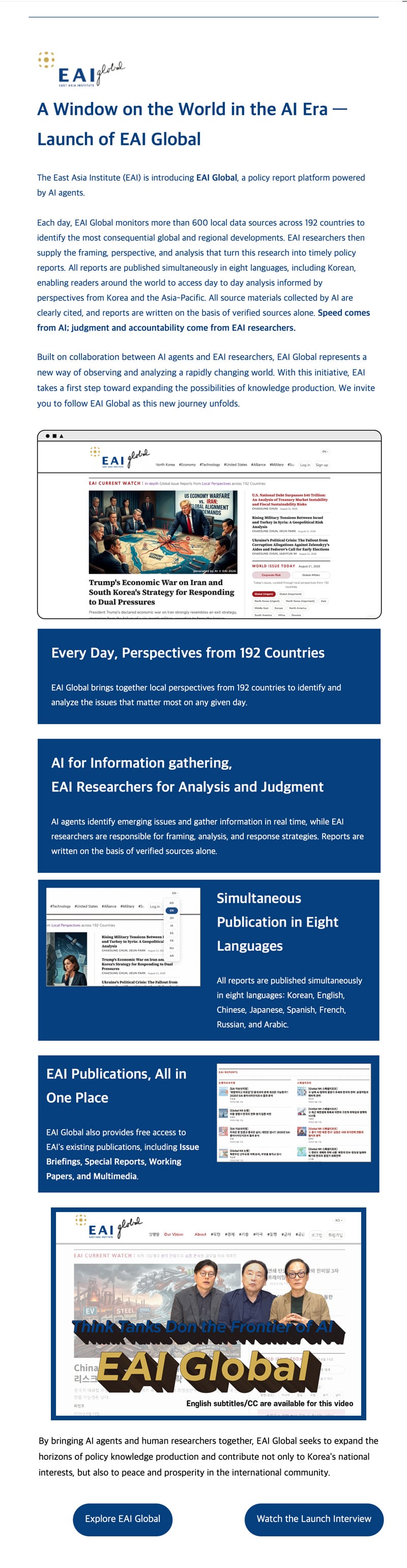
The North Korean nuclear problem and the future of the Korean Peninsula has become one of the most significant issues deciding the security and stability of the Korean people and the East Asian region. Differences of strategies and debates have contributed to the dynamic search for a solution to the North Korean nuclear problem and the right course for North Korea’s future. Both incentives and disincentives will help the North Korean leadership choose the right path for the North Korean people and the whole Peninsula.


The proper combination of essential alternatives such as sanctions, deterrence, engagement and assisting North Korea in undergoing internal transformation will be important. International society shares the wish for North Korea to become a normal state with a proper global status. This website aims to provide articles and video on North Korea produced by governments, policy institutes, media, and think tanks to track the evolution of these strategies and their impact.


Visit website: www.globalnk.org

ETC
[Column] How Should the World Respond When Countries Such as North Korea Develop Nuclear Weapons and Ballistic Missiles?

North Korean nuclear weapons serve multiple purposes. First, North Korea repeatedly states that its nuclear weapons are to deter a U.S. nuclear attack, arguing that the United States excluded North Korea from the object of nuclear no-first-use policy.   Second, Kim Jong-un wants to perpetuate a totalitarian regime and consolidate his power by personalizing control over North Korea. Given the country’s struggling economy, nuclear weapons provide Kim with political legitimation of his economically ineffective rule by showing his militant resolve to fight the prime enemy, the United States. By continuing to enhance the North’s nuclear capability, Kim sends the message to his people that increased external security threats justify the military expenditure and the poor attempt to revive the economy.   Third, when political use of nuclear weapons for power consolidation is no longer required, Kim can begin to deal with outside powers to elicit economic assistance. This is an old pattern: North Korea nuclearizes, then receives generous economic assistance for denuclearization and requires more rewards in peace negotiation vis-à-vis South Korea (Republic of Korea, or ROK) and the United States.   Fourth and final, Kim could use nuclear weapons purely for offensive purposes. North Korea could start an all-out war using nuclear weapons with the confidence of being able to control the crisis and win it if it is confident of U.S. reluctance to retaliate with nuclear weapons. It is also probable that Kim relies on the slim chance of continuing his dictatorship even after a disastrous nuclear confrontation and war.   North Korea obviously wants to progress toward a more developed nuclear arsenal and sophisticated missile force and ultimately toward intercontinental ballistic missiles (ICBMs). It is almost certain that Kim will try to muddle through to the point of attacking the U.S. homeland with nuclear missiles, perhaps even acquire second strike capability. At that point, Washington would be forced to negotiate, and Kim would come to the negotiation table asking for comprehensive economic rewards, a peace treaty with the United States to include nuclear arms reduction talks, and recognition of North Korea as a nuclear power. The situation would raise significant decoupling concerns for South Korea and Japan, which could lead to an increased possibility of their obtaining nuclear arms.   President Donald J. Trump considers “every option on the table,” and pressuring China on more cooperation is the first. China, anticipating the party congress later in 2017, needs a favorable international environment and successful crisis management, which requires mutually beneficial relations with the United States. Washington pressuring Beijing on its trade and currency policy, a worsening North Korean nuclear problem, a strengthening U.S.-ROK alliance, and U.S.-ROK-Japan trilateral security relations will hurt President Xi Jinping’s political situation. Using military options to solve the North Korean nuclear problem will drive China into a far more difficult position. After the U.S.-China summit meeting in April, Xi seems to have put more pressure on North Korea, persuading Kim to come to the negotiation table for gradual denuclearization and to conclude a peace treaty with the United States, which meets the Chinese expectation of the so-called parallel negotiation.   However, it is hard to predict whether North Korea will come back to discuss denuclearization. That will be decided by how painful international sanctions on North Korea will be and whether Kim will think that diplomacy would be beneficial to the preservation of his personal power and regime. China could suggest a complete or partial cut of oil supply, implicitly recognize U.S. surgical strike, disregard its alliance obligation to North Korea in case of military clashes, and support more severe economic sanctions. Kim will not change his strategic calculus if he can maintain his totalitarian rule under severe Chinese sanctions to the point where he succeeds in developing ICBMs.   Despite China’s efforts to conform to Trump’s requests, it will be extremely careful not to let North Korea collapse and be absorbed by South Korea, which has strong alliance ties with the United States. Being uncertain of ROK and U.S. intent toward a denuclearized—and consequently weaker—North Korea, China will try to prevent North Korea from collapsing due to severe economic sanctions.   More strategic dialogues and consensus on the post-sanction, even post-denuclearization, stage among China, South Korea, and the United States will therefore be critical. Details regarding the initial point for reopening the negotiation for denuclearization and the conditions for a peace treaty could differ among them, which could turn the situation back to the pre-sanction period.   When, or if, North Korea comes back to the negotiation table, negotiations will be long and painful. The South Korean government has been skeptical of the parallel tracks. North Korea will take full advantage of both negotiations and establish a link between two games. The North will propose unacceptable conditions for peace, such as the elimination of anti-North Korean campaign by the United States, the withdrawal of the U.S. Forces Korea, mutual reduction of arms and personnel, and the termination of joint U.S.-ROK military drills. North Korean allegations that conditions are not met for peace could stall the denuclearization process. Because the peace process affects the posture of the alliance, the parallel tracks will not be an easy process.   North Korea under Kim Jong-il reversed the course of denuclearization negotiations several times after receiving economic assistance. Only an unacceptably high cost of reversing the course of negotiations will ultimately eliminate a repeat of such betrayal. It will therefore be necessary to maintain a particular level of economic sanctions, particularly in close coordination with China. If Kim Jong-un is fully aware that severe sanctions await if North Korea continues its nuclear ambitions—countered by incentives of development assistance if he reverses course—he will pursue a genuine course of negotiation.   On the other hand, both South Korea and the United States need to make clear that peace talks should not only demand North Korea’ denuclearization but also guarantee the regime’s survival if it denuclearizes, as well as include trust-building measures in security affairs and guidelines for arms control. Durable peace will be possible only if South Korea guarantees the survival of a denuclearized North Korea and pursues a plan to engage with it. The strategy of engagement comprises several elements. First, the country that wishes to engage should reassure the other country that it is neither threatening nor antagonistic. Second, it should initiate a policy of reconciliation and peaceful exchange to invite the other to cooperate. Third, the gradual building of trust will create structural bases that will foster changes in the system and behavior of the target country.   Last, a scenario in which North Korea succeeds in developing ICBMs, making the U.S. mainland vulnerable to nuclear missile attacks, is possible and the United States should be prepared for it. Combined efforts to deter the North Korean threat by denial and massive punishment, to minimize the possibility of decoupling the U.S.-ROK-Japan security alliance, and to show the military futility of North Korea’s nuclear missiles would weaken Kim Jong-un’s expectation for entirely beneficial negotiations after developing viable nuclear weapons. ■           Author   Chaesung Chun is chair of the International Relations Studies Center at the East Asia Institute. He is also professor of the department of political science and international relations at Seoul National University. He received his Ph.D. in international relations from Northwestern University.         EAI Column presents fresh, constructive opinions and policy suggestions on Korean society and politics as well as East Asian security and international relations issues from recognized experts. Please acknowledge the source of this article if used as a citation.   The EAI is a nonprofit and independent research organization in Korea. The contents of this article do not necessarily reflect the views of EAI.      

Chaesung Chun 2017-05-11Views : 13080
ETC
[EAI Column] Interpretation of the 7th Congress of the Worker’s Party of Korea

The 7th Congress of the Workers Party of Ko-rea (WPK) was the first Congress to be held in 36 years. The opening day set the scene with a commencement ceremony, followed by two days of discussions on the 70,000-word WPK Central Committee Report. The fourth and final day concluded the event by bestowing the title of Chairman of the WPK upon Kim Jong Un and lowering the curtains after the final closing ceremony.   However, it appears that the audience who watched the full four days of this rare theatrical production were left bewildered, with muddled impressions that added up to a scene not unlike the parable of the blind men and the elephant. This article seeks to read between the lines of the script rather than analyzing what happened at face value in order to clear up this lingering confusion.   On the 5th of May, Kim Jong Un spoke at the opening ceremony, stating, “The Seventh Congress of the WPK will sum up the brilliant successes and invaluable experience our Party and people have gained during the period under review and put forward the strategic line and tasks to keep ushering in a great golden age of socialist construction and advance of our revolution.” He continued, “This Congress of the WPK will be a historic occasion for setting up another milestone in the struggle for the development of the glorious Kimilsungist-Kimjongilist Party and achiev-ing the cause of socialism.”   On the third day, Chairman Kim Jong Un wrapped up the WPK Central Committee Report with the words, “Let the whole Party, the entire army and all the people go all out for the implementation of the tasks advanced at the Seventh Congress of the Workers Party of Korea to hasten the final victory of the Juche revolution! This is the slogan to be held up by our Party, the army, and the people in their struggle.” He emphasized, “It is necessary to intensify the work of establishing the monolithic leadership system of the party on a high stage. It is necessary to continue to carry out the Party’s strategic line of simultaneously pushing forward with economic construction and the building of nuclear weapons.” He also spoke regarding the Byungjin policy, a policy that directs the government to simultaneously push for the development of nuclear weapons and the economy.“ This strategic line is the most revolutionary and scientific one reflect-ing the lawful requirements of building a thriving socialist nation and the specific con-ditions of our country.”   During the final day’s closing ceremony, Kim Jong Un summarized the 7th Congress of the WPK as having “unfolded a magnificent blueprint for realizing our people’s dreams and ideals by building a powerful socialist country on a full scale under the banner of modeling the whole society on Kimilsungism-Kimjongilism. It has also advanced important tasks to be tackled in achieving independent unification of the country and accelerating global independence.”   Looking at Kim Jong Un’s lines, it appears that the three key parts of the 7th Congress of the WPK were as follows: a “monolithic lead-ership system” as the protagonist, the “brilliant blueprint” for building a strong socialist state as the script, and the Byungjin policy as the acting guidelines.   The significance of the consolidation of Kim Jong Un’s monolithic leadership was best indicated in a speech given by First Vice Min-ister of the Organization Department of the WPK, Jo Yon Jun, during the 40-person panel session that followed Kim Jong Un’s reunifica-tion address. Vice Minister Jo recalled the Party activities aimed towards the achievement of monolithic leadership over the past four years and enumerated Kim Jong Un’s string of achievements during a crucial period in the Juche Revolution. He highlighted Kim Jong Un’s “exposure and crushing of a modern-day gang within the Party” as the turning point that brought about a fundamental shift in the struggle to unite the Party and establish monolithic Party leadership. He stressed that they had learned the hard lesson that a failure to establish monolithic leadership now could lead to the instillation of “tainted ideas” within the Party, having an irreversible effect on the Party and the revolution.   Kim Jong Un specifically emphasized the continuation of the monolithic leadership during his review of the past 36 years of Juche ideology and Songun politics during the opening of the WPK Central Committee Re-port. “The secret to the victories accomplished by the people and the Party as they carry out the Juche revolution lies within their high reverence of our Great Comrades Kim Il Sung and Kim Jong Il and the continuation of the revolutionary feats carried out by our leaders who struggled valiantly and brilliantly.”   On the second day of the Congress, Kim Jong Un, who is the third generation of Kim to appear on stage as leader after his grandfather, Kim Il Sung, and his father, Kim Jong Il, presented the WPK Central Committee Report, laying out in full-scale the “brilliant blueprint” that was hinted at during his New Year’s Address. However, the feature presentation showed us nothing we hadn’t already seen in the preview. As expected, Kim Jong Un first praised Kim Jong Il’s Songun policy and Kim Il-Song’s Juche ideology based on the “three revolutionary capabilities,” which have formed the historical landscape of North Korea’s lead-ership. He then outlined his blueprint for the future of the nation, the four stages of which can be divided as follows; building a strong socialist state, independent unification, global independence, and strengthening the devel-opment of the Party.   The Four Stages of Kim Jong Un’s Blueprint   In an effort to complete the first stage, build-ing a strong socialist power, North Korea is working hard on expanding on the plans out-lined in the New Year’s Address. The leader-ship’s top priority is to make North Korea a power in the fields of science and technology and adopt the cutting-edge technology of the 21st century. They will also push to become a civilized power, with a strong focus on culture, the arts, education, physical education, and health; a political military power, with a so-cialist system of governance and a strong mili-tary; and an economic power, by adopting a new 5-Year Economic Development Plan from 2016 to 2020.   The second stage of the plan is to build a unified world power. Rather than pushing for a new unification plan for the 21st century, the focus will be on pursuing the “Three Princi-ples of National Unification”, which were first outlined in the joint statement issued by North and South Korea on July 4th, 1972. These principles implement North Korean feder-alism, great national solidarity, a peace guar-antee, and sovereignty. However, for the sake of independence, Pyongyang criticized South Korea, calling upon the South to rid them-selves of their subservience to the US and cast off the humiliating “Follow America Policy,” as well as to stop "ganging up with the US to engage in hostile acts against North Korea," which is harmful for both Koreas. North Korea also claims that in order to guarantee peace, the US should recognize the change in North Korea’s strategic status as a nuclear power, the US should abandon its anachronistic “Hostile Chosun Policy,” the current armistice should be converted to a peace treaty, and South Korea should withdraw troops and military equipment and put an end to war exercises and thoughtless military policy provocations. For the sake of great national solidarity, North Korea must no longer cling to the hollow unification system of the past that does not align with North Korean ideals, but should instead work towards joint unification founded on federalism, which actually has the capacity to succeed.   The third stage of the blueprint is to be-come an international world power. In order to achieve this aim, North Korea will continue to follow the Byungjin line to counter the nu-clear threat posed by imperialist nations and strengthen nuclear self-defense capabilities. In addition, North Korea will use nuclear weap-ons as a deterrent and will endeavor not to launch the first strike while pursuing global denuclearization as long as it does not infringe on the autonomy of North Korea. Furthermore, the country will strive to develop friendly, cooperative ties with developed countries with whom relations were previously hostile, respect the autonomy of nations, and normalize and better relations with friendly countries.   The fourth and final stage emphasizes the importance of the establishment of Kim Jong Un’s monolithic leadership by detailing how this would “raise high the revolutionary ban-ner of Kimilsungism-Kimjongilism.” Mono-lithic leadership would “unify (the banner) again and again as the pillar of the Central Committee of the WPK, strongly move for-ward for the sake of socialist construction, strengthening the advancement of the Party, implementing global independence, and our nation’s independent unification.”   A Better Strategy?   In order to actualize his “brilliant blueprint” despite the current harsh reality, Kim Jong Un has promised to fight for and adopt the Byungjin line to make North Korea an eco-nomic and nuclear powerhouse. Kim Jong Un made it clear that, “the Byungjin line is not merely a temporary countermeasure, but rather a permanent measure that will reward us with the most revolutionary profit. This strategic path will solidify the impregnable defense capabilities of our nation by focusing on nuclear weaponry. It is also the most revolu-tionary and just path for the rapid construction of a strong socialist state by even further revitalizing the building of our economy.” Also, while informing the audience of the revisions to the “Rules of the WPK” on the last day of the Congress, Kim Jong Un emphasized the strategic and revolutionary need for mono-lithic leadership and the construction of a strong socialist state that has superior science and technology, a strong economy, which is civilized, and has a political military as matters of grave national concern.   Kim Jong Un seized the opportunity pre-sented by the 7th Congress of the WPK to pro-claim to North Korea and the rest of the world that his monolithic leadership had been real-ized. Despite this, the prospects for successfully using his “brilliant blueprint” to make his vision for North Korea a reality during the 21st century via the strategic selection of the Byungjin line are looking rather bleak. The June 2010 East Asia Institute publication The Future of North Korea 2032: The Co-evolutionary Strategy for Advancement pro-vides further insight. This publication, co-edited with Jo Dong-Ho, provides a blueprint for the 21st century that would be capable of brightening North Korea’s otherwise bleak future. From 2008 to 2011, North Korea would need to pull away from the Songun policy. Then would come the first phase, during which North Korea would reform via a co-evolutionary strategy for advancement from 2012 to 2021, followed by a second phase in-volving a complicated matrix of co-evolutionary strategy for advancement from 2022 to 2032. We also recommended that the North Korean authorities refer to our blueprint to properly design a strategy for their survival in the 21st century.   However, if Kim-Jong Un’s vision for a brilliant and splendid 21st century North Ko-rea is to be implemented, then an immediate effort must be made to change his blueprint and his Byungjin line to adhere to the reality of the 21st century, both on a national and in-ternational level. First and foremost, rather than focusing on the excessive national securi-ty plan of the economic and nuclear path that is ill-matched with the current era, North Ko-rea needs to shift towards a more appropriate national security plan that does not hinge on the pursuit of nuclear weapons.   The above-mentioned path rests squarely in the global politics of 19th century imperial-ism. However, the US is not trying to push for more 19th century style imperialism. If one were to say that the 19th century was a time that dreamed of freedom, then the 21st century is moving toward a time of joint unity. Yet, rather than creating an unrealistic and imaginary enemy deserving of America’s “hostile policy toward North Korea,” and pushing for the implementation of the Byungjin line which has thus far accomplished nothing but excessive economic sanctions, North Korea should follow a 21st century path that promotes security and prosperity via conventional weaponry. The longer North Korea takes to make this shift, the more deeply issues sur-rounding the ‘monolithic leadership’ will in-tensify.   North Korea needs to turn over a new leaf while keeping in mind the domestic and international realities of the 21st century, which are rapidly shifting away from the dreams of a unified power under the “Three Principles of Unification” that acted as the base for the revolution for the past half century. North Korea must do away with the legacy of the 20th century, which included a federalist reunification plan that would be accomplished through strengthening North Korea’s revolu-tionary capabilities, and the “Institutional Unification Theory”, which is built on the premise of the collapse of North and South Korea. Instead, North Korea must design and then implement a full-scale unification plan built around a cooperative network and suita-ble for the 21st century.   As the EAI publication, Future of North Korea 2032: The Co-evolutionary Strategy for Advancement, suggests, North Korea must again restructure its four-faceted focus on superior science and technology, a strong economy, becoming civilized, and having a political military. This strategy is a complicat-ed mix of creating a 21st-century union of states and a wealthy and powerful country reminiscent of the 19th century, to bring it in line with the three steps of the co-evolutionary strategy for advancement.   If North Korea makes this effort, we may see an 8th Party Congress in the near future. In the case of such an event, we would expect a new blueprint to be laid out showing the bril-liant future that North Korea could yet have in the 21st century. In order for this to become a reality, however, North Korea should engage in a collaborative and co-evolutionary effort with South Korea and other neighboring countries. ■          Authors Young-Sun Ha is the Chairman of the Board of Trustees of the East Asia Institute, and also a professor emeritus at Seoul National University. He currently serves as a member of President Park Geun-hye’s civilian National Security Advisory Panel. Dr. Ha received his Ph.D. in political science from the University of Washington.         Please acknowledge the source of this article if used as a citation. The EAI is a nonprofit and independent research organization in Korea. The contents of this article do not necessarily reflect the views of EAI.  

Young-Sun Ha 2016-10-09Views : 13773
ETC
[Summary] New Solutions for the DPRK Nuclear Crisis

    Abstract   The following is a summary of a report (which can be found here) published on February 26, 2016 by EAI in Korean entitled “New Solutions for the DPRK Nuclear Crisis.” The report was a product of a roundtable discussion on “North Korea Policy after the Fourth Nuclear Test” hosted by Dr. Young-Sun Ha (EAI) and Dr. Chaesung Chun (EAI & Seoul National University). The following experts attended the roundtable and contributed to this report: Dr. Byung-Yeon Kim (Seoul National University), Mr. Sung-lac Wi (Seoul National University), and Dr. Hee Ok Lee (Sungkyunkwan University).     Introduction  On January 6, 2016, the Democratic People’s Republic of Korea (DPRK) carried out its fourth nuclear test. The DPRK has continued to develop its nuclear and missile technology in the face of sanctions and criticism from the international community. Furthermore, the possibility of the DPRK developing a hydrogen bomb and intercontinental ballistic missiles (ICBMs) has taken the nuclear crisis on the Korean Peninsula to a whole new level.   In light of DPRK's increasingly threatening behavior, an investigation into why past sanction regimes have been ineffective is necessary to devise new policies. In that process, however, one must also keep in mind that the situation is much more complex now – any simple approach toward sanctions or engagement will not suffice if we are to prevent another turn in the vicious cycle of DPRK's nuclear and missile provocations.   This task is not an easy one, but we believe such new policies should at least be comprised of the following: making sanctions stronger and more efficient, a new security approach toward the DPRK without considering the nuclear option, developing a new diplomatic strategy for denuclearizing the DPRK along with a long-term engagement plan for peace on the Korean Peninsula, and devising a catalyst which can lead to the DPRK’s self-denuclearization as well as normalization through economic development.     Making Sanctions Stronger and More Efficient   Cooperation among the countries surrounding the Korean Peninsula is a requisite condition for the sanctions against the DPRK to be efficient. To do so, China’s role has been and will continue to be important.   Here, the Republic of Korea (ROK) must do all it can to keep issues related to the Korean Peninsula, including the denuclearization of the DPRK, from becoming linked to the strategic competition between China and the U.S. A key here is to clearly show China that ROK-U.S.-Japan security cooperation is not a threat. The ROK also needs to make it clear that it seeks peaceful coexistence with a non-nuclear DPRK and that it wants to pursue gradual and peaceful unification.   Accordingly, preventing a spark from igniting in U.S.-China relations over the Korean Peninsula is critical. In order to do this, it is necessary to continue improving relations and building trust with China. A China that shares aligned interests with the ROK pertaining to the denuclearization of the DPRK and actively participates in the sanctions against the DPRK is going to be the key to effectively implementing the new UN Security Council resolution.   Constructing a New Security Approach toward the DPRK   The ROK government should calmly respond to the DPRK’s development of nuclear weapons by considering longer term alternatives. Independently developing nuclear weapons is ineffective and unrealistic, and redeploying American tactical nuclear weapons to the Korean Peninsula is not feasible.   Rather, the ROK must quickly build up its deterrence and defense systems, and work to strengthen its missile defense systems and extended deterrence in cooperation with the U.S. Without running the risk of causing further instability in the region, the ROK government should ramp up its non-nuclear efforts to discourage the DPRK from developing nuclear weapons, eventually leading the Kim Jong Un regime to seek a new alternative.   At the same time, the ROK must actively strengthen its cooperation with the U.S. regarding extended deterrence. In order to respond quickly and effectively to the DPRK’s rapidly increasing nuclear threat, defense spending must guarantee such efforts are completed faster than previously scheduled.     Developing a New Diplomatic Strategy toward the DPRK  The DPRK has continued to repeat its demand for concluding a peace treaty with the U.S. since the early years of the nuclear crisis, and as the cycle of the nuclear crisis continues to roll on, there have been calls for such a peace treaty. On February 17th, Chinese Foreign Minister Wang Yi suggested pursuing a parallel track approach of simultaneously realizing denuclearization on the Korean Peninsula and negotiating a peace treaty. In order to deal with the instability on the Korean Peninsula that has been caused by the nuclear crisis, a shift to a new diplomatic strategy is needed.   The ROK government’s new policy design should not only include a demand for sincere DPRK denuclearization, but also a guarantee for the survival of the DPRK regime if it denuclearizes, trust building measures in security affairs, and finally guidelines for arms control. This kind of policy can clearly expresses to the DPRK that there is no desire to see it collapse but rather the ROK seeks to coexist with a non-nuclear DPRK. In doing so, the ROK will need to gain China's trust on its policy toward the DPRK, and subsequently utilize the strategic cooperation between the U.S. and China during the process of negotiating a system of peace on the Korean Peninsula. That being said, effort must be made to prepare a framework for negotiating these issues as quickly as possible.     A Catalyst for Self-Denuclearization and Change  The ROK government must prepare a way for the DPRK to seek on its own a path for denuclearization. The DPRK’s byeongjin policy of simultaneous economic and nuclear development is neither realistic nor desirable. Simply put, economic and nuclear weapons development are not complementary but rather contradictory.   In order to help the DPRK to realize this, the ROK and the international community must make a joint effort to encourage the DPRK to forgo the current byeongjin policy by showing how it is incurring significant security costs, and push the DPRK toward a new alternative that can be characterized by a new byeongjin policy of pursuing non-nuclear security and economic development.   Secondly, there needs to be active support for reform and opening up of a DPRK that makes strides in denuclearization. At first this will include humanitarian assistance and low levels of economic cooperation, but ultimately there will need to be a focus on the growth of the DPRK’s markets and the soft landing of its economic transition.     Policy Recommendations  1. Following the strengthening of sanctions which are a result of the DPRK’s nuclear and missile tests, the ROK government should clearly signal its intentions associated with its policies and make a strong effort to prepare a complete roadmap considering negotiations and engagement.A new complex solution comprised of making sanctions stronger and more efficient, constructing a new non-nuclear security approach toward the DPRK, developing a new diplomatic strategy for denuclearizing the DPRK, and devising a catalyst which can lead to the DPRK’s self-denuclearization should be prepared.   2. The ROK government should encourage China to participate in the implementation of the sanctions against the DPRK. Also, the ROK needs to understand China’s national interests and accept the need for strategic cooperation with China on issues related to the DPRK in the long run. The foreign policy goals of the ROK and China’s core national interests are not necessarily at odds with each other, and during strategic ROK-China dialogues it should be confirmed that they can actually harmoniously co-evolve together.   3. The ROK government should understand that developing its own nuclear weapons is costly and unrealistic. Conventional deterrence systems, without considering the nuclear option, should be pursued stronger. Given the increasing nuclear and missile threat of the DPRK, the ROK should conduct a complete review of its security systems.   4. Once sanctions against the DPRK take effect, the ROK should make it clear that the DPRK’s current approach towards a peace treaty with the U.S. is not realistic. At the same time, it would be important for the ROK to propose a new and convincing plan to all of the countries involved. This new ROK plan for peace should not only include a demand for sincere DPRK denuclearization, but also a guarantee for the DPRK regime’s survival if it denuclearizes, trust building measures in security affairs, and guidelines for arms control.   5. For the survival and prosperity of the DPRK in the twenty-first century, rather than the current byeongjin policy which incurs excessive security costs, the ROK and the international community should make a joint effort to propose a new byeongjin policy of pursuing non-nuclear security and economic development. The ROK needs to actively support reform and opening up of a DPRK that makes strides in denuclearization, and also prepare an appropriate sanctions regime which can ensure that the DPRK’s economic development does not translate into more nuclear weapons and missiles. The ROK should also control the direction and pace of improving relations. During this process, the ROK government should put forward a mid and long-term roadmap for co-evolution which will not only lead to the DPRK adopting the new byeongjin policy of non-nuclear security and economic development, but also seeks fundamental internal changes in the DPRK so that it becomes a more effective unification partner. ■           About the Authors    Young-Sun Ha is the Chairman of the board of trustees at EAI. He is also Professor Emeritus of the Department of Political Science and International Relations at Seoul National University. Currently, Dr. Ha is serving as chair of the Diplomacy & Security sub-committee at the Presidential Committee for Unification Preparation.     Chaesung Chun is the Chairman of the Center for International Relations Studies at EAI. He is also a professor in the Department of Political Science and International Relations at Seoul National University. Dr. Chun is currently serving as an expert member for the Diplomacy & Security sub-committee at the Presidential Committee for Unification Preparation.     Byung-Yeon Kim is a professor in the Department of Economics at Seoul National University. He is also the Deputy Director of the Institute for Peace and Unification Studies, a university research institute. Dr. Kim is currently serving as an expert member for the Economics sub-committee at the Presidential Committee for Unification Preparation.     Sung-lac Wi is a visiting professor in the Department of Political Science and International Relations at Seoul National University. Previously, Ambassador Wi served as a long time career diplomat in the Republic of Korea Ministry of Foreign Affairs. During his service, Ambassador Wi was Republic of Korea's chief negotiator at the Six-Party Talks, Special Representative for Korean Peninsula Peace and Security, and Ambassador to Russia.     Hee Ok Lee is a professor in the Department of Political Science at Sungkyunkwan University. Dr. Lee is also the Director of Sungkyun Institute of China Studies and visiting professor at China's Capital Normal University, Jilin University, and Fudan University, among others.    

2016-03-30Views : 13702
ETC
[Keynote Address] Division Management and Unification: Korea vs. Germany

Multimedia  [Sung-Joo Han, Former Foreign Affairs Minister of Korea] “Peaceful Unification Only with the Active Support of the U.S.”         1. Preface   After 25 years, the German unification still evokes admira-tion and envy among the Ko-reans. Before Germany was unified, the rela-tionships between East and West Germany and those between North and South Korea had shared both similarities and differences. Both countries were divided by the occupation of separate Allied powers in the wake of World War II. Both countries turned into fields of East–West confrontation while being incorporated into the postwar alliance systems. Nevertheless, neither country abandoned their hope for unification for several decades after the division. In neither case did the surrounding powers seem eager to have them unified. Germany’s neighboring countries feared that it might be reborn as a strong unified nation, whereas the countries around the Koran Peninsula were concerned about the possibly unst-able aftermath of unification, and the possibility for a uni-fied Korea to fall into some other nation’s sphere of influ-ence.   At the same time, there have been several differences between the German and Korean divisions. Five such differences stand out. For one thing with the national division, while the Koreans were inflicted with what might be called “victim’s complex,” the Germans on the other part had what might be called a “guilt complex.” Koreans had the sense that they had done nothing wrong to deserve the tragedy of division but were simply the victim of power politics and backdoor understanding between the powers, especially the United States and the Soviet Union. In contrast, the Germans recog-nized and accepted the fact that their national division was the result of what pre-World War II Germany had done; the invasion of neigh-boring countries, the persecution of some ethnic groups, particularly the Jews, and the preci-pitation of World War II.   Secondly, during the period of national di-vision, while the DDR, East Germany, was un-der effective control and protection by the Soviet Union, it posed no serious military threat on West Germany itself. In contrast, North Korea was a constant security threat to South Korea, with which an all-out military invasion of the South had resulted in the Korean War, a smaller scale of military provocations, including commando attacks, military build-up, de-velopment of nuclear weapons and missiles of various kinds, and subversive activities.   Third, while the devoted and activist movements for unification came mainly from younger generations and from the politically leftist sectors in Korea, the relatively subdued and passive calls and desire for reunification tended to derive from the older generations and more from the conservative spectrum.   Fourth, whereas West Germany was an important member and active participant of multilateral regional and security organizations such as the European Community and NATO, South Korea’s main security link to the outside world was a bilateral alliance with the United States and it enjoyed no membership in regional organizations or communities. So when unification came to Germany, the East Germans were prepared to join not only their Western brethren, but also the European Community and NATO, thereby diluting the sense that East Germany was being taken over by West Germany.   Finally, after 45 years of the German division and 70 years of Korean division since 1945, there is a big dif-ference in the nature of the relationship between East Germany and North Korea on the one hand, and the Soviet Union and China on the other hand, their respective benefactors and guardians. In 1990, the Soviet Union was a declining and disintegrating empire in need of economic help from the outside after overspending in arms build-up and competition with the West. The Soviet Union was also in the process of internal transition from autocracy and dictatorship to perestroika and glasnost. In 2015, China is a rising economic power still under an effective one party rule, challenging the domination of the United States and territorial status quo in East Asia, even though it has a strong interdependent relationship with the West, and has its own share of risks from rapid economic growth and self-aggrandizement. Nonetheless, East Germany was still under firm control of the Soviet Union and North Korea has been struggling for self-reliance and determination.     2. Status of North-South Korean relations   Roughly speaking, since the end of the Korean War in 1953, inter-Korea relations have gone through seven different phases with various degrees of hostilities and engagements. The post-Armistice period of 1953-1960 can be characterized as one of internal recuperation from the war in both Koreas and estrangement between the two sides. It was a period of a military impasse with each armed forces aligned with the major supporting powers, namely the United States on the part of South Korea and the Soviet Union and China on the part of North Korea. It was also a period of diplomatic competition whereby in a starkly bipolarized world, both Koreas established and nurtured diplomatic ties with the countries belonging to one of the two main blocs (Western and Soviet bloc) at the exclusion of the other. The so-called nonaligned bloc provided a field of completion for both recognition and votes at the United Nations on resolutions favoring one or the other of the two Koreas.   The second phase (1960-72) is one in which South Korea witnessed the emergence of a military gov-ernment, and North Korea became increasingly belligerent toward South Korea with occasional military (although on a small-scale) provocations both to South Korea and its ally, the United States. A selected list of such provocations would include the 1968 raid attempt of the Presidential mansion by a North Korean armed commando group, the 1968 capture of the USS Pueblo, and the 1969 downing of an EC-121 reconnaissance plane. These provocative acts were committed at a time where the attention and energy of both South Korea and the United States were diverted to the war in Vietnam. The third phase (1972-1984) could be characte-rized as a co-existence phase, where a series of dialogues got started as the two governments tried to use inter-Korea dialogue for the consolidation of power in their respective home fronts. The first dialogue of the series occurred as the Red Cross societies of the North and the South met from 1972 through 1973 and discussed possibilities for reunion of families separated by the war. The inter-Korea “Joint Declaration of July 4th, 1972” pledged first to resolve Korean issues by Koreans without the outside intervention of other powers, second to resolve disputes by peaceful means without resorting to military means, and third, work toward a grand unity of all the Korean people. Afterward, both sides set up the North-South Coordinating Committee to discuss reconciliation and unification. However, the dialogue was suspended in 1973 as the North refused to deal with the South.   The dialogue sputtered during the fourth phase (1984-1992), in large part because of the North Korean attempted assassination of the visiting South Korean pres-ident when the North Korean regime planted and exploded a bomb at the Aungsan Mausoleum in Rangoon, Burma in 1983. The North-South dialogue in the mid eighties began as Seoul accepted Pyongyang’s proposal to provide relief goods for flood sufferings in the South. As a result of Red Cross talks, art performance troupes and some fifty families met with relatives living in the other part of the peninsula. The dialogue in the mid-eighties was the one that could not surpass a certain level because of limitations pertaining to North Korea and distrust between the North and the South. The dialogue started mainly out of extra-dialogue motivations of the North, such as recovering international image that had been tarnished by the Rangoon bombing, enhancing the image of Kim Jong Il as successor to Kim Il Sung. Furthermore, faced with the collapse of the Soviet bloc and the unification of Germany, North Korea felt obliged to reckon with South Korea which was broadening its diplomatic horizon starting with the hosting of the 1988 summer Olympics, and thus engage with South Korea in a serious bilateral dialogue. It resulted in such landmark agreements as Basic Agreement on Reconciliation, Non-Aggression, Exchanges and Cooperation (1991), and Joint Declaration on Denuclearization of the Korean Peninsula Agreement (1992).   But the apparent lunge toward reconciliation was su-perseded by another, at the fifth phase of estrangement (1993-1998) as the North Korean nuclear weapons pro-gram became a focal issue of contention. Additionally, the passing of the “great leader” Kim Il-Song ion 1994 made it impossible for North Korea engage the South in any posi-tive and active way. In the absence of the deceased father, his son and the designated successor, Kim Jong-Il needed time to consolidate his position at home and re-figure his policy and strategy toward the South.   The sixth phase (1999-2008), the phase of “Sun-shine Policy,” was ushered in when Kim Dae-Jung, a long-time advocate of engaging the North became president in 1999. After the end of his five-years’ term, another “Sunshiner” President Roh Mu-Hyun succeeded Kim for the following five-year term until 2008. The ostensible purpose of Kim Dae-Jung’s Sunshine Policy toward the North was three-fold: One, to achieve peace by promoting cooperation, understanding and confidence. Two, to help North Korean people improve their economic conditions so that they can overcome hunger and dire poverty. Three, to induce North Korea to open itself to the outside world and enable the society to change so that ultimately both political and social conditions could improve. Improved relations between North and South Korea culminated in an inter-Korea summit meeting when President Kim Dae-Jung visited Pyongyang in June, 2000, and met his counterpart Kim Jong-Il. The result was large scale economic assistance to North Korea and an increased exchange of people, goods and services between North and South Korea.   Despite the ten-year period of “Sunshine” rela-tionship between North and South Korea, the North Korean military posture vis-à-vis South Korea did not become less aggressive or threatening. In fact, with the collapse of the 1994 Geneva Agreed Framework in 2002, North Korea openly stepped up its nuclear and missile programs with the effect of making the security situation in Korea more dangerous and threatening. In South Korea, criticism of the “Sunshine Policy” which presumably helped finance North Korea’s nuclear and missile programs mounted. Thus, when the conservative government of Lee Myong-Bak took office in 2009, the Sunshine policy was replaced by a more balanced policy which was less unconditional, one-sided and indulgent toward North Korea.   The seventh, and the current phase (2009- ) of North-South Korean relationship can be characterized by contin-uing advancement on several issues, such as: North Korean nuclear weapons program, a deteriorating eco-nomic condition of the North, the start of a third genera-tional dynastic succession process, discontinuation of dialogue and the consequent decrease in exchange, trade and eco-nomic assistance between North and South Korea, and the perpetration of provocative acts on the South by North Korea. The phase is also witnessing China seeming to take a more “protective” attitude toward North Korea lest it should collapse on its own weight of poverty and intransi-gence, and the strengthening of U.S. commitment to secu-rity relationship with its allies, South Korea and Japan.     3. Possibility for duplication?   Despite these differences between the divided Germany and Korea, however, South Koreans were hopeful after German unification that they could duplicate the German path to unification. Moreover, German unification provided North Korea with both incentives and perhaps means to prevent a similar process from taking place on Korean Peninsula.   In fact, at the time of German unification, North Korea had plenty to worry about: The Soviet empire was disinte-grating; Both China and the Soviet Union officially recog-nized the Republic of Korea and established diplomatic relations with it, while the United States and Japan did not reciprocate for North Korea; the United States and the Soviet Union agreed on a detente; China and the United States agreed on a rapprochement; and North Korea op-posed the application of the German formula to Korea.   In that sense, German unification brought about re-trogression rather than progress in the short term in the North–South Korean relationship, by stiffening the North Korean attitude. This is a very tragic irony for a divided country. That is to say, the stronger the aspiration of one side for unification is and the louder the clamor for unifi-cation is, the lesser becomes practical opportunities or possibilities to achieve it as the other side takes the aspira-tion for a desire to take over and therefore is threatening. While both North and South Korea clamor for unification, neither side would think of turning over power, or sharing it with the other side, in the name of unification. Under such circumstances, unification by either side would mean to absorb or subjugate, if not conquer, the other. Whereas North Korea’s reference to unification meant to South Koreans a North Korean takeover of the South, the South Korean reference to unification sounded to the North to signify absorption of North Korea by the South, thus evok-ing the fear and resistance from Pyongyang.   What evokes North Korea’s concern was not only German unification. As a result of transformations in so-cialist states since 1989 and the promotion of Nordpolitik by South Korea, most of them established diplomatic rela-tions with Seoul. Pyongyang of course showed negative responses to the establishment of diplomatic ties by its allies with Seoul and recalled most of its international students from Eastern Europe and the USSR. North Korea, one of the most closed, if not the most closed, regimes in the world could not but be influenced by the transformation of socialism. As a means to prevent a regime change, North Korea chose to develop WMDs including nuclear weapons and missiles and to further insulate itself from outside influence.   Only during the 10-year period from 1998–2008 of South Korea’s Sunshine Policy, North Korea chose to en-gage South Korea as the latter was eager to provide the former with extensive economic assistance. However, with the election of Lee Myungbak as President, and with the return to power of the Grand National Party in 2008, South Korea’s experiment with the Sunshine Policy had come to an end, and a policy of pragmatism and balance, which emphasized reciprocity, conditionality, and measured engagement with the North became an official policy of the South Korean government.   North Korea on its part was dissatisfied with the less ge-nerous and less indulgent South Korean government atti-tude following the more generous Sunshine Policy years. Since then, North Korea conducted three nuclear weapons tests and pursued what it named the byongjin policy, de-scribed as a parallel policy to become a nuclear weapons’ state while simultaneously reviving its economy.   In the meantime, the Park Geun-hye government that succeeded Lee Myung-bak’s government, pretty much continued the preceding government’s “measured en-gagement policy” but with greater emphasis on coopera-tion with North Korea and search for “unification,” which would supposedly bring a “bonanza” to Korea and its neighbors. The problem has been that the Park government had to overcome two hurdles to get positive results from its policy for promoting unification. One is the need to overcome North Korea’s suspicion that Park’s unification overtures are nothing less than a call for “unification by absorption,” that is, by the German formula. The other is that it had to find a formula by which North Korea would suspend and then abandon its nuclear weapons program and refrain from conventional provocations.     4. Persuading major powers   Another important task for the Korean govern-ment is to persuade the four major powers, i.e., China, the United States, Russia and Japan, that have strong interests in how the situation on the Korean Peninsula develops, that Ko-rean unification, when and if it comes, will actually be in accord with their respective interests rather than being against them. So, how will Korean unification affect their interests? One can think of both positive and negative perspectives of the major powers on Korean unification.   Let’s first talk about the interest of the United States. There are some positive reasons why the United States will think Korean unification to be in its own inter-est as well.   Positive Reasons: 1. War in or over Korea less likely 2. North Korean threat (WMDs, missiles, etc.) and provo-cations removed 3. Emergence of a unified Korea as a powerful ally 4. Korea’s increased dependence on the United States in the short term––need for economic and security support from the U.S. 5. Expansion of democracy, market economy   But there are some possible reasons why the U.S. could think Korean unification to be against its interest...(Continued)           This Keynote address was prepared for "Preparing for a Peaceful Unification of Korea" Conference which was hosted by the Presidential Committee for Unification Preparation and the Ministry of Unification, and organized by the East Asia Institute.

Han Sung-Joo 2015-12-06Views : 14333
ETC
[EAI Opinion Review] The Deterioration of Support for the Unification as a “Bonanza” Idea and a Way to Reignite Momentum

Multimedia  [Smart Q&A: Han Wool Jeong] Public Opinion on President Park’s Unification Policy           [The Public’s Appraisal of the Park Geun-hye Administration’s Unification Policy]   Support for Unification as a “Bonanza” Has Waned; Caution Regarding Unification is Rock Solid   Ways to Reignite Momentum: (1) Improve Inter-Korean Relations (2) People’s Livelihood (3) Go All-in on Suturing the Tear between the Ruling Party and the Administration         This report is the original version of a report provided to Media Today and published under the title “Opposition to Unification as a “Bonanza” Idea Leaps from 45% to 53% - The Public’s Appraisal of the Park Geun-hye Administrations North Korea Policy.” This report is published with the consent of Media Today.     Grading the Park Geun-hye Administration’s Unification Policy at Its Halfway Point   ■ Deterioration of Momentum for the Unification as a “Bonanza” Idea: Support of the “Bonanza” Idea Has Decreased; Apprehension towards Unification Remains ■ Those in Their 20s and 30s are also Skeptical   The Park Geun-hye administration has reached the halfway point and is now starting the second half of its term. It is time for the government to practically evaluate the conduct of state affairs during the first half of its term and begin earnestly planning policies for the second half. Hopefully the government is not overlooking the need for an examination and modification of the vision and strategies for matters of state because of the tensions between the ruling party and the administration caused by the conflict over the revision of the National Assembly Act. Considering the currently-strained state of inter-Korean relations and the significance of the 70th anniversary of the division of the Korean Peninsula, the need for the government to evaluate its policy towards North Korea and to examine its strategies for the second half of its term becomes more apparent. This article will look at the government’s unification policy through the eyes of the Korean public as well as diagnose the problems with the Park Geun-hye administration’s unification policy and provide possible solutions.   The Park Geun-hye administration’s unification policy has been coined as the “unification as a jackpot theory” and we can see that the public’s perception of this policy has soured over the last year (see Figure 1). Let us take a look at the results of the public opinion surveys carried out by Hankook Research at the request of EAI during May of 2015 and June of 2014. The concept of unification as a “Bonanza” was announced in January 2014 and Park Geun-hye issued her Dresden Doctrine in March 2014. Following these proclamations, a 55% of Korean’s supported the government’s unification as a “Bonanza” idea. That is to say that the Korean people responded positively to the unprecedented “Bonanza” argument that President Park Geun-hye proposed in January 2014.   However, at the present moment a year later, the percentage of those agreeing with the unification as a “Bonanza” idea has fallen to 47%. And the percentage of people who do not agree with the argument has risen from 45% to 53% over the same time period. Also, the percentage of Korean people with a positive attitude towards unification and agree with the statement “unification should take place as soon as possible” remained a small minority at 16% in 2014 and 15% in 2015. Instead, the majority of people - 63% in 2014 and 64% in 2015 - are more cautious towards unification and agree with the statement, “unification must take place, but we should not hurry” (see Figure 2). From this we can see that the government’s efforts to change the people’s attitude towards unification from passive to active is failing.   It is also no small issue that the younger generations are particularly passive about unification. It a phenomenon was identified in the early 2000s in which the younger the generation, the more skepticism grew towards unification (이내영 2010). Former governments devoted a lot of energy in order to proliferate the importance of unification to the younger generations. However, when we look at the survey conducted in 2015 by EAI, 29% of those in their 20s, 19% of those in their 30s, 15% of those in their 40s, 13% of those in their 50, and 15% of those in their 60s or older agreed with the statement “there is no need for unification.” This shows that the government was unsuccessful at slowing down the rise of skepticism towards unification observed in the younger generations, the generations which will shape the long-term development trends of public opinion (see Figure 3).   [Figure 1] Changing Attitudes towards                                [Figure 2] Change in Attitudes towards the Unification as a “Bonanza” Idea                                    Unification   Source: EAI and Hankook Research’s Security Perception Survey (May 2015; June 2014)   [Figure 3] Position on Unification Based on Generation (%)   Source: EAI and Hankook Research’s Security Perception Survey (May 2015; June 2014)     The Causes of the Deterioration in Momentum for Unification   (1) Weakening of Government’s Foundation of Support (2) Frigid Inter-Korean Relations (3) The People’s Perception of a Weakening Economy   According to each survey conducted during the administration’s second year in office, one of the reasons President Park Geun-hye’s approval rating was riding high was that many people supported her policy towards North Korea. So what caused the momentum for the unification as a “Bonanza” idea, which was once supported by a majority of Koreans, to weaken?   First and above all else, support for how the president is conducting matters of state has eroded. If we take a look at the results of the surveys Gallup Korea conducts every month to measure the approval rating from the same time period the EAI survey was conducted, we can see that the government approval rating dropped off significantly. In June 2014 nearly half of the Korean people (47%) gave President Park Geun-hye a positive rating, but in June 2015 only 39% approved of her work (see Figure 4). It is a well-known fact that as you move closer to the core group that supports President Park Geun-hye, including the ideologically conservative and the steadfast supporters of the Saenuri Party, the stronger the support for the unification as a “Bonanza” idea grows. If we take a look at the approval rate for the unification as a “Bonanza” idea based on ideological disposition, in both surveys the support from liberals is low while support from conservatives is high (see Figure 5). We can see that the decline in support for the unification as a “Bonanza” idea is therefore closely related to the decline in support for the President herself.   Second, it is easy to see that the Korean people feel the strain in inter-Korean relations. No matter how much the government clamors on about the unification as a “Bonanza” argument, if there is no improvement in inter-Korean relations then the people cannot help but feel wary towards unification. In the 2015 survey, when asked how inter-Korean relations had changed over the last year, a whopping 65% of the respondents answered that “inter-Korean relations had deteriorated.” 34% felt the status quo in relations with North Korea had been maintained and answered “the situation has not changed since last year,” and only 2% felt that “inter-Korean relations had improved.” If changes in inter-Korean relations cannot be felt, then support for the unification as a “Bonanza” idea will wane as time passes (see Figure 6).   Third, among the causes of the weakening support for the unification as a “Bonanza” idea, one that cannot go unnoticed is the people’s perception of a weakening economy. (see Figure 6). In the 2015 survey, 55% of respondents felt the economy had worsened over the last year. The logic of the economic voting concept need not be repeated and support for the President will rise when the people perceive that the economy is improving (EAI 오피니언리뷰 2015-02). In addition, compared to people who positively appraise the economic situation, those who are pessimistic towards the economy are not keen on unification as it will likely bring an economic burden. If we compare the approval rating of the unification as a “Bonanza” idea based on the people’s perceptions of the economy, those who felt the economy had improved supported the “Bonanza” argument at a rate of 59% and those who thought the economy had not changed were at 52%. This is in contrast to those who felt the economic situation had worsened and supported the unification as a “Bonanza” idea at a rate of 42% (see Figure 7).   There has been no substantive progress made on any of the issues described above including the deterioration of support for the government, the lack of improvement in inter-Korean relations, and the people’s perception of a worsening economy. Therefore we can assume that the worsening situation felt by people is causing the weakening of support for the government’s unification policy which is symbolized by the unification as a “Bonanza” idea.   [Figure 4] Changes in the Approval                                           [Figure 5] Approval of Unification as a  Rating of the Park Administration (%)                                       “Bonanza” Idea Based on Ideology (%)   Source: Gallup Korea’s Regular Survey                                   Source: EAI and Hankook Research’s Security (May 2015; June 2014)                                                             Perception Survey (May 2015; June 2014)   [Figure 6] Change in Evaluation of National                             [Figure 7] Approval of “Bonanza” Idea Economy and Inter-Korean Relations (%)                                Based on Perception of the Economy (%)   Source: EAI and Hankook Research’s                                        Source: EAI and Hankook Research’s Security  Security Perception Survey                                                         Perception Survey (May 2015; June 2014) (May 2015; June 2014)     How to Save the Momentum for the Unification as a “Bonanza” Idea   ■ All Out Effort on the Economy and Inter-Korean Relations is Needed to Revive Momentum   The fact that the Korean people’s support of the government’s North Korea policy is weakening means that momentum for the unification as a “Bonanza” idea is slowing. Revitalizing momentum to restore interest in and support for the unification as a “Bonanza” idea is the primary task of the Park Geun-hye administration with regards to their North Korea policy. How can the Park Geun-hye administration, which is now in the latter half of its term, reignite the interest for unification?   First, the government must solve the political crisis that has emerged due to the tensions between the ruling party and the administration, and must also strive to rebuild its foundation of political support. Nothing creates more anxiety and disappointment amongst the Korean people than friction within the ruling party. During the early part of the administration, the reason President Park Geun-hye’s approval rating remained high despite various unfavorable conditions is that, compared to previous administrations, the current government has been able to effectively manage tensions within the ruling group (EAI 오피니언리뷰 2014-02; 2014-03). Considering that governments usually lose steam as they move into the latter half of their term, the administration must work with, at the very least, the ruling party and even the opposition party if it is to truly manage state affairs well. If this cannot be accomplished then it will be impossible to revive support for the government. If the internal crack in the ruling group is neglected as it is now, it is unlikely that restoring the foundation of political support for the unification as a “Bonanza” idea will be possible.   Also, the realistic obstacles that are blocking the unification as a “Bonanza” idea need to be resolved. In inter-Korean relations, both the North and the South must work together if any significant progress is to be made. No matter how much the president emphasizes inter-Korean relations, if no tangible change can be induced, then producing results will be difficult. Furthermore, in order to strengthen the support for the government and the unification policy, there must be an all out effort made to improve the economic sentiment of the people. If the economy weakens and there is a significant amount of economic uncertainty, then the people cannot help but consistently demand a risk-aversive response to the unification issue. To summarize, the government must concentrate on improving inter-Korean relations and reviving the economy and produce results that the Korean people can feel. Only then can the unification as a “Bonanza” idea be reignited. The ruling party and administration should not waste time fighting amongst themselves. ■

Han Wool Jeong 2015-09-06Views : 13398
ETC
[EAI Column] Reading Kim Jong Un’s Fortune through the North Korean New Year’s Address

Young-Sun Ha is the Chairman of the Board of Trustees of the East Asia Institute, and also a professor emeritus at Seoul National University. He currently serves as a member of President Park Geun-hye’s civilian National Security Advisory Panel. Dr. Ha received his Ph.D in political science from the University of Washington.           At the beginning of each year, as an annual tradition, I read North Korea’s New Year address. This year was no exception. Since I wrote an article last year entitled, “Prospects for North Korea 2014: Hermeneutic Interpretation of the New Year’s Address” ([EAI Commentary No.32] 2014/01/27), I thought it better not to repeat the same commentary this year. However, many domestic and foreign analyses of Kim’s New Year speech missed the mark. Thus this paper will try to look through a crystal ball and predict in more detail what will happen in North Korea during the upcoming year.   First, there is no fundamental change between this year and last year in the address’s structure. It evaluates 2014 as, “a year of brilliant triumph in which the foundations for hastening the final victory on all fronts of building a thriving nation were consolidated firmly and the invincible might of the DPRK was demonstrated under the leadership of the Party.” And presents its 2015 rallying cry as, “Let the whole nation join efforts to open up a broad avenue to independent unification in this year of the 70th anniversary of national liberation!” To achieve this goal, the address utilizes the framework of “strengthening three revolutionary capabilities,” which has guided North Korea’s vision for over half a century, and emphasizes the three great revolutionary capabilities: domestic capability, unification capability, and international capability.   Kim Jong Un’s Fortune during the First Part of the Year: International Capability May Weaken   In order to read Kim Jong Un’s fortune in 2015, we should consider the tasks North Korea will seek to complete this year and the measures that will be used to accomplish those tasks given that North Korea’s view of the world remains unchanged. In his annual State of the Union address, U.S. President Barack Obama staunchly reiterated a point made in his commencement remarks at West Point Military Academy earlier in May when he said that, “the question is not whether the U.S. leads in the world, but how.” The President emphasized combining military and diplomatic power as a key tool to achieve this aim. More specifically, he gloated over the success of sanctions on Russia, called for restraint against implementing new sanctions against Iran as negotiations over its nuclear program progress, and stated that Congress should immediately work to lift the embargo placed on Cuba many decades ago. Even though Obama did not mention North Korea, the U.S. intends to exercise its diplomatic might through strict sanctions.   At the end of last year, North Korea carried out a cyber attack against Sony Pictures which produced The Interview, a comedy movie about an assassination plot against Kim Jung Un. President Obama deemed this attack a threat to U.S. national security and, as a result, issued an executive order placing a new round of financial sanctions on North Korea given his appraisal of the success of the 2005 sanctions. In addition to financial sanctions, the U.S. is cooperating with its allies, including South Korea, Japan, and Australia, to affect change in North Korea on issues such as cyber attacks and human rights, including taking action following the UN Commission of Inquiry’s (COI) report on North Korea released in February 2015. The U.S. has used bilateral and trilateral cooperation with South Korea and Japan to increase deterrence against the North Korean threat. At the same time, the U.S. has remained open to the possibility of six-party talks, demanding, as a precondition, that North Korea make at least a minimal effort of taking steps towards truthful and concrete denuclearization.   North Korea has criticized the Obama administration’s North Korea policy, making accusations such as “The United States and its vassal forces are resorting to the despicable ‘human rights’ racket as they were foiled in their attempt to destroy our self-defensive nuclear deterrent and stifle our Republic by force.” They consider the prospects of six-party talks based on preconditions as a political intrigue to force disarmament. Finally, North Korea argues that President Obama’s recent “North Korea internal breakdown scenario” reveals the United States’ true intention which is to avoid starting a dialogue. The Kim Jong Un regime is preparing respective countermeasures against various U.S. sanctions – financial, human rights, cyber, military – while stating that they are ready to suspend the fourth nuclear test and to have direct talks at any time if the U.S. stops the ROK-U.S. joint military exercise in March. Furthermore, the administration proclaims that, “as long as the enemy persists in its moves to stifle our socialist system, we will consistently adhere to the military-first (songun) policy and the line of promoting the two fronts simultaneously (byungjin) and firmly defend the sovereignty of the country and the dignity of the nation, no matter how the international situation and the structure of relations of our surrounding countries may change.”   Kim Jong Un’s fortune for the first half of the year depends on how well he deals with the U.S.’s North Korea strategy. The major roadblocks are that North Korea’s efforts to strengthen its international capability are being hindered by the U.S.’s complex sanction package, which is working better than before, and North Korea’s difficulties in finding support for the byungjin policy which states that North Korea will develop its economy while simultaneously developing nuclear weapons. Therefore, if North Korea fails to minimize damage from sanctions and to take an advantageous position in negotiations, Kim Jong Un’s attempt to “defend the socialist state” will face turbulent waters.   Kim Jong Un’s Fortune for the Middle Part of the Year: Difficulty in Improving Inter-Korean Relations   In middle of the year, in addition to the weakening of North Korea’s international capability, Kim Jung Un will have difficulty improving relations with South Korea and reinforcing his unification capability. Throughout his speech, Kim Jung Un preserves the basic structure of last year’s Three Charters for National Unification, Struggle for Security and Peacekeeping, and Improving Inter-Korean Relations, and explains it in more detail. First, Kim Jong Un states that eliminating the risk of war on the Korea peninsula, easing tensions and managing peaceful environment are essential to opening the “great path towards independent unification.” Next, he emphasizes regime protection according to the Three Charters for National Unification, the key elements of which include independence, peace, and great national solidarity. Lastly, he explicitly conveys that, “We think that it is possible to resume the suspended high-level contacts and hold high-level talks if the South Korean authorities are sincere in their desire to improve inter-Korean relations through dialogue. And there is no reason why we should not hold a summit meeting if the atmosphere and environment for it are created.” The New Year address also includes preconditions for improving inter-Korean relations including: halting military drills with the United States, banning the distribution of leaflets, and the removal of the sanctions regime placed on North Korea by the Lee Myung-bak administration in 2010, etc.   The North has not accepted the Park Geun-hye administration’s various ideas for improving inter-Korean relations. Instead, the North has only suggested conditions that promote unification in their own way, based upon the “Three Charters for National Unification.” Therefore, as long as there are no firm agreements on basic principles, slight improvements in inter-Korea relations are nothing but a house of cards in a gusty wind.   Kim Jong Un’s Fortune for the Last Part of the Year: Limits of Domestic Capability Building   The last crucial point for accurately interpreting Kim Jong Un’s fortune for the latter part of the year assesses how he could succeed in building up his domestic capability. During the short period following the execution of Jang Sung Taek, North Korea has experienced fragile political instability and economic development. In the address, North Korea declares, “Uphold the slogan, ‘Let us all turn out in the general offensive to hasten final victory in the revolutionary spirit of Paektu!’ Bearing in mind the soul and mettle of Paektu, we should become honorable victors in the general offensive to exalt the dignity of our socialist country and promote its prosperity on the strength of ideology, arms and science and technology.” However, as long as North Korea keeps pushing its byungjin policy, which is now in its third year, and it remains under international financial sanction for nuclear development, the country will find it impossible to attract global scale financial support and investment which is essential for its “domestic capability.” In the end, North Korea cannot expect economic growth using same tactics and the path to becoming a modern nation will be fraught with difficulties.   South Korea’s Unification Policy in 2015   Having evaluated Kim Jong Un’s future using the three key areas of domestic capability, international capability, and inter-Korea capability, it would be helpful to use the same criteria to read South Korea’s fortune for the this year. Above all, cooperation with the U.S. is vital to enhancing South Korea’s international capability. The U.S. will continue its push of strong and complex controls on North Korea, yet this policy cannot be maintained forever and South Korea should be ready to actively participate in diplomatic negotiations once the U.S. returns to the table. If South Korea hopes to transform the status quo and move from sanctions to cooperation, it also needs to take on the role of mediator between the U.S. and China. Moreover, in order to buttress international capability, Korea should be a reliable partner for countries with a stake in negotiations with North Korea such as Japan and Russia.   Various exchange and cooperation programs that are attractive to North Korea to strengthen inter-Korea relations should be established. However, to put these programs into practice, both sides should begin the process of forming an agreement on the basic principles of inter-Korean relations for exchanges and cooperation. In order to do this, detailed plans aimed at improving relations should be prepared so that sanctions can eventually be lifted with deeper cooperation to follow. There needs to be a genuine discussion and plan for a nuclear free, peaceful and prosperous Korean Peninsula that respects the dual system approach.   Finally, an advanced unification process in the 21st century requires strengthening domestic capability as well as improving inter-Korean relations and international capability. To this end, politicians must move beyond the stale, old-fashioned arguments among conservatives and progressives and discuss and develop new unification policies. Creative ideas are needed to implement a 21st century-style, ‘complex’ unification program, or in other words a unification program that requires multiple approaches in various areas by many interested actors that enables both the South and North to operate both independently and cooperatively. ■         Acknowledgement This column was originally published in Korean on the EAI website on February 11, 2015 and can be found here.   EAI Column presents fresh, constructive opinions and policy suggestions on Korean society and politics as well as East Asian security and international relations issues from recognized experts. Please acknowledge the source of this article if used as a citation.   The EAI is a nonprofit and independent research organization in Korea. The contents of this article do not necessarily reflect the views of EAI.

Young-Sun Ha 2015-07-07Views : 12521
ETC
Witness to Transformation: Refugee Insights into North Korea

Dr. Stephen Haggard visited the East Asia Institute on 11 July, 2011 to discuss the main findings and conclusions he presented in his latest book, Witness to Transformation: Refugee Insights into North Korea. This book is based on the insights from North Korean refugees now living in China and South Korea.   Summary of the Seminar   Based on the findings from the surveys on refugees, Professor Haggard presented an image of a North Korean society that is becoming more unequal and an economy driven by corruption.   In showing an overview of the refugees surveyed, Professor Haggard noted that a majority suffered from post-traumatic stress. Contrary to popular belief, this was not due to the terrible conditions from life as a refugee, but actually from the experiences endured in North Korea with forced starvation or having witnessed executions.   For the majority of refugees surveyed, engaging in corrupt or criminal activities is the only way to get ahead. Furthermore, they also believed that the only way to advance in society is to become a government official which would allow them to engage in this kind of activity. Seen together, it shows how corruption is becoming more ingrained in society and is part of the markets that most people depend on to survive. The political attitudes of refugees are also important in understanding the level of opposition in North Korea. The surveys show that the majority believe the government to be responsible for North Korea’s economic failings. While that may not be surprising for refugees, the fact that those who believe foreign countries are responsible for economic failings has decreased significantly shows growing disillusionment with the regime. Professor Haggard though pointed out how this does not translate into political opposition. When viewing the data on the level of overt political activity, the numbers are very low, even for political gestures such as making jokes.   The growing marketization would seem to indicate that the official ideology in North Korea is being challenged as people have growing access to foreign news and media. However, Professor Haggard believed that there is still no major opposition to the regime. Collective action and organization – a mix of institutions, political movements, and technology – are essential for a revolution to take place, and North Korea lacks all of those key ingredients to facilitate change.   With the growing corruption and market activities, some discussants wondered how long the North Korean regime could survive. In Professor Haggard’s view though, the North Korean regime is expected to survive the current dynastic leadership succession process, avoiding the “hard landing” scenario that many analysts fear. Party cadres and military elites would mostly perceive the incentives to support Kim Jong-un to outweigh the possible benefits of openly challenging him. Moreover, although marketization is creating a distinct socioeconomic sphere outside the reach of the state, it has not developed enough to be a platform which can challenge the regime from below. It is expected that the regime will probably proceed to further rein in the market once the power transition is completed.   When discussants raised the possibility for outside intervention to facilitate reforms, Professor Haggard felt that it would be best if the regional powers adopted coordinated policies that can address the material depravation in North Korea while also encouraging structural transformation, such as by supporting Pyongyang’s membership in international financial institutions. A line should be drawn when making polices, however, between reciprocal economic engagement and unconditional humanitarian aid, as the purpose of the later is neither to change the regime nor to improve relations.   In this regard, the question of providing humanitarian aid to North Korea was debated considering the current dire situation in North Korea and the high levels of corruption as outlined before. Professor Haggard believed that the situation in North Korea was worse than 2008 (the previous period of major food shortages) and therefore required urgent food aid. He believed that the question of whether to provide aid should not hinge upon seeking developments in nuclear negotiations but should be purely to address the dangers of widespread famine. Aid though should still be properly monitored with the further goal of promoting agricultural reforms in mind. ■         About the Speaker Stephen Haggard is the Lawrence and Sallye Krause Professor at the University of California, San Diego Graduate School of International Relations and Pacific Studies, where he is director of the Korea-Pacific Program since 1999. He is also a member of the Council on Foreign Relations, as well as the editorial boards of journals such as International Organization, the Korean Journal of Policy Studies or International Relations of the Asia-Pacific.   Stephen Haggard received his Ph. D. in political science from Berkeley in 1983, and taught in the department of government at Harvard University from 1983 to 1991. He also served as director of the University of California's system-wide Institute on Global Conflict and Cooperation (IGCC), based at UC San Diego. His research interests center on international relations and political economy, with a focus on East Asia and Latin America. He has written on East Asia's economic growth, the Latin American and East Asian financial crises, democratization and federalism. He has recently turned his attention to the study of the North Korean economy, writing two books in cooperation with Dr. Marcus Noland.   Moderator Sook-Jong Lee, President of the East Asia Institute   Discussants Youngshik Bong, Asan Institute for Policy Studies Byung-Yeon Kim, Seoul National University Yong-Hyun Kim, Dongguk University Young-Ho Park, Korea Institute for National Unification Seungji Woo, Kyung Hee University Ho-Yeol Yoo, Korea University

Smart Talk with Prof. Stephan Haggard 2011-08-04Views : 14323
ETC
North Korea and the Non-Proliferation Treaty Regime

North Korea has long been a challenge to the Non-Proliferation Treaty (NPT) regime by pursuing nuclear weapons, withdrawing from the NPT, and twice testing nuclear device. On March 28, 2011, the East Asia Institute invited Ambassador Robert Joseph, former Under Secretary of State for Arms Control and International Security under the Bush administration. He considered some key questions related to the North Korean nuclear crisis such as why the Six-Party Talks have not worked, what lessons can be learnt from previous successful disarmament experiences such as Libya, and what the prospects for the future are.   The following is a summary of the presentation by Ambassador Joseph and the roundtable discussion with leading South Korean scholars and experts. Ambassador Joseph’s remarks are his own expressed opinions and views.   Summary of the Forum   The case of Libya’s decision to give up its Weapons of Mass Destruction (WMD) program in 2003 has been considered a non-proliferation success story and held up by policy experts as a model for the denuclearization of North Korea. Understanding the causes and motivations of the Libyan government in making this strategic decision is important and a closer analysis of the events at the time indicates four factors involved in Libya’s decision.   Invasion of Iraq There was great fear within the Gaddafi regime that it would be the next target of the United States if it hung onto its WMD program.   Exposure of the WMD Program In late 2003, the Libyans were caught red-handed importing uranium centrifuges from Malaysia. This public exposure by the U.S. and UK intelligence services provoked the Gaddafi regime to be more open about its WMD program.   Disruption of the A.Q. Khan Network Libya’s WMD program was dependent upon a single foreign network run by the Pakistani nuclear scientist A.Q. Khan. Having cut off this crucial link, the Libyan WMD program was disrupted.   Reform and Opening The Gaddafi regime at the time was interested in pursuing reforms and opening, including supporting the U.S. War on Terror.   While it is true that all states have different circumstances, the lessons learned from this case can be applied to others including North Korea. These successes can be effectively applied when the failures of the past are taken into account.   Amb. Joseph stated that the Six-Party Talks have ended up in failure, but that does not mean that the framework of the Talks is at fault. Bringing together all the related countries with North Korea is the right way to approach the problem. However, it has been the policy and actions of various countries, including the United States which has resulted in North Korea expanding and enhancing its nuclear capability as opposed to giving it up. The Six-Party Talks have achieved nothing because of its repeated cycle of provocation, negotiation, lack of verification, withdrawal, and again provocation. In fact, this cycle has worked in North Korea’s favor to the extent that it views possession of nuclear weapons as a golden goose that it will not give up. Moving on from the failures of the past and applying these lessons, there are three ways to make the Six-Party Talks a success.   Resolute Approach The United States needs to be perceived as serious when negotiating in the Six-Party Talks.   Multiple Instruments of Power Skilled use of multiples instruments of state power will help apply real pressure on North Korea; this includes diplomacy, economic tools, intelligence, and military force.   The Right Strategy There is a need for a clear strategy to denuclearize North Korea, simply participating in the Six-Party Talk themselves is not a strategy.   In addition to a new approach to the Six-Party Talks, the role of China is critical for pressuring North Korea. Following North Korea’s nuclear test in 2006, Beijing showed a willingness to pressure Pyongyang through supporting UN sanctions. This stands in contrast to the situation following the sinking of Cheonan in 2010 where China has shown little interest in pressuring the North Korean regime. Currently, there are no consequences for China if they do not pressure the North. What will be required are coordinated efforts to encourage China to back efforts to pressure North Korea. ■         Robert Joseph is Senior Scholar at the National Institute for Public Policy and Professor in the Graduate Department of Defense and Strategic Studies (Missouri State University). Prior to July 2007, Ambassador Joseph served as U.S. Special Envoy for Nuclear Nonproliferation, Under Secretary of State for Arms Control and International Security, and Special Assistant to the President and Senior Director for Proliferation Strategy, Counterproliferation and Homeland Defense in the National Security Council. Amb. Joseph received his M.A. from the University of Chicago and Ph.D. from Columbia University. Amb. Joseph authored a book recounting and assessing some of his counterproliferation experience, Countering WMD: The Libyan Experience (National Institute Press, 2009).   Moderator Young-Sun Ha (Seoul National University, Trustee of EAI)   Discussants Kang Choi (Institute of Foreign Affairs and National Security) Jaechun Kim (Sogang University) Young Ho Kim (Korea National Defense University) Ho Kwon (JoongAng Ilbo)  Sang-Hyun Lee (Sejong Institute)  Sook-Jong Lee (Sungkyunkwan University)    Seongji Woo (Kyunghee University) 

The 20th Global Net 21 Forum 2011-04-04Views : 15358