- About Us
- EAI People
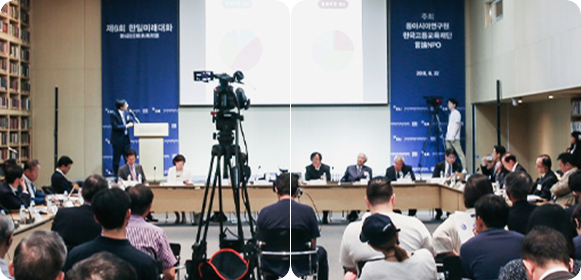
As an independent think tank, EAI strives to spread ideas through various activities such as international conferences, forums, education, and publishing, focusing on research and policy development on key domestic and foreign issues.
EAI's research activities are conducted in eight research centers, focusing on six major projects (U.S.-China competition and South Korea's strategy, reading directly from North Korea, reconstruction of Korea-Japan relations, democratic cooperation, the future of trade, technology and energy order, future innovation and governance).
At the same time, a task force team has been formed to produce and express opinions on important national and social issues.
The EAI research team consists of domestic and foreign scholars and policy experts related to the issue, and produces research results that reflect balanced theories, policies, and public intentions.
In addition, EAI serves as a hub for East Asian knowledge networks by strengthening joint research and human exchanges with overseas think tanks such as the U.S., China, and Taiwan as well as the U.S.
The EAI presents the results of its research activities through reports such as booklets, English-language journal Journal of East Asian Studies (SSCI-listed sites), working papers, and issue briefings, and strives to spread knowledge through the media.
We also strive to develop more effective strategies and policy alternatives by hosting international conferences, forums, and seminars to provide a forum for discussion among scholars and experts in various fields.
| Position | Name | Affiliation |
|---|---|---|
| Chairman | Young-Sun Ha | Professor Emeritus, Seoul National University |
| Trustee | Yooshik Gong | Chairman, YoungSan Foundation |
| Trustee | Byung-Yeon KIM | Professor, Seoul National University |
| Trustee | Jisyng Kim | CEO, Afiniti Inc. |
| Trustee | Hyun-Jhon Kim | CEO, Hiddenbay Hotel |
| Trustee | Kenneth Park | Vice Chairman&CEO, PSK, Inc |
| Trustee | Jin-Won Park | Beautiful Store Chairman |
| Trustee | Chan-Keun Park | CEO, BMK Ltd |
| Trustee | Yul Sohn | Professor at Graduate School of International Studies, Yonsei University |
| Trustee | Soo-Young Song | lawyer, Shin & Kim Law Firm |
| Trustee | Dong-Chan Yeo | Chairman, S4T |
| Trustee | Changsoo Yoo | Vice Chairman, Eugene Investment & Securities |
| Trustee · Director of Finance | Yong G. Yun | CEO, BH-Tech, Co., Ltd |
| Trustee | Nae-Young Lee | Professor, Korea University |
| Trustee | Sook Jong Lee | Professor, Sungkyunkwan University |
| Trustee | Hyun-Chin Lim | Professor Emeritus, Seoul National University |
| Trustee | Dongjin Chang | Vice Chairman , CBridge Holdings |
| TrusteeㆍPresident | Chaesung Chun | EAI President; Professor, Seoul National University |
| Trustee | Hae Il Jung | Senior Advisor, Attorneys at Law Yulchon |
| Trustee | Joon Han | Professor, Yonsei University |
| Auditor | Park Jung Sup | Partner, Dae Joo Accounting Corporation |
| Position | Name | Affiliation |
|---|---|---|
| Chairman Emeritus | Hong-koo Lee | Former Prime Minister of the Republic of Korea |
| President Emeritus · EAI Distinguished Fellow | Byung-Kook Kim | Former Professor, Korea University |
| President Emeritus · EAI Distinguished Fellow | Sook Jong Lee | Distinguished Professor, Sungkyunkwan University |
| President Emeritus · Distinguished Fellow | Yul Sohn | Professor, Yonsei University |
| EAI Non-resident Senior Fellow | Won-Taek Kang | Professor, Seoul National University |
| EAI Non-resident Senior Fellow | Dong Ryul Lee | Professor, Dongduk Women’s University |
| EAI Non-resident Senior Fellow | Seung Joo Lee | Professor, Chung-Ang University |
| EAI Non-resident Senior Fellow | Yong Wook Lee | Professor, Korea University |
| EAI Non-resident Senior Fellow | Joon Han | Professor, Yonsei University |
| Position | Name | Affiliation |
|---|---|---|
| Chairman | Young-Sun Ha | Professor Emeritus, Seoul National University |
| President | Chaesung Chun | President, EAI; Professor at the Department of Political Science and International Relations, Seoul |
| Chair of the North Korea Studies Center | Won Gon Park | Professor at Department of North Korean Studies of Ewha Womans University |
| Visiting Fellow | Huney Kong | Advanced Society Initiative |
| Executive Director & Senior Research Fellow | Inhwan Oh | Global NK, Human Resources, Education Program, Publications |
| Director | Hyemi Kang | Director of the Administration Department / Financial Accounting, Human Resources Management |
| Team Leader | Jieun Park | External Relations, Education Program, Publications |
| Senior Research Associate | Minje Kim | IT & WEB Support, Technical Support, Video Content Management |
| Research Associate | Hayeon Lee | Journal of East Asian Studies(JEAS) Journal Operations |
| Research Associate | Jaehyun Im | Asia Democracy Cooperation (ADRN), National Security Panel (NSP) |
| Research Associate | Sangjun Lee | Global NK, Providing assistance in research projects, public opinion surveys |

The new 21st-century Asia-Pacific order, led by the United States and China, is entering a full-fledged construction phase.
The research on the new civilizational architecture of the Asia-Pacific, conducted by the EAI in collaboration with leading research institutes in the United States and China, holds significant domestic and international significance.
EAI research forecasts the military, economic, energy, and technological landscape of the new Asia-Pacific order, which will ultimately determine the survival and prosperity of the Korean Peninsula in the 21st century, through 2050, and explores strategies for survival and prosperity for Korea, a middle-income nation, within this new order. These efforts will lead policy planning and research on the US-China-led East Asian order, which is still in its infancy, in new directions. At the same time, international joint research led by EAI is attracting considerable attention for its more complex and long-term analysis than previous studies.
Despite numerous inter-Korean summits and North Korea-US summits over the past two years, North and South Korea have struggled to find a path toward improved relations.
Amidst the inability of both sanctions and engagement to easily resolve the North Korean denuclearization issue, the EAI has launched Global North Korea, an English-language portal site, as a new alternative, based on a four-pronged approach: engagement, domestic reform, sanctions, and deterrence.
While the North Korean issue is our own, we sincerely welcome the launch of Korea's first full-fledged English-language portal site.
The EAI continues its efforts to spread the charm of Korea, a middle-income country, to the world, which can become the standard of civilization in the 21st century.
I think it is very important to try to spread the Korean-style political and economic model to neighboring countries who dream of becoming middle-income countries and at the same time examine the possibilities and limitations of the Korean cultural model symbolized by BTS in earnest.
The support association that supports researchers with extraordinary affection, the families of researchers centered on director Son Yeol who are showing new ideas and practical skills, and the network of EAI intellectuals who are engaged in dedicated participation will harmonize beautifully together to develop EAI into a world-class research institute that solves problems on the Korean Peninsula and the Asia-Pacific at the same time.
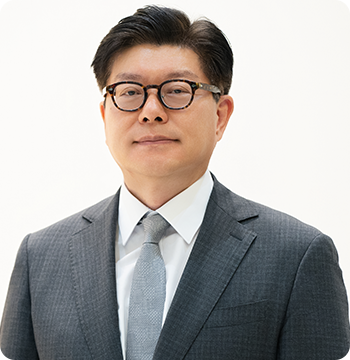
The East Asia Institute (EAI) is founded on the mission of transforming the Korean Peninsula, East Asia, and ultimately the world through a dynamic network of knowledge and ideas. Grounded in the principles of democracy, market economy, and open society, EAI aspires to contribute to the construction of a new global order rooted in the values of liberalism.
Today’s international order stands at the heart of a profound structural transition. The rules- and norms-based international order that has long underpinned the peace and prosperity of the Republic of Korea is now under serious challenges. As nationalism and populism move to the forefront of politics, major powers increasingly doubt whether the existing order can continue to secure their growth, welfare, and domestic stability, turning instead toward unilateralism and national interests over international cooperation.
The United States and China, the two superpowers, are locked in an intense strategic rivalry for leadership in the Asia-Pacific across every domain—military, economic, technological, knowledge, cultural, and global governance. This competition threatens to erode Korea’s strategic autonomy. Meanwhile, the divided and confrontational Korean Peninsula faces a multitude of challenges, as the pathways toward denuclearization, inter-Korean reconciliation, lasting peace, and shared prosperity remain unresolved.
In the face of these formidable challenges, EAI devotes its research capacity to charting a blueprint for Korea’s future. Beyond presenting practical policy agendas and solutions to pressing issues, EAI strives to provide a long-term vision that aligns with the standards of a new global civilization in the twenty-first century. To this end, EAI conducts pioneering research across six core fields—U.S.–China competition and Korea’s strategy, in-depth analysis of North Korea, reconstruction of Korea-Japan relations, the future of trade, technology, and energy orders, democratic cooperation, and innovation and governance—while also engaging a wide range of topics, all with the ultimate goal of offering a blueprint for a new Asia-Pacific civilization.
The path of an independent think tank has never been easy, and will not be in the future, especially in an environment that often demands fragmented knowledge serving short-term interests and political power. Nevertheless, as the 2018 Global Go To Think Tank Index Report recognized, EAI has secured its position as the world’s 64th leading think tank in foreign and security affairs. This achievement has been made possible through the intellectual leadership of Chairman Young-Sun Ha, the dedication of Korea’s foremost scholars, the tireless commitment of the dedicated and capable staff, and the steadfast support of our patrons.
Now at the threshold of its youth, EAI is writing a new chapter in the history of Korea’s independent think tanks. We ask for your continued interest, support, and encouragement as we carry this mission forward.